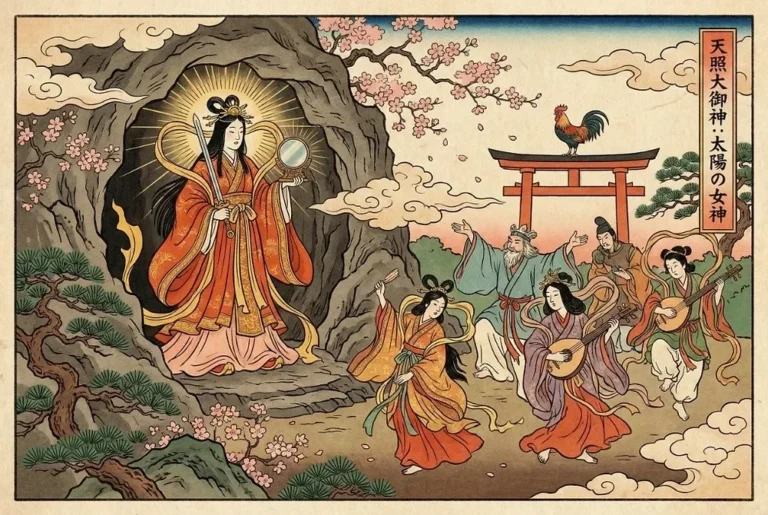
Amaterasu Omikami is the sun kami of Japanese mythology. In the Kojiki, she is born during Izanagi's purification, rules the heavenly realm and becomes the mythic ancestor of Japan's imperial line. Her best-known story is the heavenly rock cave myth, in which her withdrawal removes light from the world.
This guide separates the classical story from later interpretations. It explains what Amaterasu means, why she hid in a cave, how the sacred mirror and imperial regalia enter the myth, and why Ise Jingu remains central to her worship.
Amaterasu quick facts
| Question | Short answer |
|---|---|
| Who is Amaterasu? | The sun kami in Japan's classical mythology |
| What does her name mean? | Commonly, “shining in heaven” |
| Parents and siblings | Born from Izanagi; sister of Tsukuyomi and Susanoo in the Kojiki |
| Famous myth | Amano Iwato, the heavenly rock cave |
| Main symbols | Sun, light, mirror and Ise Jingu |
| Major shrine | Naiku at Ise Jingu in Mie Prefecture |
| Classical sources | Kojiki and Nihon Shoki, both compiled in the eighth century |
What does Amaterasu mean?
Amaterasu is written with characters associated with heaven and shining. The name is commonly translated as “shining in heaven” or “the one who illuminates heaven.” Her fuller name, Amaterasu Omikami, adds an honorific sense often rendered as “great august kami.”
Calling her a sun goddess is useful English shorthand. Kami, however, is not an exact synonym for the Western idea of a god. In Shinto usage it can refer to sacred presences, forces, ancestors and deities. Amaterasu is one of the most prominent kami in the classical myths and in imperial tradition, but Shinto does not operate as one universal, fixed hierarchy in every shrine and community.
Who is Amaterasu in Japanese mythology?
In the Kojiki account, Izanagi returns from Yomi, the land of the dead, and purifies himself. Amaterasu appears as he washes his left eye, Tsukuyomi from his right eye and Susanoo from his nose. Izanagi gives Amaterasu authority over Takama no Hara, the heavenly plain.
The Nihon Shoki preserves several versions of the birth of the islands and kami, so there is no need to force every tradition into one single canon. The left-eye birth is the best-known Kojiki version. Across the classical narratives, Amaterasu is associated with sunlight, the heavenly realm and the genealogy used to explain imperial authority.
For the wider religious context, read our guide to kami in Shinto. It explains why kami should not be treated as a simple list of Japanese equivalents to Greek or Roman gods.
The cave myth: why did Amaterasu hide?
Amaterasu's most famous myth follows a conflict with her brother Susanoo. He damages rice fields and sacred spaces, then throws a flayed horse into the heavenly weaving hall. A weaver dies in the chaos. Amaterasu withdraws into Ame no Iwato, the heavenly rock cave, and closes the entrance. Without the sun kami, heaven and earth fall into darkness and disorder.
The assembled kami do not solve the crisis through force alone. Omoikane prepares a plan involving ritual objects, song and performance. Ame-no-Uzume dances outside the cave and the kami burst into laughter. Curious about the celebration, Amaterasu opens the entrance slightly. A mirror catches her attention, and Tajikarao pulls the door aside so light can return.
| Stage | What happens | Why it matters |
|---|---|---|
| Conflict | Susanoo violates Amaterasu's fields and weaving hall | Order in the heavenly realm breaks down |
| Withdrawal | Amaterasu closes herself inside Ame no Iwato | The world loses sunlight |
| Council | The myriad kami gather and plan together | The solution is collective and ritual |
| Performance | Ame-no-Uzume dances and the kami laugh | Curiosity draws Amaterasu toward the entrance |
| Mirror | Amaterasu sees a brilliant reflection | The sacred mirror becomes central to the episode |
| Return | Tajikarao opens the way and light returns | Cosmic and social order are restored |
What does the cave myth symbolize?
At its simplest, the story explains the disappearance and return of light. It also contrasts destructive conduct with coordinated ritual, persuasion and celebration. Modern readers often connect it to an eclipse, the winter solstice, seasonal renewal or the restoration of social order. Those are interpretations, not one explanation stated by the Kojiki itself.
The mirror is especially important. It does not merely flatter Amaterasu. It creates the visual surprise that brings her closer to the cave entrance, allowing the other kami to complete their plan. This mythic mirror is Yata no Kagami, later counted among the Three Sacred Treasures.
Amaterasu and the Three Sacred Treasures
The Three Sacred Treasures, or Sanshu no Jingi, are the mirror Yata no Kagami, the sword Kusanagi no Tsurugi and the jewel Yasakani no Magatama. The mirror and jewel appear in the cave episode; the sword enters the narrative later through Susanoo and the eight-headed serpent Yamata no Orochi.
| Regalia | Role in mythology | Traditional association |
|---|---|---|
| Yata no Kagami, mirror | Used in the plan to draw Amaterasu from the cave | Associated with Amaterasu and Naiku at Ise Jingu |
| Kusanagi no Tsurugi, sword | Found by Susanoo after defeating Yamata no Orochi | Traditionally associated with Atsuta Jingu |
| Yasakani no Magatama, jewel | Magatama beads decorate the ritual display outside the cave | Associated with the imperial regalia kept in Tokyo |
Descriptions of their present locations are matters of court and shrine tradition. The sacred objects are not displayed for public authentication, so responsible wording is “traditionally associated with” rather than claiming that modern observers have verified the original mythic objects.
Amaterasu, Ise Jingu and the imperial line
Ise Jingu, officially called Jingu, is a complex of 125 shrines. Its Inner Shrine, Kotaijingu or Naiku, is dedicated to Amaterasu Omikami. The shrine administration describes the sacred mirror as her symbol and says it is enshrined inside the innermost sanctuary, an area visitors cannot enter.
The main sanctuaries are renewed through Shikinen Sengu, a cycle in which sacred buildings and objects are reconstructed or transferred every twenty years. This practice preserves ritual skills and architectural knowledge while renewing the sanctuary. The next major cycle is scheduled to culminate in 2033.
In mythic genealogy, Amaterasu sends her grandson Ninigi to the earthly realm. Later narratives connect his descendants to Jimmu, the legendary first emperor. This tradition is central to the political meaning of the Kojiki and Nihon Shoki. It should be described as sacred genealogy, not as modern biological evidence.
Amaterasu, Inari and Kitsune: what is the real link?
Amaterasu, Inari and foxes can all appear in discussions of Shinto, but they do not form a simple command chain. Amaterasu is primarily linked with the sun, the imperial tradition, the sacred mirror and Ise. Inari is associated with rice, cultivation and prosperity in many traditions. Foxes are especially known as Inari's messengers.
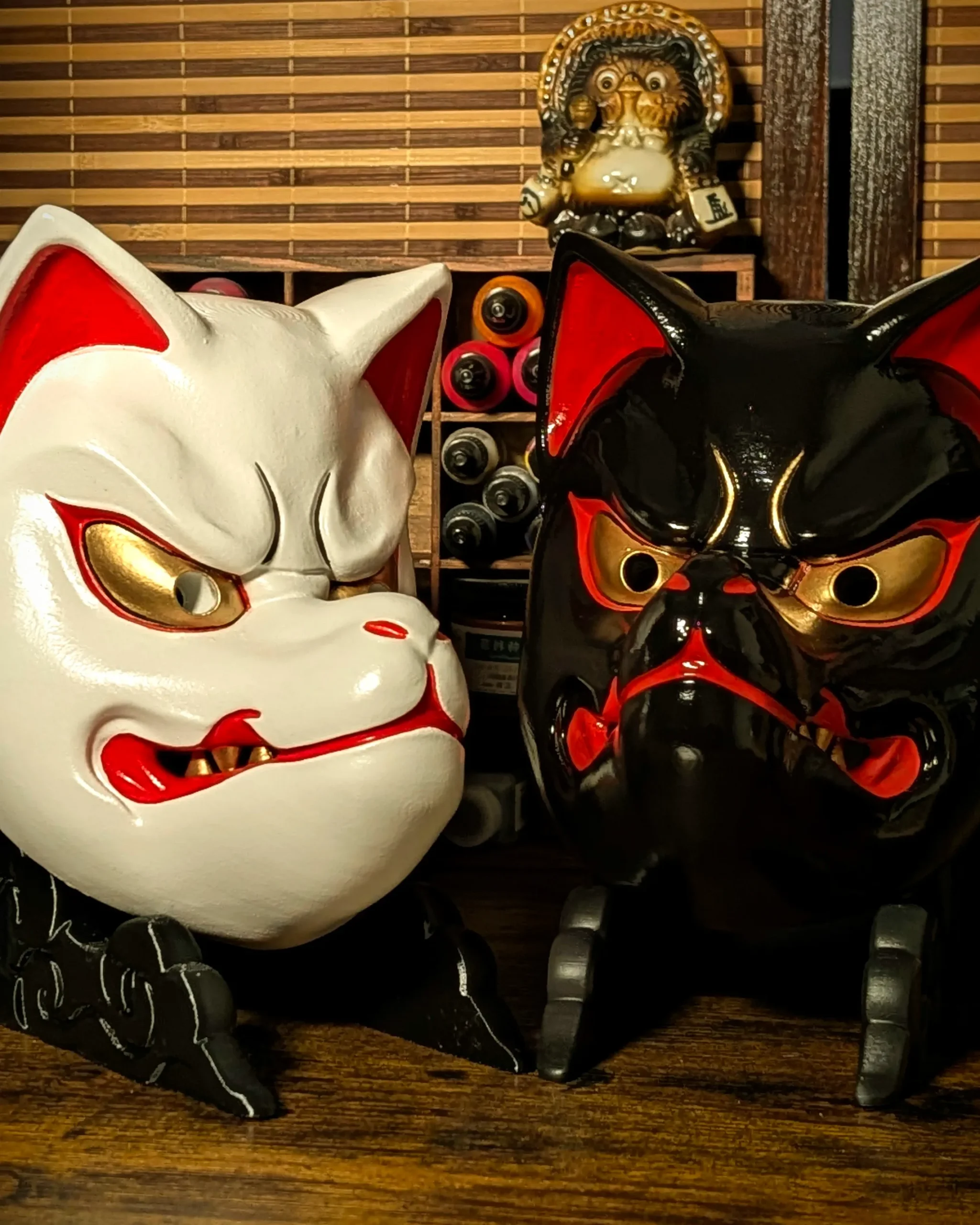
That distinction matters: a Kitsune is not automatically a messenger of Amaterasu. Continue with our guides to Inari Okami and the meaning of the Kitsune mask, or browse the Kitsune mask collection.
Amaterasu symbols: sun, mirror and light
| Symbol | Reliable connection | Common overstatement to avoid |
|---|---|---|
| Sun and light | Amaterasu is the sun kami whose withdrawal darkens the world | Every Japanese sun symbol is a direct portrait of her |
| Sacred mirror | Yata no Kagami is used in the cave myth and linked with Ise | The public can verify the original mythic mirror |
| Ise Jingu | Naiku is dedicated to Amaterasu | Every Shinto shrine places all kami beneath her |
| Hinomaru flag | Its red disc represents the sun | The flag officially depicts Amaterasu herself |
| Fox or Kitsune | Foxes are strongly associated with Inari worship | Kitsune are Amaterasu's messengers |
The Hinomaru belongs to Japan's broad solar symbolism, but it should not be presented as an official portrait of Amaterasu. Likewise, the name Nihon or Nippon is commonly interpreted as “origin of the sun,” yet that does not prove that every national use of the sun refers specifically to the goddess.
Sources and further reading
Ise Jingu, About Ise Jingu, official information on Naiku, Amaterasu and the sacred mirror.
Japan Tourism Agency, Opening Amano Iwato, a detailed institutional retelling of the cave myth.
Nippon.com, Amaterasu: The Japanese Sun Goddess, commentary on the Kojiki narrative, the cave ritual and imperial authority.
FAQ
Who is Amaterasu?
Amaterasu Omikami is the sun kami of Japanese mythology. In the Kojiki she is born during Izanagi's purification, rules the heavenly realm, and becomes the mythic ancestor of Japan's imperial line.
What does Amaterasu mean?
Amaterasu is commonly understood as “shining in heaven” or “the one who illuminates heaven.” Ama refers to heaven, while terasu means to shine or illuminate.
Is Amaterasu a god or a goddess?
English sources usually call Amaterasu a goddess because she is presented as female in Japan's classical myths. Kami is the more precise Shinto term and does not map perfectly onto the English word god.
Why did Amaterasu hide in a cave?
In the cave myth, Susanoo damages her fields and sacred spaces and throws a flayed horse into the weaving hall. After this violence and the death of a weaver, Amaterasu withdraws into the heavenly rock cave, and the world loses her light.
Who brought Amaterasu out of the cave?
The kami act together. Omoikane devises the plan, Ame-no-Uzume performs a dance, the assembled kami laugh, a mirror attracts Amaterasu's attention, and Tajikarao pulls the cave door aside when she looks out.
What are Amaterasu's main symbols?
Her clearest symbols are the sun, light, the sacred mirror Yata no Kagami, and Ise Jingu. The mirror plays a central role in the cave myth and is traditionally associated with her worship at Naiku.
Is Amaterasu connected to Japan's imperial family?
Yes, in mythic genealogy. The Kojiki and Nihon Shoki connect the imperial line to Amaterasu through her descendants. This is a religious and political tradition, not a claim that can be tested as modern biological history.
Is Amaterasu connected to Inari or Kitsune?
They belong to the wider Shinto landscape, but there is no simple chain from Amaterasu to Inari to foxes. Kitsune are especially associated with Inari, not with Amaterasu, whose strongest symbols are the sun, the mirror and Ise Jingu.