| Question | Reliable answer |
|---|---|
| What does Fujin mean? | Wind kami or wind deity |
| What is his role? | Wind, weather, movement and protection |
| Why the bag? | It makes invisible wind visible |
| Is he an Oni? | No. His appearance can be Oni-like, but Fujin is a deity |
| Who is paired with him? | Raijin, the thunder god |
What does Fujin mean?
Fujin is written 風神. Fu means wind, while jin is a reading of the character for kami, deity or spirit. The direct meaning is therefore “wind kami” or “wind deity.” The name can describe divine wind in general as well as the familiar bag-bearing figure seen in Japanese sculpture and painting.
The long vowel is sometimes written Fūjin, but Fujin is the common spelling in English. The word is not a personal name with one fixed biography in every tradition. It sits at the meeting point of Shinto wind kami, Buddhist protective imagery, temple sculpture, painting and later folklore.
Is Fujin a kami, an Oni or a yokai?
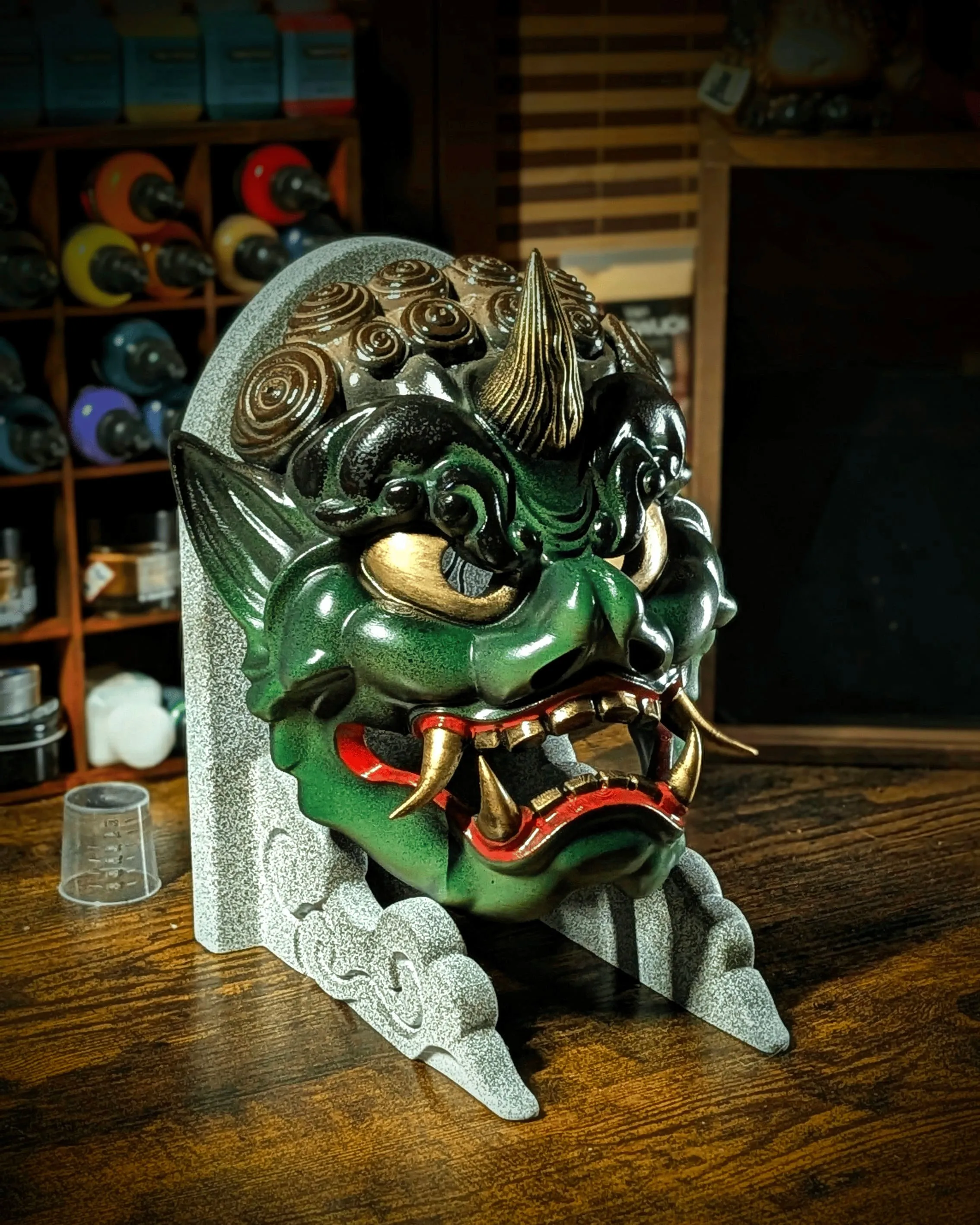
Fujin is a kami or deity associated with wind. Later artists often gave him fangs, claws, wild hair and a powerful body. Those features resemble an Oni, but appearance alone is not a reliable classification. Oni belong to broad demon and ogre traditions, while Fujin personifies and governs a natural force.
| Figure | Category | Main association |
|---|---|---|
| Fujin | Kami or deity | Wind and weather |
| Shinatsuhiko | Kami in classical texts | A wind kami named in the Kojiki and Nihon Shoki |
| Vayu | Indian wind deity | A Buddhist and Indian layer visible at Sanjusangendo |
| Oni | Demon or ogre figure | Danger, punishment, protection or fierce strength depending on context |
For the vocabulary behind this distinction, read our guide to kami in Shinto. The separate guide to Japanese yokai explains why deity, demon and spirit should not be treated as interchangeable labels.
Fujin is not one figure with one origin story
Japanese wind belief existed in more than one form. Kokugakuin University’s Encyclopedia of Shinto identifies Shinatsuhiko, also called Shinatobe in the Nihon Shoki, as a kami of wind. The texts connect this figure with breath dispersing the mist over the land. This is an indigenous mythic layer, but it should not be flattened into the claim that every later image of Fujin is simply a portrait of Shinatsuhiko.
Buddhist art adds another layer. At Sanjusangendo in Kyoto, the Wind God stands among protectors of the Thousand-armed Kannon. The Japan Tourism Agency describes the figure’s Sanskrit name as Vayu, a wind deity associated with the “breath of life.” The famous Japanese Fujin image developed through contact between religious traditions rather than from one isolated source.
Why does Fujin carry a bag of winds?
The bag solves an artistic problem: wind cannot be seen directly. A swollen sack, streaming cloth, bent limbs and flying hair show that air is moving. Fujin is often pictured lifting the bag across his shoulders or opening it as he runs through clouds. The pose gives a still image speed and direction.
At Sanjusangendo, the Kamakura-period Wind God kneels on a cloud-shaped pedestal with a bloated wind bag. On Tawaraya Sotatsu’s seventeenth-century screens, Fujin races across gold leaf with the bag stretched behind him. These works helped make the object his clearest visual identifier.
How is Fujin represented?
| Feature | What it communicates | What not to assume |
|---|---|---|
| Wind bag | Air, motion and control of wind | It is not a literal weather manual |
| Wild hair and cloth | Movement through clouds | Every artwork uses a different design |
| Fangs and claws | Fierce divine power | They do not make Fujin an Oni |
| Green skin | A famous color in Sotatsu’s screens | Green is not mandatory in every tradition |
| Four fingers | A recurring stylization | The cardinal-direction explanation is not established doctrine |
Fujin’s color varies. Sotatsu’s green figure is exceptionally influential, so green has become the modern default in tattoos, prints and masks. Other works use blue, red, brown or pale skin. The safest interpretation is visual convention, not a universal color code.
The same caution applies to fingers. Modern pages often claim that Fujin’s four fingers represent the cardinal directions while Raijin’s three represent past, present and future. That is a neat symbolic reading, but major museum and temple sources do not present it as doctrine. It should be treated as a later interpretation, not a fixed ancient rule.
Fujin and Raijin: wind and thunder together
Fujin and Raijin form one of Japan’s best-known visual pairs. Fujin controls wind and carries the bag. Raijin controls thunder and is surrounded by drums. Artists place them together because wind, rain and thunder belong to the same experience of a storm.
| Feature | Fujin | Raijin |
|---|---|---|
| Natural force | Wind | Thunder, lightning and rain |
| Main object | Large wind bag | Ring of linked drums |
| Common pose | Carrying or opening the bag | Striking or preparing to strike |
| Visual effect | Speed and directional movement | Impact and sound |
| Relationship | Frequently paired in art | Frequently paired in art |
Calling them brothers is common in modern retellings, but it is not needed to explain the pair. Official descriptions from Sensoji, Sanjusangendo and the Kyoto National Museum present them as companion wind and thunder deities. That verified relationship is stronger than a simplified family story.
Continue with the companion Raijin meaning guide, then compare the pair in the Raijin and Fujin mask duo.
Three places and artworks that shaped Fujin’s image
At Sanjusangendo in Kyoto, the Wind God is one of two life-size deities placed at the ends of a line of Buddhist guardians. The Kamakura-period sculpture shows Fujin kneeling on clouds with the wind bag over his shoulders. It is one of the clearest surviving examples of the deity’s Buddhist protective role.
At Sensoji in Tokyo, statues of Fujin and Raijin guard the Kaminarimon, whose fuller name is Furaijin-mon. The temple states that the pair was enshrined there to protect it from natural disasters. A fearsome appearance can therefore signal guardianship rather than evil.
Tawaraya Sotatsu’s Wind God and Thunder God Screens, painted in the seventeenth century, are a National Treasure associated with Kennin-ji. Fujin appears on the right screen and Raijin on the left, floating across an open gold field. The Kyoto National Museum notes that Ogata Korin and Sakai Hoitsu later replicated the composition, extending its influence.
Did Fujin come from Greece?
The accurate answer is more interesting than the headline version. Fujin himself did not simply travel from Greece to Japan. Japanese wind worship has its own textual and ritual history, including Shinatsuhiko. At the same time, art historians have traced the wind-bag pose through a long chain of visual exchange from the Greek north-wind god Boreas, through Greco-Buddhist and Central Asian art, to East Asia.
This is best described as possible iconographic ancestry. Images, poses and attributes can travel between cultures while taking on new religious meanings. Fujin is therefore not “Boreas with a Japanese name.” The comparison helps explain the bag motif, not the complete identity or origin of the Japanese wind deity.
Did Fujin create the kamikaze?
Kamikaze means “divine wind.” Later Japanese tradition interpreted storms associated with the failed Mongol invasions of 1274 and 1281 as divine protection. Art and religious accounts linked the victory to intervention by kami, but that is not the same as a secure medieval statement that Fujin personally opened his bag and sank both fleets.
Historians also debate the weather’s precise role, especially during the first invasion. It is accurate to connect Fujin symbolically with protective wind, and accurate to explain the meaning of kamikaze. It is too categorical to call kamikaze Fujin’s title or credit one named deity with the entire historical outcome.
What Fujin symbolizes today
Today Fujin can symbolize movement, freedom, change, speed and the power to turn natural danger into protection. In tattoo composition, the wind bag, clouds, streaming cloth and Raijin make the subject identifiable. The personal meaning still depends on the wearer, artist and surrounding motifs rather than one universal code.
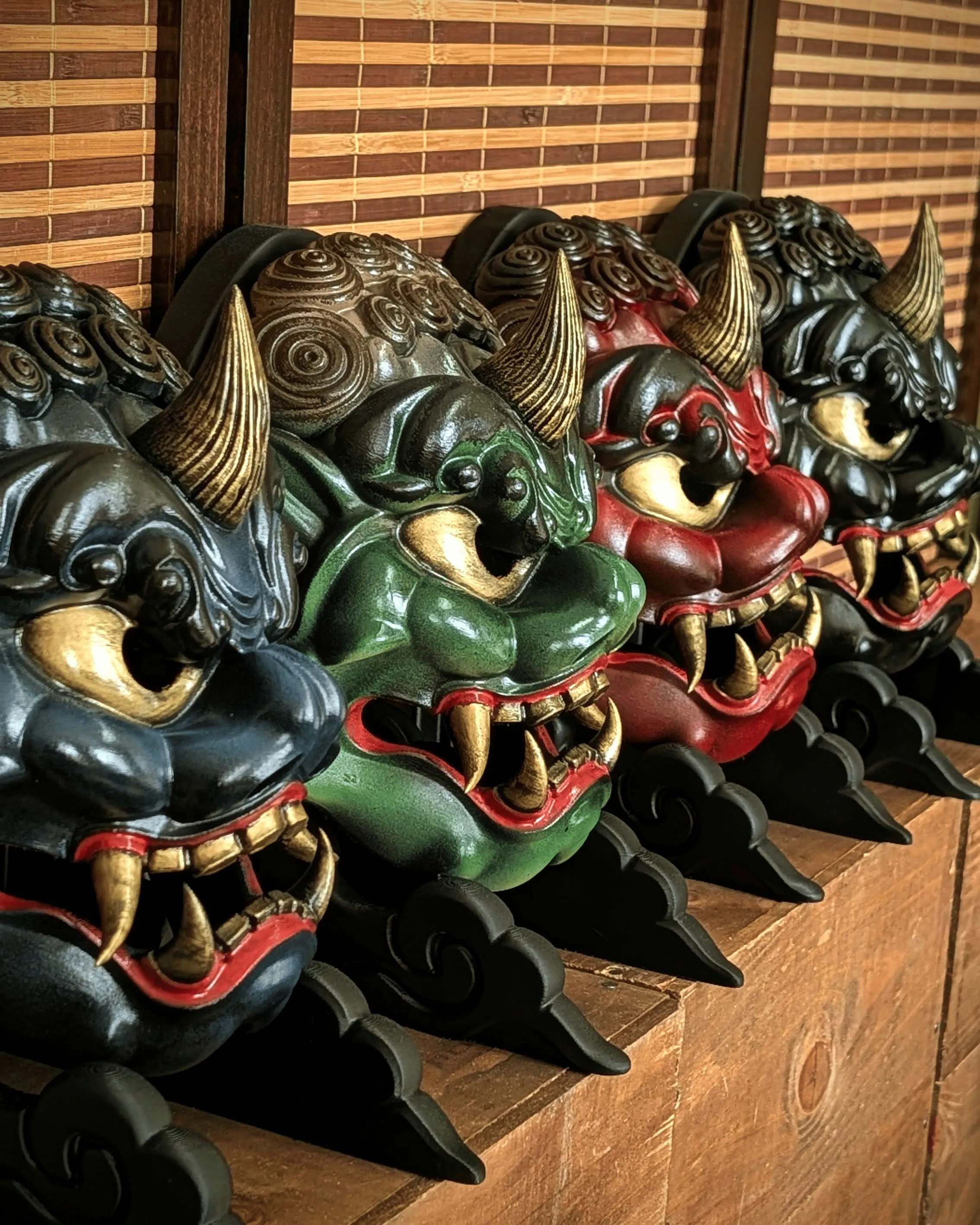
In a contemporary mask, swept hair, sharp teeth and a sideways gaze create a sense of motion even when the piece hangs still. Dai Yokai masks are handmade in Brittany from PETG bases that are sanded, primed, painted, varnished and finished by hand. They are modern art pieces for display, collecting, conventions or light costume use, not Japanese ritual objects.
See the Fujin wind god mask, the Raijin and Fujin mask duo, or browse the wider handmade Japanese-inspired mask collection.
Designing the Dai Yokai Fujin mask
Jérémy already knew Fujin through popular culture, including Mortal Kombat. Exploring Japanese kami led him to create the Fujin and Raijin pair. For his mask, swirling hair conveys movement without reproducing the entire wind bag. Keeping those strands readable and sufficiently symmetrical was the difficult part of modelling.
Sources and further reading
- Kokugakuin University Encyclopedia of Shinto, Shinatsuhiko and wind kami in classical texts
- Japan Tourism Agency visitor guide, Fujin, Vayu and the guardian statues at Sanjusangendo
- Sensoji, official history of the Fujin and Raijin figures at Kaminarimon
- Kyoto National Museum, Sotatsu’s Wind God and Thunder God Screens
- Leiden University Press, academic study of classical motifs transmitted into Japanese art
- National Diet Library Search, historical reassessment of the Mongol invasions and divine-wind narrative
FAQ
Who is Fujin?
Fujin is the Japanese wind deity or wind kami. In art he is commonly shown moving through clouds with a large wind bag over his shoulders. The name can refer broadly to divine wind as well as to this recognizable figure.
What does Fujin mean?
Fujin is written 風神. Fu means wind and jin is a reading of the character for kami or deity, so the direct meaning is wind deity or wind kami.
Is Fujin a god, an Oni or a yokai?
Fujin is a deity or kami, not an Oni. His fangs, claws and wild expression can look Oni-like in later art, but visual resemblance does not make the categories identical. Calling him a yokai also loses his religious role.
Why does Fujin carry a bag?
The bag makes invisible wind visible. Fujin is shown carrying or opening it so that air seems to pour across the composition. At Sanjusangendo in Kyoto, the Kamakura-period Wind God statue has a swollen wind bag slung over his shoulders.
Are Fujin and Raijin brothers?
They are frequently paired as the gods of wind and thunder, but reliable temple and museum descriptions do not require a brother relationship. It is safer to call them companion deities or an artistic pair.
Why is Fujin green?
Green is famous because Tawaraya Sotatsu painted Fujin that way on his seventeenth-century screens. It is not a mandatory sacred color. Fujin appears in different colors across periods, artists and modern designs.
Did Fujin create the kamikaze?
Kamikaze means divine wind and later tradition linked storms with the failure of the Mongol invasions. That does not prove that medieval sources named Fujin personally as the cause. The historical event and its religious interpretation are more complex than the popular claim.
Did Fujin come from Greece?
Not literally. Art historians have traced similarities between Fujin’s wind-bag pose and images of Boreas transmitted through Greco-Buddhist and Asian art. This concerns visual ancestry, not the origin of every Japanese belief about wind.