The main difference is straightforward: Noh theater uses carved masks, called omote, for many roles, while Kabuki mainly transforms the face through makeup, costume, and acting. The Hannya belongs to the Noh mask repertoire. The phrase “Kabuki mask,” common online, often mixes up two distinct traditions.
Noh vs. Kabuki: a comparison
| Feature | Noh theater | Kabuki theater |
|---|---|---|
| Face | A carved mask for many roles, particularly the main character | A face usually left uncovered and transformed with makeup |
| Mask or makeup | Omote carved from wood and painted | Codified makeup, including kumadori for certain characters |
| Acting | Restrained, symbolic, precise movements | Stylized acting, striking poses, dramatic changes, and stage effects |
| Historical development | A form refined by Kan'ami and Zeami from the 14th century onward | A tradition that began around 400 years ago and developed within the urban culture of the Edo period |
| Familiar visual features | Okina, old man, demon, male, female, and vengeful spirit masks | Onnagata, aragoto, kumadori makeup, and the mie pose |
| Common misconception | Assuming every actor always wears a mask | Calling any brightly colored Japanese face a “Kabuki mask” |
Why the phrase “Kabuki mask” can be misleading
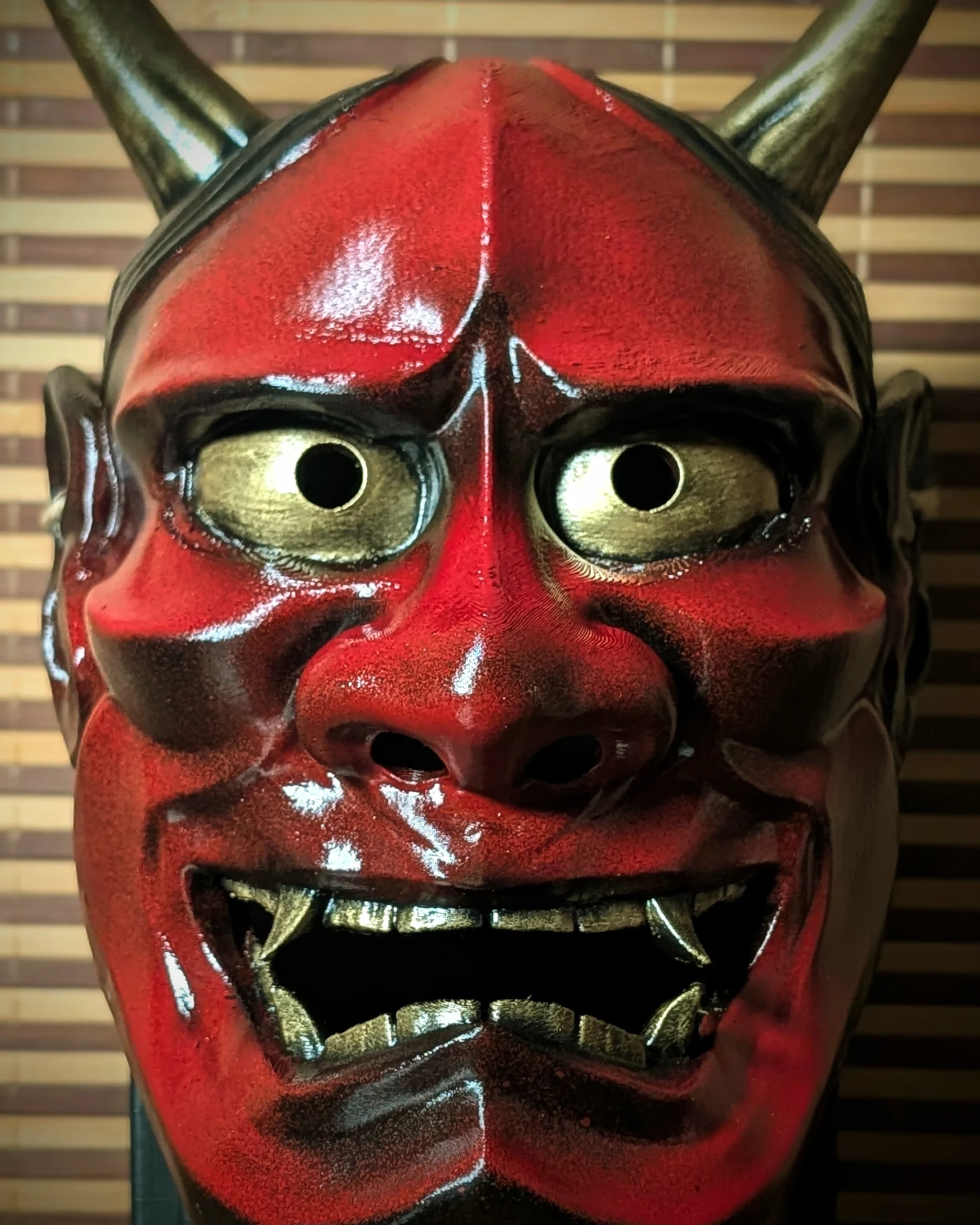
In shops, tattoos, and image libraries, “Kabuki mask” is often used as a visual label. It may refer to a white face crossed with red or blue lines, a Hannya, or even an Oni. That shorthand can help with an image search, but it does not accurately describe Japanese theater.
Kabuki depends on the actor's own face. Makeup, expressions, and poses remain visible. Noh can instead replace the face with a carved object representing a type of character. Kabuki makeup and Noh mask are therefore more precise terms, while leaving room for the specific requirements of individual plays.
In Noh, the mask becomes the character's face
Noh and Kyogen masks are called omote. Putting one on is described as tsukeru or kakeru. They are carved from wood and then painted, and the Japan Arts Council notes that some are regarded as works of art. Dozens of types are classified by the character's role, age, gender, or nature: a young woman, an old man, a deity, a demon, or a vengeful spirit. The choice depends on the play and its interpretation.
It is still too broad to say that all Noh actors wear masks. According to the Japan Arts Council's official introduction to Noh masks, it is mainly the principal character who performs masked in most cases. Other roles may appear with an uncovered face.
The mask does not necessarily look motionless. The angle of the head, the actor's technique, and the light change what the audience reads in its features. The same face can appear calm, sorrowful, or threatening without changing shape. That ambiguity is part of what gives Noh masks their expressive power.
In Kabuki, the face remains expressive
Kabuki combines theater, music, and dance. Its acting may use striking held poses called mie, entrances along the hanamichi through the audience, elaborate costumes, and rapid scene changes. The actor's face is part of that expressive whole.
Kabuki makeup has several codified forms. Applying it is called kao o suru, or making the face. The actor first covers the whole face in a base color: white for a virtuous or high-status character, a shade close to tea brown for ordinary townspeople or villains, and red for a villain's subordinate. Kumadori is the most recognizable type, but it does not cover all Kabuki makeup. It involves drawing and blending lines that exaggerate facial muscles and blood vessels. It is closely associated with aragoto, a deliberately forceful and exaggerated acting style.
The colors are not a dictionary that applies to every scene, but they help establish the character. Crimson, beniguma, may express justice, courage, or hot-blooded youth. Indigo, aiguma, may indicate great villainy or a vengeful ghost. Light brown, chaguma, may suggest ogres and spirits. The way the kuma lines are drawn matters as much as their color. The Japan Arts Council's official kumadori guide explains these conventions.
Is the Hannya a Noh or Kabuki mask?
The Hannya is primarily a Noh mask. It represents a female figure whose jealousy, suffering, and anger have taken on a demonic form. Its horns, metallic eyes, and tense mouth have made it recognizable far beyond the theater.
Japanese tattooing, video games, cinema, and decoration have since borrowed its silhouette. Stories and motifs also move between different theatrical forms. That helps explain the confusion, but it does not make the Hannya a defining Kabuki mask. For more on its history and colors, see the Hannya mask guide.
Noh and Kabuki tell stories differently
Noh is a form of chanting and dance in which small movements carry deep meaning. It was known as Sarugaku until the Edo period, and reached its height in the 14th and 15th centuries. UNESCO proclaimed Nohgaku in 2001 and inscribed it in 2008; Kabuki was proclaimed in 2005 and inscribed in 2008. Ghosts, spirits, and characters returning to tell their stories play an important part in Noh. The set is often sparse, allowing movement, music, costume, and the mask to guide the imagination.
Kabuki developed later, alongside the popular culture of Edo-period cities. It uses strong imagery, eventful stories, and stage techniques that can surprise the audience. Thinking of Noh as restrained and Kabuki as spectacular can help you get your bearings, but it is not a rigid rule. Both traditions have their own rhythms, subtleties, and varied repertoires.
What about Oni, Kitsune, Tengu, and Hyottoko?
A yokai or folkloric figure is not automatically a theater mask. Oni appear widely in Japanese stories, rituals, and popular imagery. Kitsune belong to fox folklore and can take many forms. Tengu have their own religious and legendary traditions. Hyottoko is especially associated with festivals and folk dances.
These figures may appear in, be referenced by, or influence theater, but their origins cannot be reduced to Noh or Kabuki. The guide to Japanese mask types puts each family in context without grouping everything under the word “Kabuki.”
Which kind of mask should you choose today?
If you need a reproduction for practicing or studying Noh, look for a specialist mask maker, a specific type of omote, and construction suited to stage use. For decoration, a collection, or a piece to wear at a convention, you can start with the figure that speaks to you: Hannya for the tension between pain and anger, Kitsune for transformation, or Oni for strength.
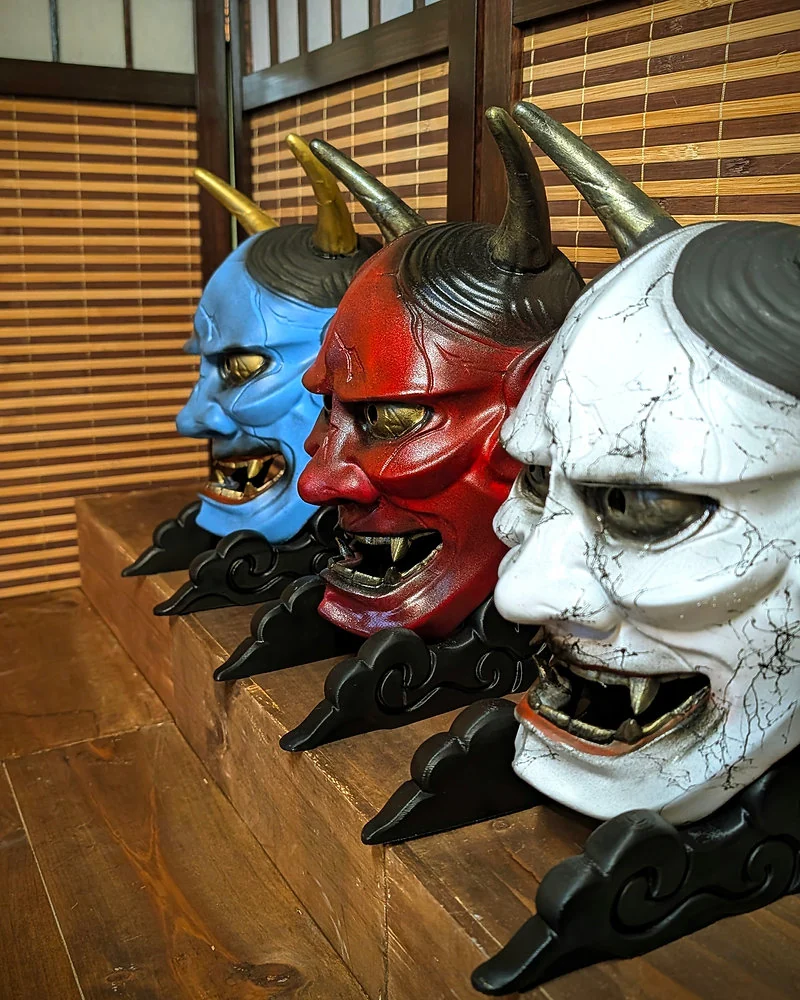
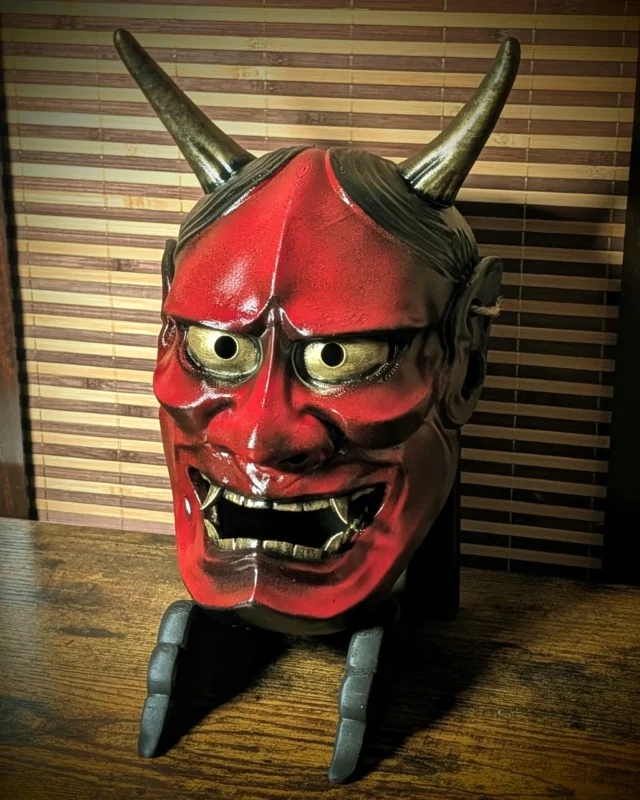
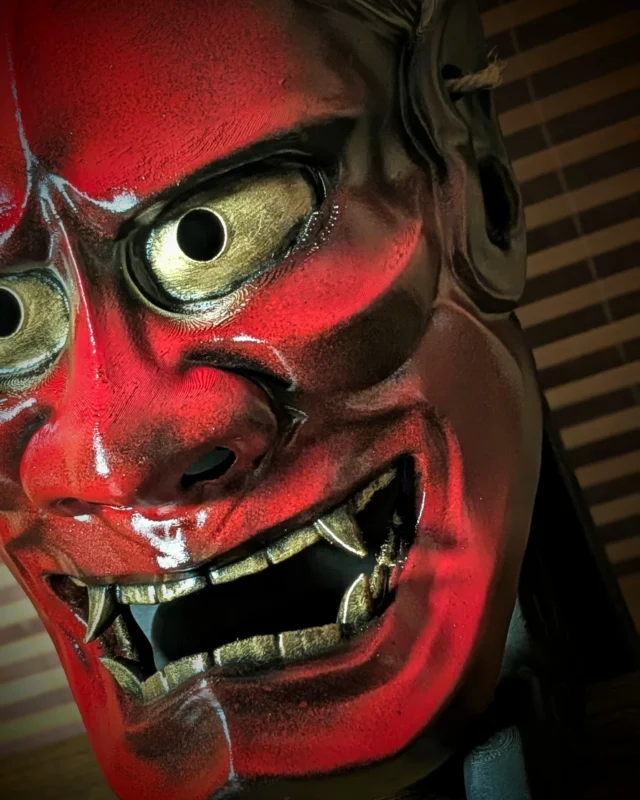
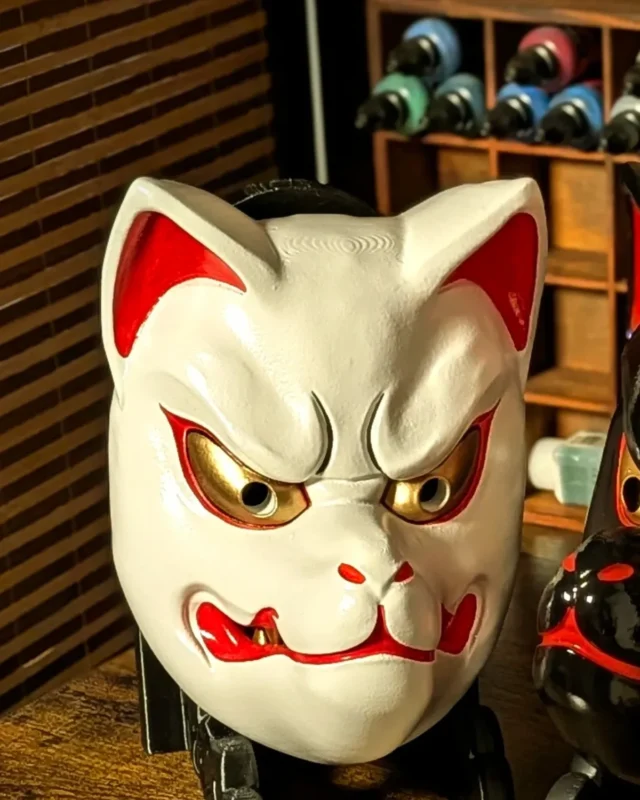
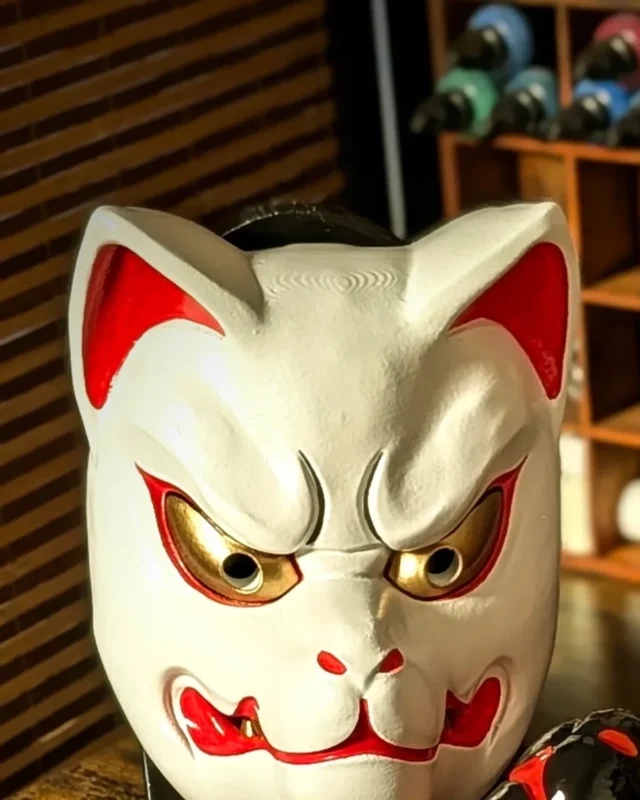
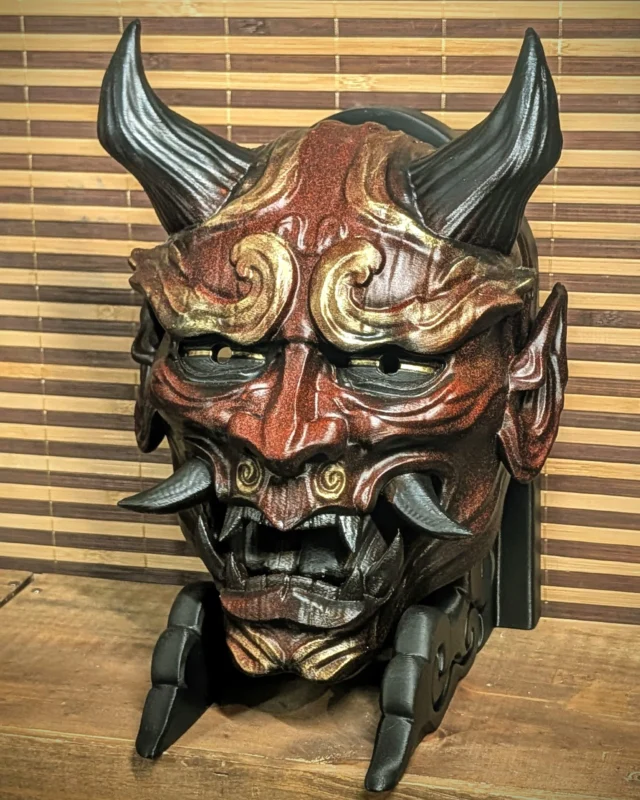
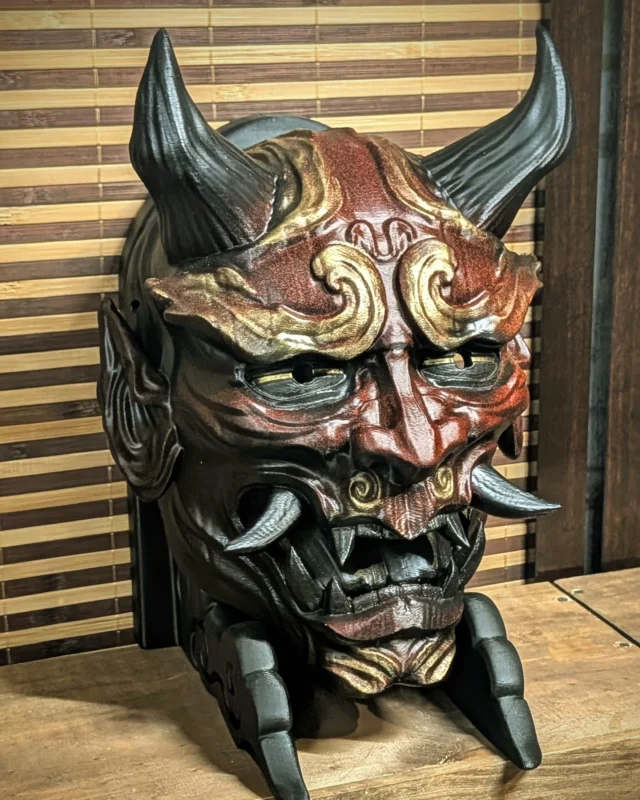
At Dai Yokai, I do not present my work as antique masks or authentic theater props. I make contemporary PETG pieces, prepared, painted, and finished by hand in Brittany. They draw on shapes from folklore and Noh, which I reinterpret in my own work.
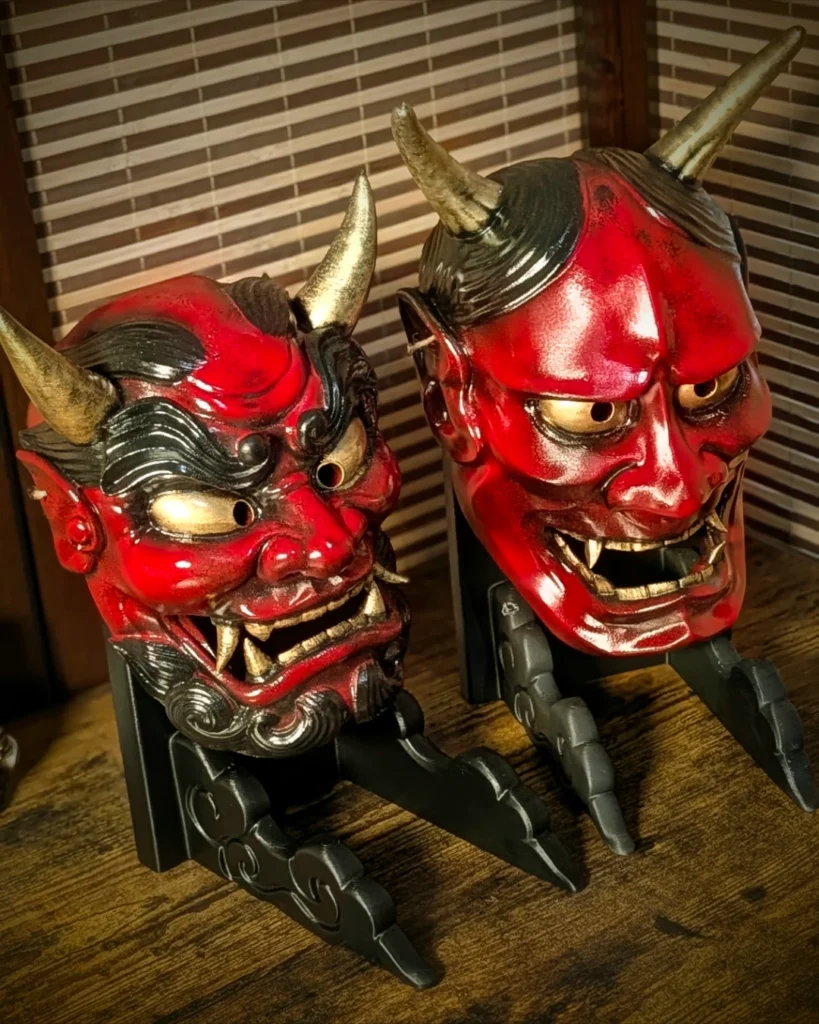
Related pieces
These pieces show three contemporary interpretations. They are not presented as traditional stage masks.
The key points in 20 seconds
- Noh: wooden masks, restrained gestures, chanting, dance, and a strong symbolic dimension.
- Kabuki: an uncovered face with makeup, stylized acting, mie poses, costumes, and stage effects.
- Kumadori: a distinctive type of Kabuki makeup, not the name for all Kabuki makeup.
- Hannya: a Noh mask representing a female figure who has become demonic, rather than a “Kabuki mask.”
Questions about Noh masks and Kabuki
What is the main difference between Noh and Kabuki?
Noh uses carved masks for many roles and favors restrained acting. Kabuki mainly transforms the face through makeup, expressions, costumes, and highly stylized stage performance.
Do Kabuki actors wear masks?
Kabuki is mainly performed with an uncovered face and makeup. Treating a “Kabuki mask” as the equivalent of a Noh mask is therefore usually imprecise, although an individual play may use a prop that covers the face.
Do all Noh actors wear a mask?
No. The main character performs masked in most cases, depending on the role and play, but other performers may appear with an uncovered face.
What is a Noh mask called?
The Japanese term is omote. There are dozens of types, classified by the character's role, age, gender, or nature.
What is Kabuki makeup called?
Kumadori is the most famous type, with colored lines that emphasize facial features. It does not refer to every kind of makeup used in Kabuki.
What do kumadori colors mean?
Crimson may suggest justice, courage, or energy. Indigo may indicate a major villain or a vengeful spirit, and light brown may indicate demons or spirits. The pattern and the role matter as much as the color.
Is the Hannya a Noh mask or a Kabuki mask?
The Hannya is a Noh mask. Its silhouette has since been widely adopted in tattooing, decoration, and popular culture, which helps explain the confusion with Kabuki.
Are Dai Yokai masks authentic theater masks?
No. They are contemporary creations inspired by folklore and some Noh forms, made and hand painted in Brittany. They are not sold as traditional stage props.