Shōjō is a being associated with water and sake, represented in Noh theatre by a smiling red face. The name also appears on miniature carvings and in local festivals. A stage mask, a netsuke and a large procession figure need to be understood as different kinds of objects.
Shōjō in Noh theatre
The Nohgaku Performers’ Association’s mask guide describes Shōjō as a sake-loving being that emerges from water. The play bearing its name has a festive atmosphere.
In The-Noh’s synopsis, the Chinese merchant Kōfū learns that a mysterious customer is Shōjō and later finds him again beside a river. The being drinks and dances, leaving an inexhaustible jar. The encounter proves to have been a dream, but the jar remains within the story. This ending belongs to the play; it does not establish abilities shared by every representation of Shōjō.
Reading the smiling red face
The JPARC teaching guide describes a tooth-showing smile and disordered hair suggesting emergence from water. The red complexion evokes intoxication. The face makes sense alongside the hairstyle and role, rather than through colour alone.
The Tokyo National Museum holds a Shōjō mask, C-1535, passed down by the Konparu troupe in Nara and dated to the fifteenth or sixteenth century, in the Muromachi period. The museum’s 2021 exhibition text describes the smiling mask alongside a large red wig and red trousers. That theatrical context helps explain why a red face does not automatically identify an Oni.
The Met’s small brown carving
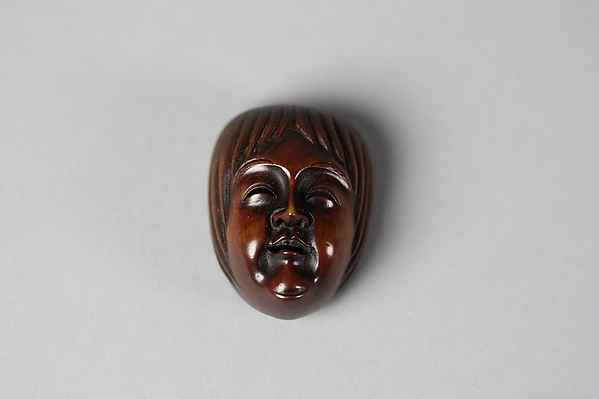
The photograph in this article shows a netsuke in the Metropolitan Museum of Art, rather than a mask worn on stage. The catalogue dates it to the nineteenth century and gives its size as 4.4 cm high by 3.4 cm wide. Its material is dark brown wood.
In the photograph, carved locks frame the polished forehead, the eyelids are lowered and the lips part slightly. No red is visible. Scale changes how we read it: the face fits into a hand, although a close photograph can initially suggest a full-size mask.
Our Baku article explains the general function of a netsuke as a toggle securing an accessory at the obi. The comparison concerns carved objects, rather than a historical relationship between the two beings.
Large figures in Nagoya’s local festivals
The Nagoya City Museum documents a local form of Shōjō: wearable figures over two metres tall in Minami and Midori, alongside smaller versions for children. The museum describes a protective belief connected with contact from their large hands. This is a locally recorded belief, not evidence of a medical effect or a description of every Shōjō.
Keep the name, place and purpose together when comparing these examples: theatrical character, miniature carving or festival figure. The name by itself tells you neither the scale nor the use of an object.