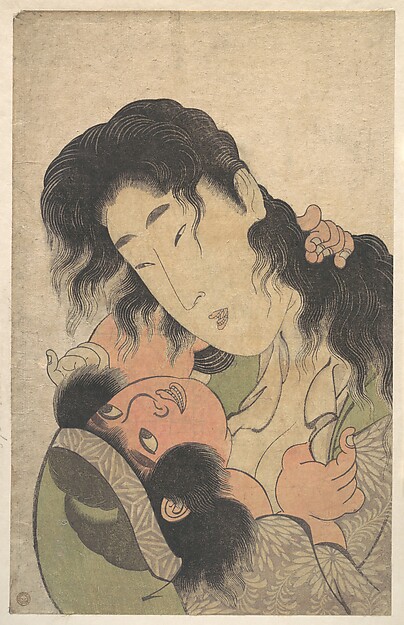
Yamauba (山姥), also known as Yamamba or Yamanba, is a female figure of the mountains. Noh masks and Utamaro’s prints give her different faces.
Utamaro: Yamauba and the child Kintarō
In this print by Utamaro, Yamauba leans towards Kintarō, who nestles against her with his hands raised towards her hair. The Metropolitan Museum of Art describes the child as her adopted son, found and raised in the forest.
On the Noh stage: the dancer and Yamamba
The guide on The-Noh.com attributes Yamamba (山姥, やまんば) to Zeami “according to one tradition”. Its synopsis follows a Kyoto dancer, famous for a sung dance about Yamamba, travelling to Zenkō-ji. A woman gives her lodging near the border of Etchū and Echigo, reveals that she is Yamamba and asks for the dance. At midnight, she returns to dance herself and describe her life in the mountains.
The hostess and the dancer are separate characters. The guide’s cast and mask list gives the hostess a woman’s mask such as Shakumi or Fukai at first, then the Yamamba mask. The dancer, called Hyakuma-yamamba, is the tsure role and wears a Ko-omote.
For another story adapted for Noh, our article on the Nue and Yorimasa follows a defeated creature returning to ask for prayers.
Two masks, two histories
The National Noh Theatre holds a Yamamba mask presented by Japan’s Agency for Cultural Affairs: NM69, dated to the 17th-18th century and 21.5 cm high. The entry highlights the absence of wrinkles despite the name referring to an old woman. Gold on the eyes and teeth marks a supernatural being.
The Tokyo National Museum also holds a mask “purportedly Yamanba”, C-1888, from the fourteenth century. Its attribution to Shakuzuru is traditional and the carver remains unknown. The Japanese entry records its use as Shinja by the Umewaka family in the Meiji era. Traces of hair-implantation holes and a CT examination suggest a different original function, which remains hypothetical.
Sources
- The Metropolitan Museum of Art, Kitagawa Utamaro, Yamauba Playing with Kintarō, ca. 1795, JP981
- the-noh.com, Yamamba synopsis
- the-noh.com, Yamamba author, roles and masks
- Agency for Cultural Affairs, Japan, 山姥 mask, National Noh Theatre, NM69
- Tokyo National Museum via e-Museum, 能面 伝山姥, C-1888 (in Japanese)