The Nue (鵺, ぬえ) is a composite creature. In the summary of the Heike Monogatari published by the New National Theatre Tokyo, it has a monkey’s head, the body of a tanuki (raccoon dog), a tiger’s legs and a snake’s tail.
The story in the Heike Monogatari
In this story, the creature disturbs Emperor Konoe at night. Yorimasa shoots an arrow into the cloud above the palace. The theatre programme, for a contemporary adaptation, also connects its name with a bird’s cry.
The Noh play Nue
The play Nue gives the defeated creature a voice. A synopsis on The-Noh.com outlines the action. At Ashiya (Settsu, now Hyōgo Prefecture), a travelling priest meets a boatman. The boatman turns out to be the spirit of the Nue, which asks for prayers and then reappears in its creature form.
The guide on The-Noh.com attributes the play to Zeami.
Two phases, several possible masks
The cast and masks page of the same guide describes two phases of the shite role: the boatman, then the spirit of the Nue. For the boatman it lists masks such as Ayakashi, Awa-otoko and Chigusa-otoko; for the Nue’s return, Sarutobide and Kotobide, among others. The options listed by this guide help trace the character’s changes during the performance.
To explore more stage expressions, our article on the Shikami mask introduces another face from Noh theatre.
An ink work attributed to Hokusai
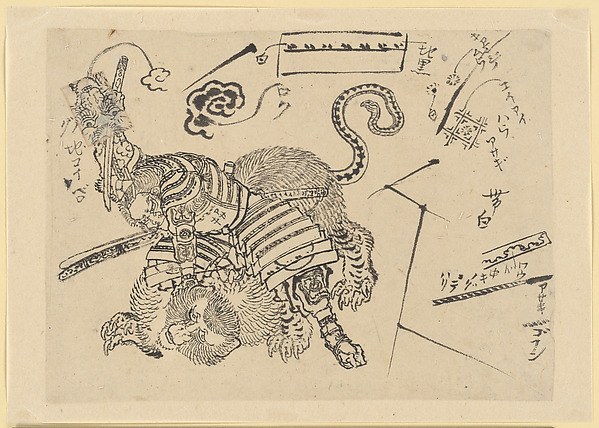
The Metropolitan Museum of Art holds Yorimasa Killing Nue, an ink work on paper attributed to Katsushika Hokusai. The museum dates it to the 18th-19th century and makes its image available through Open Access.
An armoured warrior appears above an animal with a monkey’s head, clawed limbs and a tail raised in a loop. Sketches and inscriptions are visible on the right. The drawing shows how the fight can be conveyed through a few poses and silhouettes.
The Nue on a kozuka
The Museum für Kunst und Gewerbe Hamburg holds a kozuka by Hamano Hideyuki from the last third of the 18th century (inv. 1896.311). On this handle of a small knife associated with the sword, Minamoto no Yorimasa appears with the defeated Nue at the warrior’s feet. Engraving, relief, inlays and gilding bring this small shibuichi object to life.
Sources
- New National Theatre Tokyo, 2008/2009 programme: Heike Monogatari summary for a modern production.
- The-Noh.com, Nue synopsis: written by specialist editors.
- The-Noh.com, Nue cast and masks: open-ended list.
- The Metropolitan Museum of Art, Yorimasa Killing Nue, 56.121.3: attributed to Katsushika Hokusai, public domain.
- Museum für Kunst und Gewerbe Hamburg, kozuka by Hamano Hideyuki, 1896.311: German-language record.
- The-Noh.com, Japanese synopsis of 鵺: Japanese name and reading, location of Ashiya.