Namazu (鯰) is the catfish once believed in Japan to cause earthquakes. The colour prints called namazu-e put it at the centre of the action. The National Diet Library (NDL) presents sheets circulated after the 1855 Edo earthquake.
The Edo earthquake and its date
The earthquake struck Edo on the 2nd day of the 10th month of Ansei 2, or November 11, 1855 in the Gregorian calendar. The National Museum of Japanese History places the prints in this context.
The NDL lists recurring motifs: Kashima, the kaname-ishi stone, gourds, other deities and artisans.
Fear, loss and rebuilding
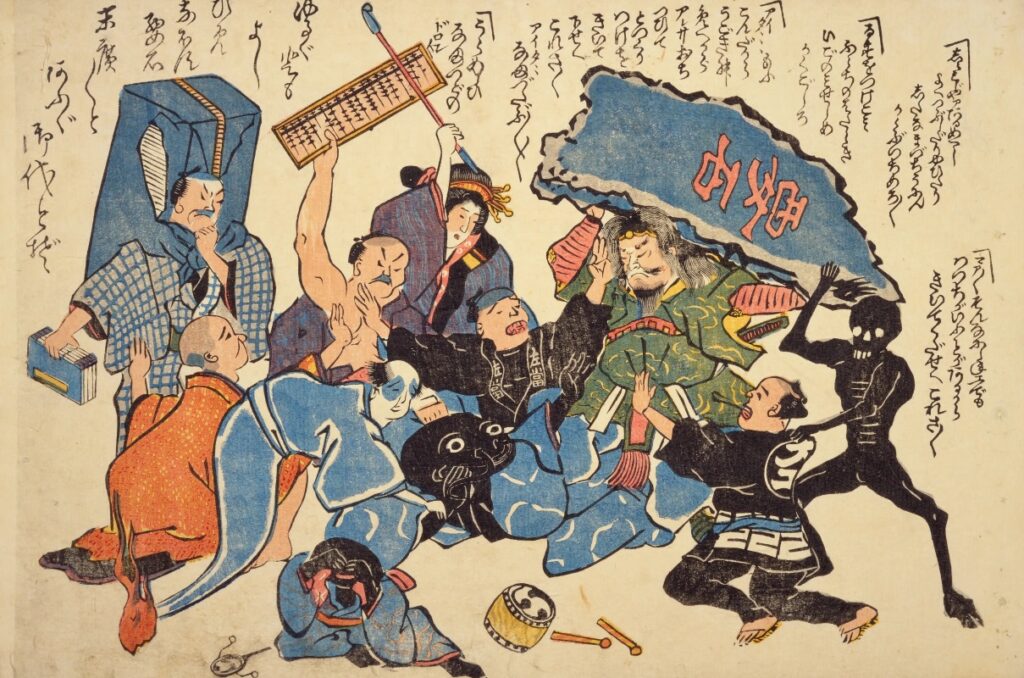
The museum’s 2021 exhibition shows varied responses: victims attacking the fish, artisans benefiting from reconstruction, fear and hopes for renewal. The scenes carry social meanings that depend on the individual work.
The NDL print (要石)
The image reproduced here is held by the NDL under the title (要石), within the group 安政大地震絵. Its individual record leaves the artist and publication year undetermined. Its association with the 1855 earthquake comes from the ImageBank presentation of the group.
The catfish, recognisable by its whiskers, has a human body dressed in blue. Around it, people raise their arms or lift objects. A large figure carries a blue block on its head. These details invite a closer look at how the artist turns the animal into a participant in a collective scene.
A different print in Tokyo
The Tokyo Metropolitan Library holds another sheet, [鯰と要石], dated 1855 in its record (Tokyo Shiryō 0277-C40). An old figure leaning on the stone has fallen asleep. The record identifies this figure as Ebisu and notes that this is an interpretation. Kashima returns on horseback.
The record explains the belief that the stone at Kashima shrine holds the catfish in place, and that such prints were used as protective images.
Compare with Amabie
The 1846 Amabie broadsheet offers another example of a creature circulating in print. Compare the two images: how much space is given to the figure, the writing and other characters? Looking at these details helps explore the uses of each sheet.
Sources
- National Diet Library, ImageBank, “Namazu-e”: definition, date, motifs.
- National Museum of Japanese History, 鯰絵のイマジネーション, 2021: Japanese text, summarised; sections 趣旨, 鹿島・要石・神馬 and 損する人・得する人.
- NDL Search, (要石), PID 1304005: record with no artist, publisher or year.
- Tokyo Metropolitan Library, [鯰と要石]: a different print; Ebisu given as an interpretation.
- NDL ImageBank, about: images drawn from public-domain materials.