Noppera-bō (のっぺらぼう) is a Japanese figure with a featureless face, depicted under that name in the 1853 Kyōka Hyaku Monogatari. The erased face also appears in Hearn’s story under the name Mujina, and in a database entry about Ōnyūdō.
The 1853 illustration
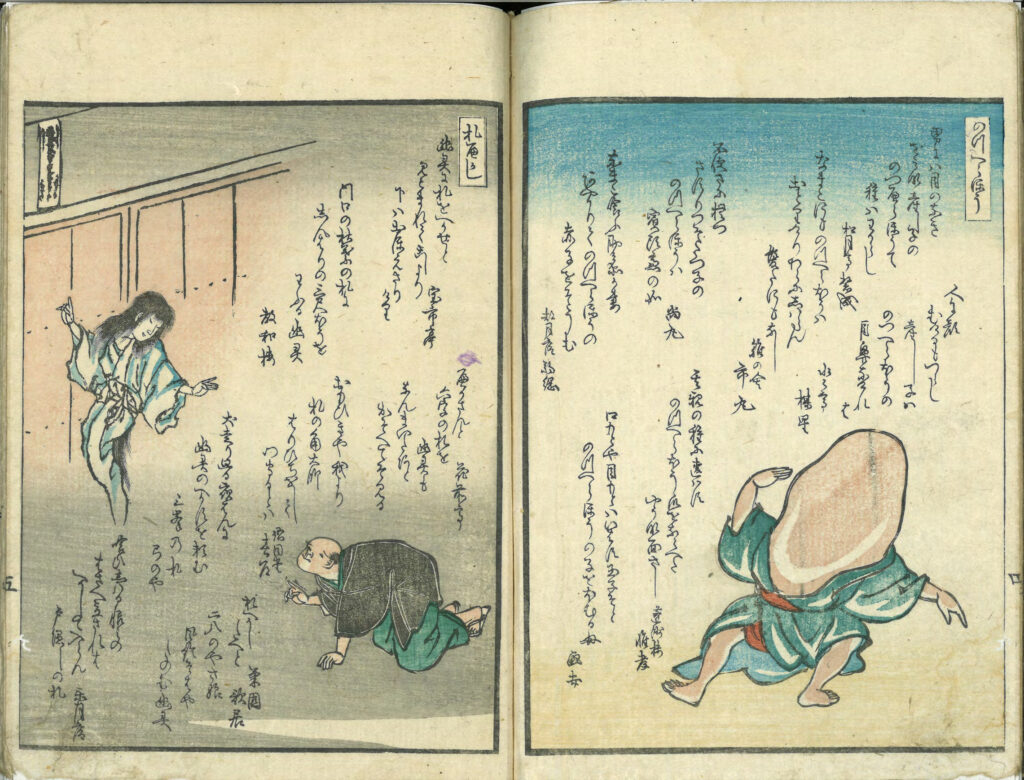
The Kyōka Hyaku Monogatari (狂歌百物語) has a postface dated 1853. In the PDF of the third volume, page 42 shows a two-page spread. On the right, under the title のっぺらぼう, a figure in a green robe crouches, its face huge, oval and blank. Rokurokubi appears on the left. The artist is 竜斎閑人正澄.
The scan comes from a three-volume copy in the Hearn Collection, numbers 2298 to 2300, listed in the University of Toyama catalogue. The image predates 1904, and any precise link to Hearn's story has yet to be established.
“Mujina”, the 1904 story
“Mujina” fills pages 77 to 80 of Kwaidan (1904), whose original text is available on Wikisource. A merchant from Kyōbashi finds a woman weeping by the moat at Kii-no-kuni-zaka, on the Akasaka Road in Tokyo. He offers to help her. She turns and reveals a face without eyes, nose or mouth. He flees to a soba seller's lantern. The seller then wipes away his own features, and the light goes out.
The name Mujina appears in both the title and the story. The tale can be read as a double revelation, where the hoped-for refuge repeats the first shock. The year 1904 dates the publication of this literary version. Kwaidan also includes “Yuki-Onna”, a story about the snow woman.
The Ōnyūdō entry and its 1991 source
Nichibunken’s Ōnyūdō entry 0160201 summarises an article in Ina, published in May 1991 (issue 756, p. 45). At Iida in Nagano, a giant apparition with a featureless face blocks a path near a bamboo grove. The witness flees into temple grounds. This account attributes the form to tanuki.
One motif, three names
- Artwork, 1853. The image is titled のっぺらぼう.
- Story, 1904. Hearn titles a tale of two erased faces “Mujina”.
- Entry, 1991 article. Ōnyūdō has a のっぺらぼう face, a form this version attributes to tanuki.
Sources
- University of Toyama catalogue, Kyōka Hyaku Monogatari, Hearn Collection 2298 to 2300
- PDF of the third volume, page 42, public domain, University of Toyama
- Wikimedia Commons, file record for Masasumi Noppera-bo
- Lafcadio Hearn, “Mujina”, Kwaidan, 1904, pages 77 to 80, Wikisource
- Nichibunken, Ōnyūdō entry 0160201
