Who is Yuki-onna?
Yuki-onna is a figure of Japanese folklore tied to snow, storms and death by cold. Most accounts describe her as a yokai, sometimes as a spirit of winter, sometimes as something closer to a ghost. Her name means, literally, snow woman.
She appears during blizzards as a woman with very pale skin, dressed in white. Depending on the region and the period she kills travellers with an icy breath, spares them, or marries one of them. That looseness is part of who she is: she was never locked into a single narrative.
Is Yuki-onna a yokai, a spirit or a ghost?
The honest answer is that all three words apply, but not at the same level. In most stories she is a yokai, a supernatural presence of Japanese folklore. She also works as a spirit of snow, because she personifies winter, the blizzard and the mountain. Some versions bring her closer to the Japanese ghost, especially when she is presented as a woman who died in the snow.
Choosing one label and applying it everywhere is what creates confusion. The useful question is which register a given story is working in.
What her name means
The name is written with two kanji: 雪 (yuki), snow, and 女 (onna), woman. Literally, the snow woman. It is that simple. What is not simple is that individual provinces long had their own names and their own version of the character, which is why the accounts vary so much from one region to the next.
The Japanese reference portal Kotobank describes her as a female supernatural figure appearing on snowy nights, and the encyclopedias gathered there stress that no single form holds across all regions.
Where the legend comes from
Among the early mentions commonly cited, the Sōgi Shokoku Monogatari describes an apparition in Echigo, today's Niigata Prefecture. The account is attributed to the poet Sōgi, but the collection that transmits it belongs to the Edo period, even though the episode itself is associated with the late Muromachi. It is therefore more accurate to speak of an early testimony than of a fifteenth-century manuscript with a settled date.
In that account she appears as a young woman of barely twenty in a kimono, described at around three metres tall, with an almost translucent complexion. She interacts with no one: Sōgi sees her, she withdraws into the forest, and a villager later confirms the figure is known locally. White hair is not a detail established by this source, and neither is the icy breath, which belongs to later versions.
Before she was a literary character, she was most likely a way of putting a face on a very concrete fear. In the snowbound mountain regions, cold killed for real. A legend shaped like a silent, beautiful woman made that danger tellable, transmissible, and easier to teach to children and travellers alike.
The best known version: Lafcadio Hearn, 1904
The version that became best known outside Japan is the one published by Lafcadio Hearn, also known as Koizumi Yakumo, in Kwaidan in 1904. In his preface Hearn writes that a farmer from Chōfu told him the story as a local legend. Academic work nonetheless debates how much of the text is oral transmission and how much is literary composition. It is safer to speak of the version published by Hearn than of a guaranteed word-for-word transcription. The English text is available through Project Gutenberg.
Two woodcutters, old Mosaku and his apprentice Minokichi, are caught in a blizzard and take shelter in a hut. During the night a woman dressed entirely in white comes in, leans over Mosaku and kills him with an icy breath. She then turns to Minokichi, finds him young, and decides to spare him on one condition: never tell anyone what he saw.
Years later Minokichi marries a woman named O-Yuki, "Snow". She is pale, beautiful, and does not seem to age. They have ten children. One winter evening, watching her sew, he finally tells her about the night of the storm. O-Yuki rises: that woman was her, and he has broken his promise. She spares him a second time, because of the children, then dissolves into a mist that disappears up the chimney.
It is a ghost story, a love story and a lesson about a given word, all at once.
What Hearn's version does not prove
His account documents one local version and its literary publication. It does not establish that every Yuki-onna marries a husband, kills with a cold breath or demands a vow of silence. Mosaku, Minokichi and O-Yuki belong to the Kwaidan story. They are not fixed characters in every Japanese snow woman legend.
Regional variants
Hearn popularised a rather melancholy Yuki-onna. Northern Japan tells much darker ones.
In Yamagata Prefecture, the ubume, the spirit of a woman who died in childbirth, is identified with Yuki-onna. The ubume holds out a child to a passer-by and wants to hand it over; whoever looks at the child finds leaves or stones. The shared theme is loss, which the Yuki-onna of other regions usually leaves unexplained.
A separate motif, circulating in several parts of Tōhoku, describes a child whose weight keeps increasing until the bearer is pinned in the snow. Depending on the telling, the ordeal kills him or earns him exceptional strength. No single source fixes this version, so it is better named than attributed.
Tsurara-onna is not simply another Yuki-onna
Tsurara-onna, the icicle woman, is sometimes listed among the alternative names for Yuki-onna. The two stories nonetheless have little in common beyond their closeness to cold. A lonely man wishes for a wife as slender as the icicle hanging from his roof. The next day a woman appears at his door and becomes his wife, but she avoids hot baths. When her husband insists, she melts, and only fragments of ice remain in the water. There is no storm, no mountain and no vow of silence. The best known version comes from Niigata.
Placed side by side, these accounts make the same point: the snow woman is not one character in regional costumes. She is a cluster of winter stories that share a name, and some of what gets filed under that name barely belongs to it.
Symbolism: cold, quiet death, broken promise
A modern reading sometimes connects Yuki-onna to the effects of hypothermia. Severe cold can cause confusion, loss of judgement and drowsiness, and paradoxical undressing is documented in some deaths, as summarised in the NCBI Bookshelf review of hypothermia. That connection remains interpretive. No historical source allows it to be treated as the origin of the legend, and the medical mechanism does not reduce to a simple rush of blood back to the skin.
Some Japanese traditions link mountains and seasons to deities called yama no kami. Encyclopedias also connect certain forms of Yuki-onna to seasonal or mountain figures. That does not make her a guardian everywhere, charged with punishing travellers. The reading has to stay tied to the traditions that document it.
The Nichibunken yōkai tradition database is the practical way to see that spread for yourself, region by region.
How she is depicted
The ko-omote is a Noh mask representing a very young woman. It is not a mask specific to Yuki-onna. A modern staging may choose among different female masks depending on the production. There is no single historical mask form that counts as the Yuki-onna mask everywhere.
In prints and illustrations, white, snow and a female silhouette recur often. Black hair, a full moon or a willow do not form a universal code, and presenting them as one turns a set of artistic habits into a rule that never existed.
Yuki-onna in irezumi tattooing
In Japanese tattooing, Yuki-onna brings an image few other motifs offer: a female figure, cold, tied to winter and to a quiet death. She is often associated with impermanence, mono no aware, the acceptance that nothing lasts, like snow that melts.
Classic compositions place her among snowflakes, a full moon and willows, sometimes set against a dragon or an Oni on the opposite side of the body, to play the contrast of hot and cold. The risk is reducing her to a blue woman. Without winter, silence, the promise and the disappearance, only a cold palette is left.
Yuki-onna in popular culture
Froslass, the Ice and Ghost type Pokémon, is often connected to Yuki-onna because of its female silhouette and its white garment-like shape. The comparison is plausible, but no official Pokémon source is cited to prove a direct adaptation. It should be described as a probable influence or a common reading, not as an officially established link.
The same caution applies to the many manga, games and films that borrow the winter register. Borrowing an atmosphere is not the same as adapting a documented legend.
Yuki-onna, Kuchisake-onna and Hannya: three dangerous women, three logics
| Figure | Register | Core fear |
|---|---|---|
| Yuki-onna | Snow, winter, mountain, landscape | Cold, the broken promise, disappearance |
| Kuchisake-onna | Modern urban legend | The question, the hidden mouth, the reveal |
| Hannya | Noh theatre | Human emotion turned into a demonic face |
Hannya comes from Noh and tells of a woman transformed by jealousy. She is not a generic word for a frightening female figure. To stay with the female figures of Japanese folklore, read the guide to dangerous women in Japanese folklore or the broader top 10 Japanese yokai.
Dai Yokai's Yuki-onna reading
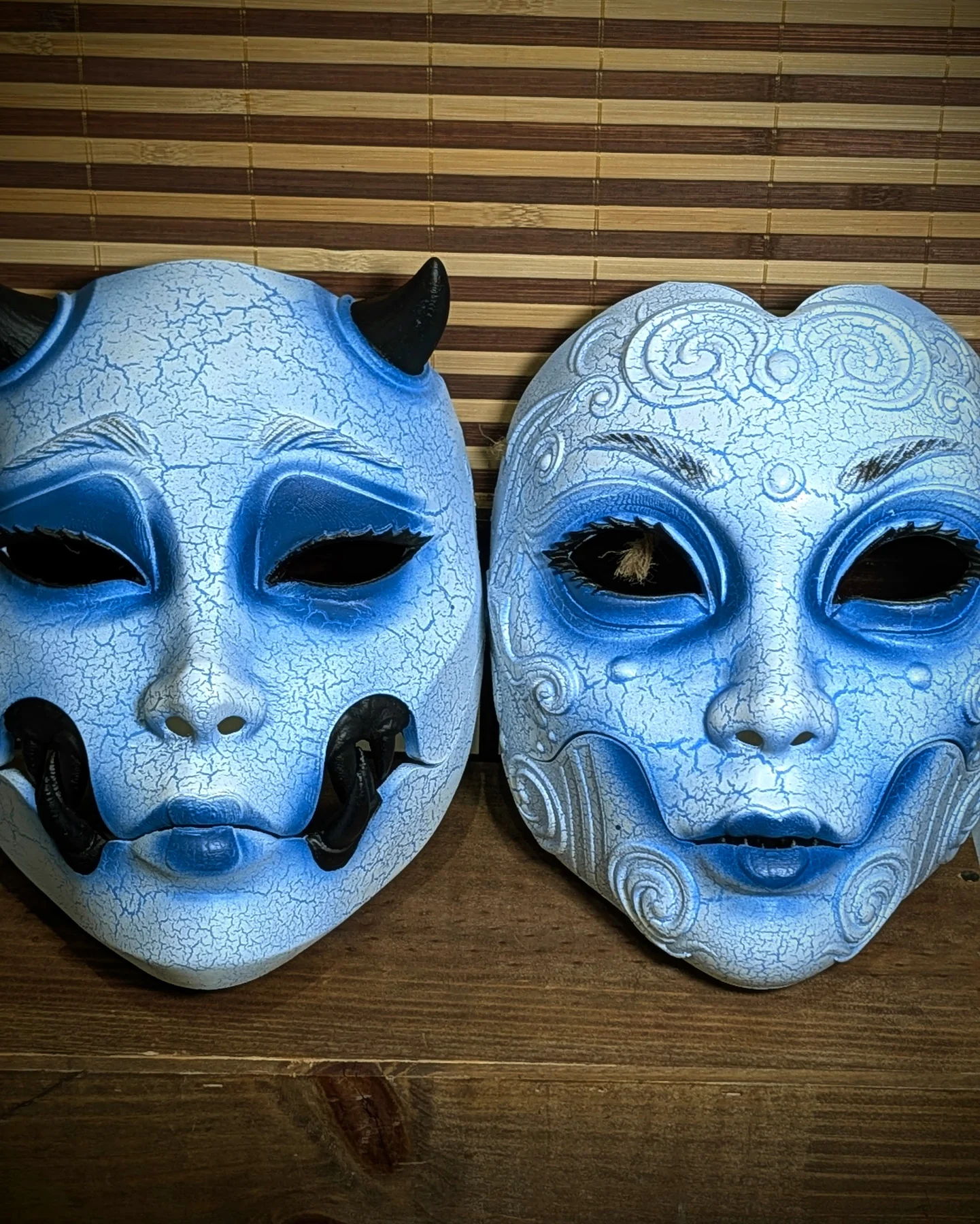
Dai Yokai is a workshop in Brittany, France. The Yuki-onna inspired pieces are contemporary masks, not ritual objects and not historical replicas. There is no traditional Yuki-onna mask form to replicate, which leaves the workshop free to work the register rather than copy a model.
The PETG base is prepared, sanded, primed, painted, varnished and finished by hand. On this motif the difficulty is white and blue: an industrial pure white reads as plastic, so the work goes toward matte, slightly powdery tones and a still expression. The point is not a screaming face. It is a face that seems to arrive from the cold.
For a contemporary interpretation, see the Yuki-Onna mask in Geisha or articulated Kuchisake form. It sits alongside our articulated masks and wider handmade Japanese mask collection.
Sources
- Lafcadio Hearn, Kwaidan: Stories and Studies of Strange Things, 1904
- Kamigraphie, University of Vienna: Yuki-Onna, drawing on Murakami Kenji, Yōkai jiten, 2000, for the Sōgi account, the Yamagata ubume identification and Tsurara-onna
- Kotobank, Japanese entry 雪女
- Nichibunken, database of yōkai traditions
- Yōko Makino, study on tradition and literary creation around Yuki-onna
- NCBI Bookshelf, medical review of hypothermia
Frequently asked questions
Who is Yuki-onna?
Yuki-onna is the snow woman of Japanese folklore. She often appears during storms as a pale woman dressed in white, and she carries beauty, cold, danger and disappearance at the same time.
What does Yuki-onna mean?
Yuki-onna is written 雪女: yuki means snow and onna means woman. The name means, literally, snow woman.
Is Yuki-onna a yokai?
She is generally classified as a yokai. Depending on the region she can also be understood as a spirit of winter or as a figure close to the Japanese ghost, the yūrei.
Where does the Japanese snow woman legend come from?
Yuki-onna traditions come from several snowbound regions of Japan. Early mentions exist between the late Muromachi period and the early modern period, but the sources do not establish a single origin story. Lafcadio Hearn published the version that became best known outside Japan in 1904.
What does Yuki-onna symbolise?
She can be read as a personification of snow, of winter danger, of isolation, or of the broken promise in Hearn's version. These themes vary from one account to another. They do not form a single symbolism valid across Japan.
Is Yuki-onna dangerous?
In some versions she kills travellers or makes them disappear. In others she spares someone, marries a human, sets a test or grants a reward. Her behaviour depends on the tradition being told.
Is there a traditional Yuki-onna Noh mask?
No. The ko-omote represents a very young woman and is not specific to her. No single historical mask form counts as the Yuki-onna mask everywhere, which is why modern stagings and workshops each interpret her differently.
What is the link with the Pokémon Froslass?
Froslass is often read as inspired by Yuki-onna because of its Ice and Ghost typing and its female silhouette. The comparison is plausible, but it should not be presented as an officially confirmed adaptation without a Pokémon source.
Conclusion
Yuki-onna means snow woman, and the figure has no single fixed biography. Hearn's Kwaidan made the story of Minokichi and O-Yuki famous. Alongside it, regional traditions give old women, children, winter visitors, ordeals, rewards and seasonal links to mountain deities. An accurate explanation always names the version it is describing.