A Nekomata is a Japanese cat yokai linked to two different traditions: a dangerous feline said to live in the mountains, and an old domestic cat that becomes supernatural. A Bakeneko is more broadly a ‘changed’ or transforming cat. The famous two-tailed design is the clearest later marker of a Nekomata, but the folklore is less rigid than a simple monster evolution chart.
Nekomata vs Bakeneko: the short answer
The practical difference is this: Bakeneko describes a supernatural or shape-changing cat, while Nekomata refers to a more specific cat yokai tradition. In later descriptions, a Nekomata is commonly shown with a forked tail or two tails. Both may walk upright, speak or deceive humans, and their stories overlap.
| Point | Bakeneko | Nekomata |
|---|---|---|
| Name | 化け猫, ‘changed’ or ‘transforming cat’ | 猫又 / 猫また, commonly read as ‘forked cat’ |
| Core idea | A cat that has gained supernatural powers | A distinct cat yokai found in mountain and domestic traditions |
| Tail | Usually one tail in modern comparisons | Usually forked or two-tailed in later art |
| Typical setting | Household tales, disguise, revenge and theatre | Remote mountains in early accounts, households in later tales |
| Common abilities | Human speech, upright walking, disguise, strange fire | Similar powers, plus curses or corpse control in some accounts |
| Important nuance | Not a perfectly fixed species | Not simply a universal ‘next stage’ of Bakeneko |
Calling either creature a ‘cat demon’ is convenient English shorthand, but yokai is more precise. A yokai can be a monster, apparition, transformed animal or uncanny phenomenon; it does not map neatly onto the Western idea of a demon.
What is a Nekomata yokai?
The Nekomata is one of Japan's best-known feline yokai. Its history is not one continuous origin story. Older texts describe a wild, man-eating creature in the mountains. Later accounts bring the fear inside the home, where a long-lived pet cat acquires intelligence and supernatural power.
The mountain Nekomata
A record from 1233 in Fujiwara no Teika's diary Meigetsuki describes a catlike beast in Nara, with eyes like a cat and a body as large as a dog, that killed people. The creature belongs to the dangerous wilderness: an animal at the edge of the known world rather than a transformed pet with a standard set of powers.
The domestic Nekomata
By the medieval and Edo periods, stories also warned that a household cat kept for many years could become a Nekomata. This version watches its owners, understands human behaviour and may turn against a cruel household. The forked tail became its best-known sign, especially in later illustrated culture.
What is a Bakeneko?
Bakeneko literally points to a cat that has changed or transformed. It is less a zoological category than a flexible folklore label. A Bakeneko may speak like a person, stand on its hind legs, wear a cloth on its head while dancing, take human form or create mysterious fire. Some stories make it a vengeful pet; others use it as a theatrical ghost-cat figure.
This is why a one-tail-versus-two-tails rule is useful for recognising modern images, but incomplete as history. Regional tales, illustrated books and stage traditions borrowed from one another. Powers now assigned exclusively to one cat can appear with the other in a different retelling.
Why does the Nekomata have two tails?
Later folklore treats the split tail as the visible result of age and accumulated supernatural power. The name itself was written in several forms, including 猫又 and 猫股, which encouraged the ‘forked cat’ reading. Edo-period artists helped make the double tail memorable, and modern anime, games and tattoo designs turned it into an instant visual code.
That does not mean every early Nekomata account mentioned two tails. The oldest mountain stories focus on size, danger and location. A careful reading therefore treats the two tails as a strong later convention, not a detail that must be projected backward into every version of the legend.
Powers and behaviour in cat yokai stories
Cat yokai abilities change from tale to tale. The list below shows recurring motifs, not a fixed rulebook.
| Folklore motif | What it expresses | Usually linked to |
|---|---|---|
| Human speech and upright walking | A familiar pet crossing the boundary into human behaviour | Both |
| Shape-changing or impersonation | Fear that appearances and identities cannot be trusted | Especially Bakeneko |
| Strange fire | Cats, lamp oil and unexplained household fires | Both in different tales |
| Curses and revenge | A mistreated animal returning power against its owner | Both |
| Controlling the dead | Pollution, funerary fear and the uncanny movement of a corpse | Often Nekomata in modern summaries |
| Dancing with a cloth on the head | A secret imitation of human entertainment | Often Bakeneko |
Why cats became supernatural in Japan
Cats were valuable because they hunted mice that threatened food stores and silkworm production. They were also hard to read: active at night, silent in movement, bright-eyed in low light and independent around people. A useful animal could therefore become uncanny without ever leaving the house.
Old oil lamps strengthened the association with strange behaviour. Lamp oil could contain fish oil, so a cat reaching up to lick it might cast a large, distorted shadow on a wall. Folklore transformed that ordinary scene into a cat standing like a person or feeding a supernatural flame.
From Edo art and kabuki to modern cat yokai
The Edo period gave cat yokai a powerful visual life. Illustrated yokai collections catalogued uncanny creatures, while kabuki made the Bakeneko a dramatic figure of disguise and revenge. Cats could be frightening, comic or humanlike, sometimes within the same century.
Modern fiction often cleans this ambiguity into a simple hierarchy: an old cat becomes a Bakeneko, then gains a second tail and becomes a stronger Nekomata. That model is easy to use in games, but it is not the only folkloric relationship. The older material is messier, which is exactly why the two names are still debated.
Historical context and reliable sources
Three useful reference points show how the tradition changed. The BYU Bakemono project summarises the Nekomata's recurring features. A peer-reviewed study from the Chinese University of Hong Kong traces Nekomata culture through Edo-period documents and paintings. The Museum of Kyoto's cat exhibition explains how late-Edo theatre and print culture turned the Bakeneko into a popular ghost-cat figure.
How to recognise a Nekomata design
In contemporary art, the quickest clue is a feline figure with two tails. Artists may add upright posture, ghostly fire, a theatrical human expression or a dark domestic setting. None of these details alone proves a precise historical source, but together they signal the modern Nekomata vocabulary.
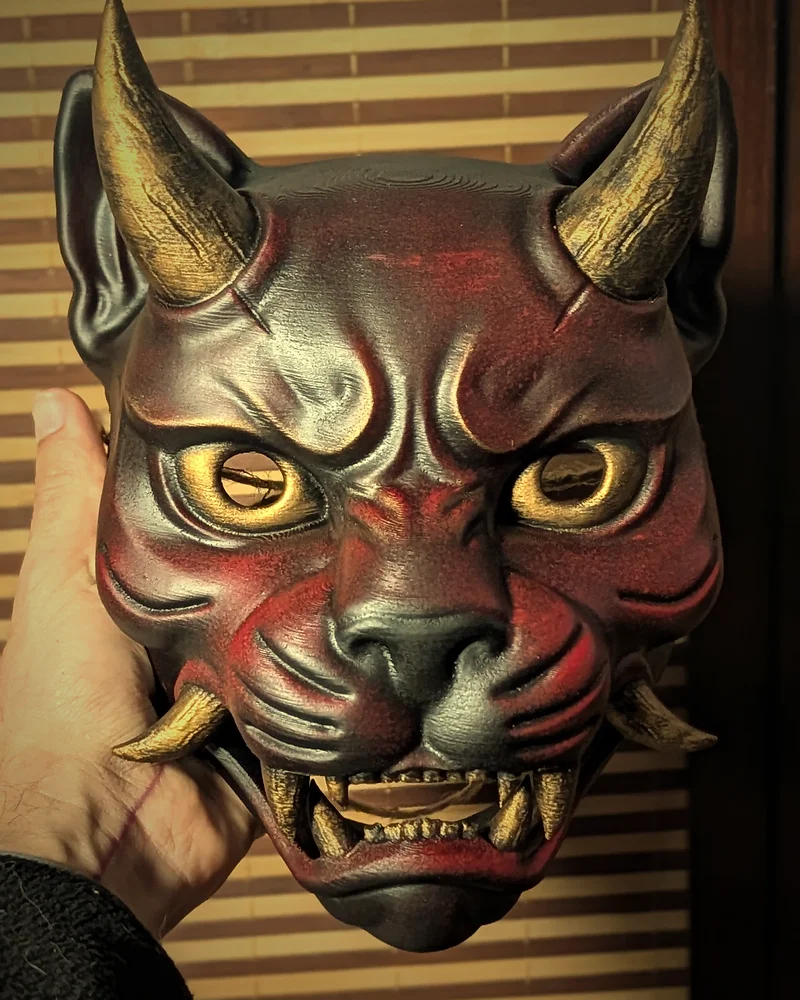
Dai Yokai translates that tension into a physical face rather than a literal illustration of every legend. See the Nekomata demon cat mask, explore the broader handmade Japanese mask collection, or continue with the guide to yokai in Japanese folklore.
FAQ
What is the difference between a Nekomata and a Bakeneko?
Bakeneko is a broad name for a cat that has acquired supernatural powers, especially transformation. Nekomata names a related cat yokai with its own mountain and domestic traditions. In later art, the Nekomata's forked or double tail became the clearest visual distinction, but older stories do not form a perfectly fixed taxonomy.
Is a Nekomata a yokai?
Yes. A Nekomata is a Japanese cat yokai. Early accounts describe a dangerous catlike beast in the mountains, while later folklore also describes an old domestic cat that becomes supernatural.
Why does a Nekomata have two tails?
Later folklore says an old cat's tail forks as its supernatural power grows. The two tails became the Nekomata's strongest identifying feature in Edo-period and modern imagery, although the earliest mountain Nekomata accounts did not always describe this feature.
What powers does a Nekomata have?
Depending on the tale, a Nekomata may speak, walk on two legs, change shape, create strange fire, curse a household or control the dead. These powers vary by source and should not be treated as one universal checklist.
Are Nekomata and Bakeneko evil?
They are usually feared in folklore, but yokai are not a simple good-versus-evil species. Stories use supernatural cats for revenge, deception, household anxiety and the danger of the unfamiliar. Modern fiction often makes them playful, loyal or protective instead.
How old must a cat be to become a Nekomata?
There is no single canonical age. Different stories mention long life, unusual size or a long tail, but the numbers vary. The fixed age sometimes repeated online is a modern simplification, not a universal rule of Japanese folklore.