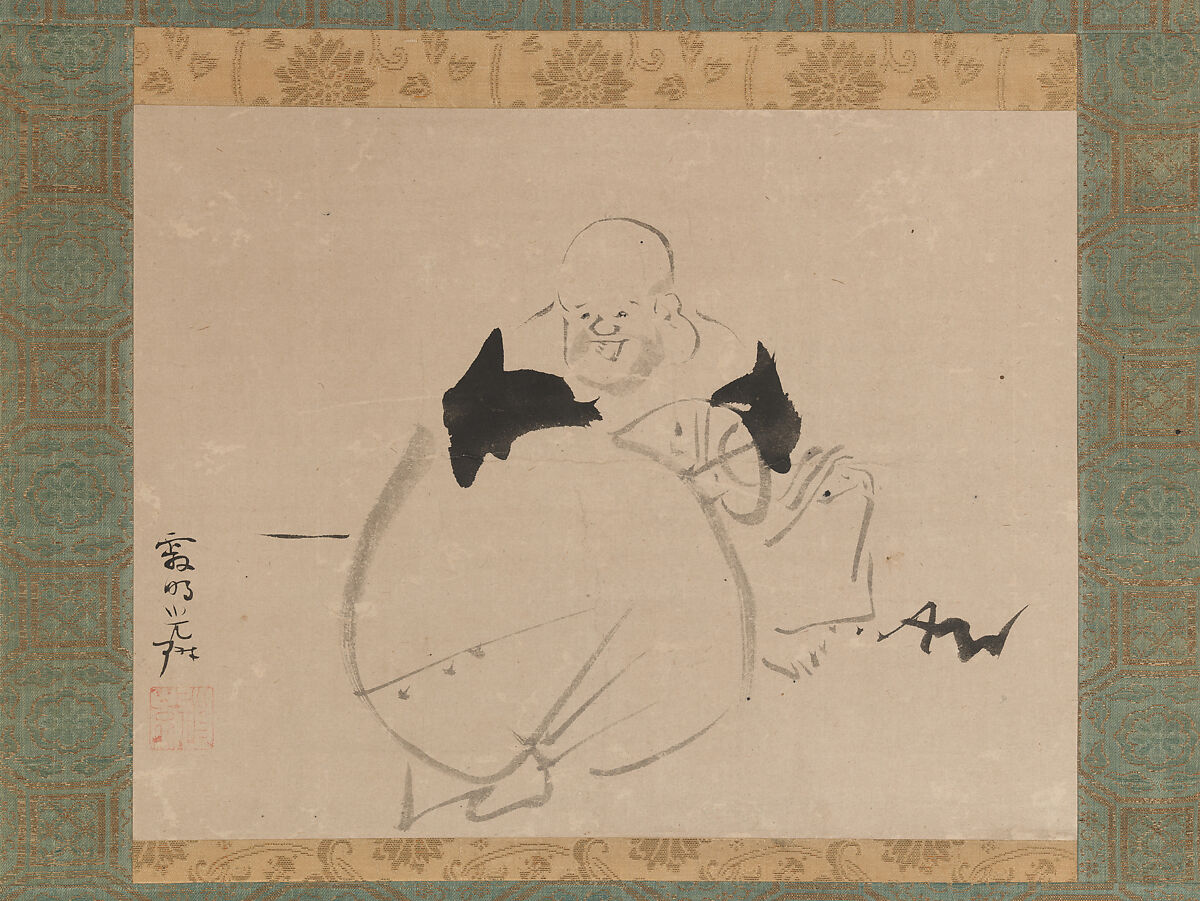
Hotei is the Japanese name for Budai, the round-bellied figure with a shaved head and a large cloth bag often called the “Laughing Buddha.” Associated with contentment and generosity, he is one of Japan’s Shichifukujin, the Seven Lucky Gods.
He does not represent Shakyamuni, the historical Buddha. Keeping that distinction clear helps explain his appearance without treating every Buddhist statue as the same figure.
Budai and Hotei: two names, one figure
The Metropolitan Museum of Art identifies Hotei as the Japanese name for Budai, a semi-historical Chinese monk associated with the ninth and tenth centuries. Stories and images show him traveling with a cloth sack holding his few possessions. His cheerful appearance and unconventional behavior made him a favorite subject in Zen painting.
Buddhist tradition connected him with Maitreya, called Miroku in Japan, the Buddha of the Future. That religious association is distinct from the identity of the historical Buddha. Budai and Hotei refer here to the cloth-bag figure in Chinese and Japanese contexts.
Why is he called the Laughing Buddha?
The familiar name reflects a common appearance: a shaved head, exposed belly, loose robe and smiling or laughing face. The National Gallery of Victoria describes a poor but content figure associated with generosity, wisdom and kindness, sometimes surrounded by children.
The historical Buddha, named Siddhartha and known as Shakyamuni, belongs to a different history and narrative. “Laughing Buddha” is a useful everyday name for recognizing Budai or Hotei, but it is too imprecise to identify all religious sculptures from Asia.
The bag, belly and smile in Hotei imagery
The cloth bag is his most distinctive attribute. Depending on the composition, Hotei carries it, leans against it or rests nearby. His rounded body and open robe contrast with many more formal religious figures. He can also hold a fan or appear with children.
Artists do not always give him the same expression or activity. A painting attributed to Shinno Noami in the Met collection shows Hotei pointing toward the moon, a gesture within Zen painting’s visual language. Treating every depiction as a promise of money would miss much of this range.
Hotei and the Seven Lucky Gods
The Shichifukujin generally comprise Ebisu, Daikokuten, Bishamonten, Benzaiten, Fukurokuju, Jurojin and Hotei. The JNTO presents the group through local festivals and traditions. Its members have different origins and attributes, rather than forming a set of interchangeable characters.
Hotei can appear alone or with the other six. To identify a figure, consider several details together: the bag, head, clothing, objects held and surrounding characters. A sack on its own is not enough, since other figures may carry one too.
Understanding a statuette before choosing it
An old sculpture, a souvenir and a contemporary creation can share a silhouette while serving different purposes. Read the maker’s name for the piece, its material and its origin. A gold-colored finish does not establish that an object is metal, and a symbolic association does not replace information about how it was made.
For a decorative piece, measure its display space and look closely at the face. Expression, posture and the size of the bag change how a statue sits on a shelf. The guide to Japanese good luck symbols and objects offers a comparison with other auspicious figures while keeping their roles distinct.
Japanese figurines coming to Dai Yokai
New Japanese figurines are coming soon to Dai Yokai. Models and availability will be announced when they are introduced.
The Japanese statues and figurines collection remains the place to discover the creations currently offered.
Sources
- The Metropolitan Museum of Art, Hotei by Ogata Kōrin, Budai, Zen context and the Seven Lucky Gods.
- The Metropolitan Museum of Art, Hōtei Pointing to the Moon, another painted interpretation.
- National Gallery of Victoria, Buddha’s Smile, Budai label, imagery and associations.
- The Metropolitan Museum of Art, Life of the Buddha, the historical Buddha’s identity.
- JNTO, Shichifukujin Festival, the Seven Lucky Gods group.