
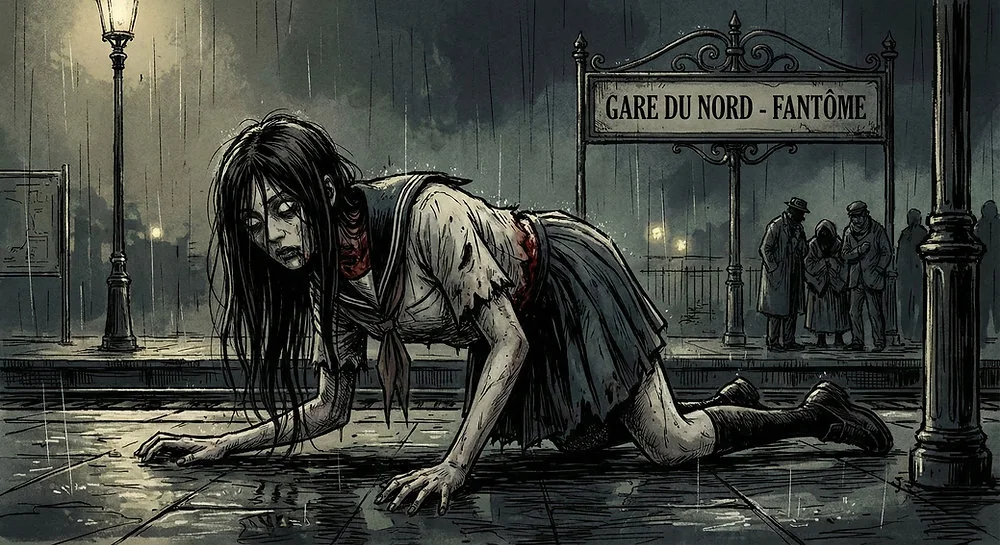
Teke Teke is a modern Japanese urban legend about a fast-moving ghost with no lower body. She is usually heard before she is seen, crawling on her hands or elbows with a repeated teke-teke sound. Stories often place her near schools or railways, but her identity, death and escape rules vary widely.
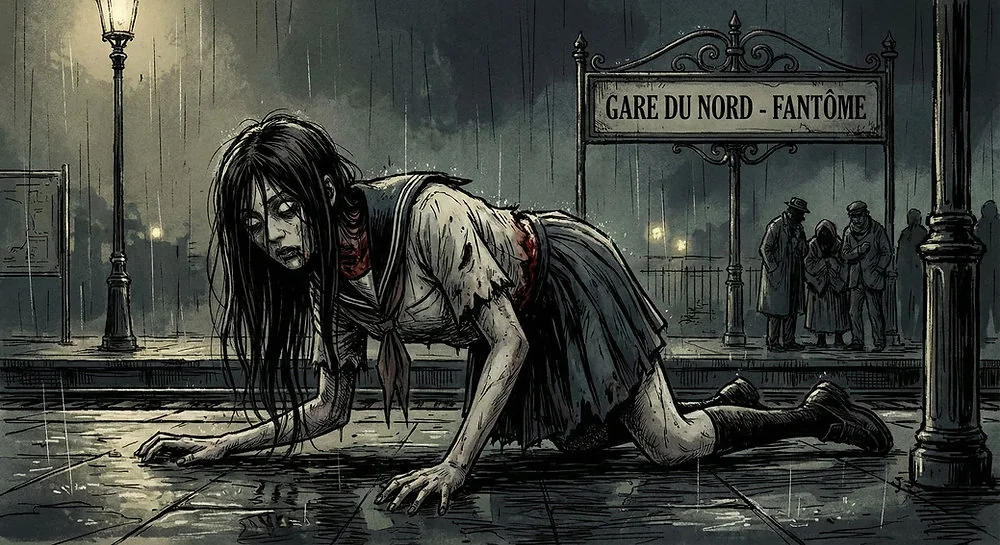
Who is Teke Teke?
The core image is simple: a human figure, usually a girl or young woman, is missing everything below the waist. She propels herself with her hands or elbows at impossible speed. The scraping or tapping sound of that movement gives the figure her name.
Many English retellings present one complete biography, but oral legends do not behave like fixed fictional characters. In some accounts Teke Teke was killed by a train. In others the cause is different or absent. Some stories describe a woman, some a man, and some never specify a gender.
| Element | Common version | Known variations |
|---|---|---|
| Appearance | A young woman missing her lower body | A man, an older woman or an unidentified upper body |
| Movement | Crawls rapidly on hands or elbows | Climbs, flies or appears at a window |
| Location | Railway crossing, station or night road | School corridor, playground, park or residential street |
| Threat | Chases and cuts a victim in half | Takes the victim's legs, asks a question or simply disappears |
What does the name Teke Teke mean?
Teke-teke is treated as an onomatopoeia, a word imitating the hard repeated sound of the figure moving across the ground. The name is memorable because children can repeat it and perform the rhythm while telling the story.
Japanese writer and urban-legend researcher Asato Itsuki describes related regional names such as Pata-Pata, Koto-Koto and Kata-Kata in a Web Mu study of school ghost stories. The changing sound words support the idea that several local half-body stories were later grouped under the Teke Teke name.
How did Teke Teke die?
The best-known story says a schoolgirl fell, was pushed or became trapped on a railway line, where a train severed her at the waist. Hokkaido is frequently named, and some versions add winter cold, a crossing or a station worker who failed to help.
No single accident has been verified as the historical source. Other collected stories place the origin in Okinawa, Hyogo or a school building, or provide no human past at all. The train death is therefore part of the legend, not a confirmed news event.
The Japanese source review traces an Okinawan half-body story reported from 1980 and explains how 1990s school-horror publishing may have merged it with a separate railway-accident tale. That is more cautious than claiming the legend definitely began after the Second World War.
Teke Teke and Kashima Reiko: are they the same?
Kashima-san, often expanded to Kashima Reiko in English, is another modern ghost story involving missing legs. She may contact someone in a dream or by telephone and ask questions. A wrong answer leads to death or the loss of a body part.
Because the two legends share bodily mutilation, later versions borrow names, railway accidents and survival rules from each other. That does not create one authoritative family tree. In one schoolyard they may be the same ghost; in another they are separate.
| Feature | Teke Teke | Kashima-san / Kashima Reiko |
|---|---|---|
| Main image | A fast crawling upper body | A ghost missing her legs |
| Typical encounter | Physical pursuit near a school or railway | Question delivered in a dream, call or encounter |
| Name | From the sound of movement | A personal name with several explanations |
| Relationship | Sometimes merged with Kashima | Sometimes named as Teke Teke's identity or a separate ghost |
How do you escape Teke Teke?
There is no stable answer. One version says she moves too quickly to escape. Another gives a three-day deadline after seeing her. Others require a word or answer borrowed from the Kashima-san legend. These contradictions are not mistakes that need one solution. They show how children modify a story to create a challenge, a warning and a rule for retelling it.
| Claim found online | Careful answer |
|---|---|
| You can outrun her | Many versions say the opposite |
| One phrase always saves you | Answers vary and often belong to Kashima-san variants |
| You die three days after seeing her | A rule found in some later tellings, not all versions |
| The story gives real safety advice | No, these are fictional rules inside an urban legend |
Is Teke Teke a yokai or an onryo?
Teke Teke is often labelled an onryō because she is imagined as a dead person returning in anger. She is also catalogued with yōkai in modern reference sites. The most precise description is a contemporary urban-legend ghost that circulated through school storytelling.
A small 2020 survey of Japanese participants, presented in a University of Florida honors thesis, recorded striking differences: respondents described train and traffic accidents, a school-rooftop death, male and female forms, and several escape ideas. This variation is typical of living urban folklore.
For the broader vocabulary, see the Dai Yokai guides to yūrei and Japanese ghosts and yōkai in Japanese folklore.
When did the legend spread?
Related half-body stories were circulating among children by the 1980s. The Teke Teke name became more widely established during the Japanese school ghost-story boom of the 1990s, when books, magazines and television collected local rumors and returned standardized versions to a national audience.
The legend later moved into films, forums, videos and social media. Kōji Shiraishi's 2009 films Teketeke and Teketeke 2 used a particular railway-origin version. A film adaptation is evidence of the legend's popularity, not proof that its plot is the original account.
Teke Teke and modern Japanese horror imagery
Teke Teke is not a traditional mask character. Her horror comes from movement, sound and an incomplete silhouette rather than a canonical face. Contemporary illustrations, cosplay and film effects invent their own appearance, so no one design can be called an authentic Teke Teke mask.
Dai Yokai makes contemporary masks inspired by Japanese folklore and horror aesthetics, not ritual replicas. For nearby themes, compare the modern urban legend of Kuchisake-onna with the theatrical history of the Hannya mask. They should not be treated as the same tradition. For an older folklore comparison, explore regional Yuki-onna legends.
Conclusion
Teke Teke endures because the idea is easy to recognize and easy to change: a sound in the dark, a body moving impossibly fast, and a rule that may not save you. The conflicting origins and escape methods are part of the evidence. This is a living urban legend, not one fixed biography or a documented supernatural case.
Sources and further reading
- Web Mu, Asato Itsuki, Japanese review of Teke Teke's regional forms and school-story development
- University of Florida honors thesis, survey evidence for variations in Japanese urban legends
- YOKAI.JP, sourced overview of modern Teke Teke variants and media history
FAQ
Who is Teke Teke?
Teke Teke is a figure from a modern Japanese urban legend. She is usually described as a fast-moving ghost missing the lower half of her body. Many versions place her near a school, railway crossing or station, where she pursues people while making a repeated scraping sound.
Is Teke Teke real or fake?
Teke Teke is an urban legend, not a documented supernatural being. No verified historical accident has been established as the single origin of the story. The many conflicting names, locations and deaths are evidence of a tale changing as children, books, television and online media retell it.
Why is she called Teke Teke?
The name is usually explained as an onomatopoeia for the repeated sound made when the figure moves rapidly on her hands or elbows. Regional stories recorded similar sound-based names, including Pata-Pata, Kata-Kata and Koto-Koto, which suggests that the noise was central to the legend's transmission.
How did Teke Teke lose her legs?
The best-known version says that a young woman or schoolgirl was severed by a train. Other accounts give no railway accident, describe a fall from a school building, or make the figure male. The train story is widespread, but it should be treated as one version rather than verified history.
How do you escape Teke Teke?
There is no official escape rule. Some versions say she is too fast to outrun, while others introduce a correct answer, a three-day deadline or a connection with Kashima-san. These changing rules are storytelling devices, not real safety instructions, and often come from legends that have merged together.
Are Teke Teke and Kashima Reiko the same ghost?
Not consistently. Kashima-san or Kashima Reiko is usually a separate missing-legs legend involving questions, dreams or telephone calls. Because both figures lack a lower body, later retellings often combine their names, railway deaths and escape rules. The relationship changes from one version to another.
Is Teke Teke a yokai or an onryo?
English summaries often call Teke Teke an onryō, or vengeful ghost, and modern encyclopedias may group her with yōkai. More precisely, she belongs to contemporary urban legend and school ghost-story culture. Unlike many classical yōkai, her form and origin are not fixed by an old canonical account.
When did the Teke Teke legend begin?
Its exact beginning is unknown. Related half-body figures were being told among children by the 1980s, and the name became established during Japan's school ghost-story boom of the 1990s. Claims of one post-war accident or one Hokkaido origin remain unverified versions of the legend.