Kuchisake-onna, the Slit-Mouthed Woman, is a Japanese urban legend that became a nationwide phenomenon in 1979. A masked woman asks a passer-by, “Am I pretty?”, reveals a mouth slit towards her ears, then repeats the question. Weapons, answers and escape methods change between tellings, which is why the legend should be read as a changing rumor rather than one fixed ancient story.
| Quick question | Evidence-based answer |
|---|---|
| What does the name mean? | Slit-Mouthed Woman |
| When did the famous rumor spread? | From late 1978 through the first half of 1979 |
| Where did the documented wave begin? | Gifu Prefecture, before spreading across Japan |
| What are the stable features? | A masked woman, a slit mouth and the repeated beauty question |
| Is the samurai-wife origin proven? | No, it is a later and variable backstory |
| Is there one correct escape method? | No, the methods differ between regional and schoolyard versions |
What does Kuchisake-onna mean?
The name is written 口裂け女 and translates as “Slit-Mouthed Woman.” It describes the feature shared across many versions: a woman whose mouth is cut from its corners towards her ears.
The spelling Kuchisake-onna is useful in English because it keeps the Japanese name and the hyphen makes the compound easier to read. “Slit-Mouthed Woman” is a translation, not a separate character.
The core Kuchisake-onna story
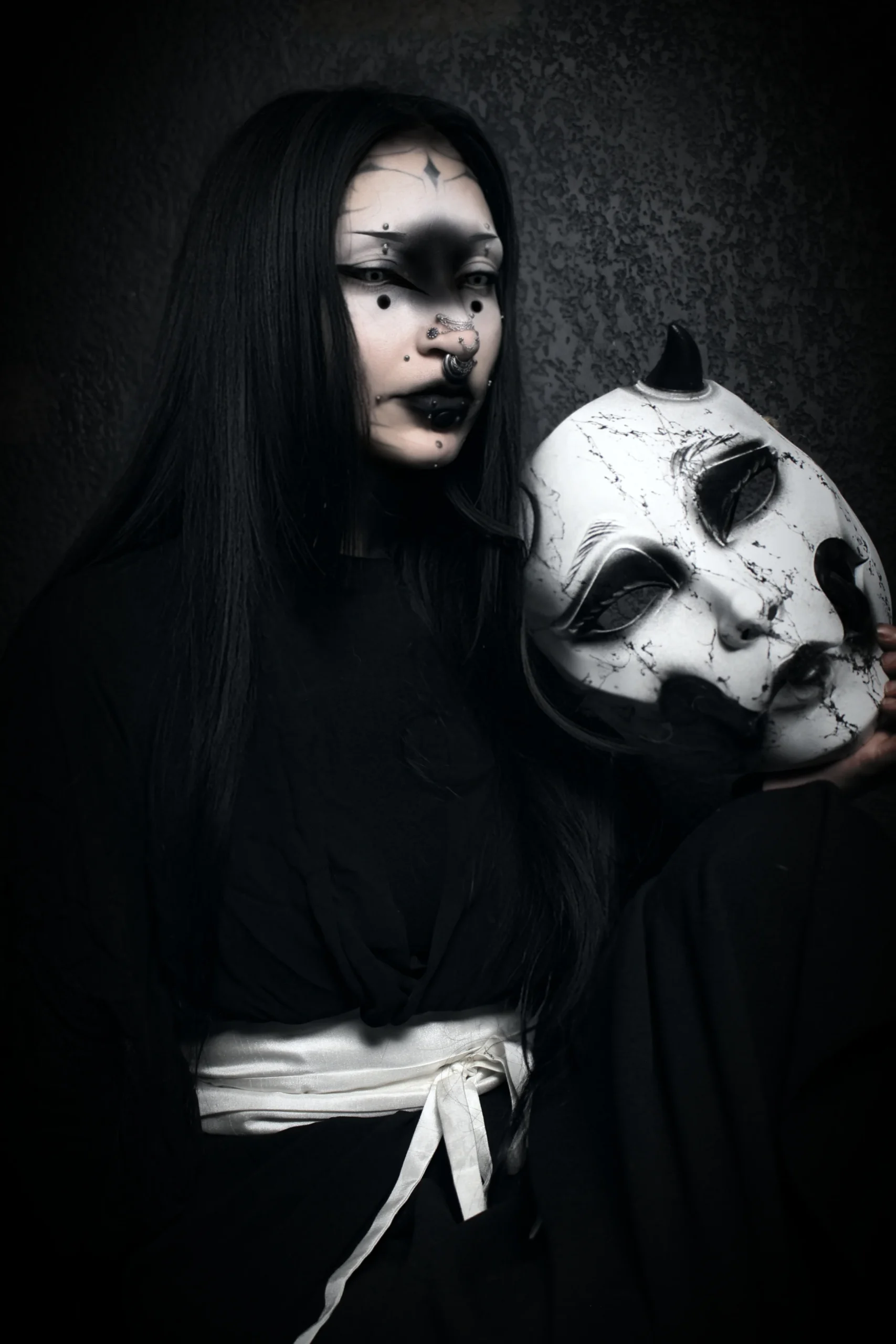
In the best-known form, a woman wearing a face mask approaches a passer-by, often a child, on an urban or suburban street. She asks “Watashi, kirei?”, usually translated as “Am I pretty?” A yes does not end the encounter. She removes the mask, reveals the wound and asks again, often as “Even like this?”
The next step is not consistent. Some versions say she attacks after a negative answer. Others say she cuts the victim’s mouth after a positive answer. Scissors, a knife and a sickle all appear in different tellings. The repeated question and concealed mouth are more stable than the weapon or ending.
When did the legend spread across Japan?
The strongest evidence concerns the modern rumor. Folklorist Iikura Yoshiyuki places the early circulation in Gifu Prefecture at the end of 1978; Yaotsu is a reported location, not a certain point of origin. A local newspaper covered it, children repeated it, and the legend spread nationwide within roughly six months.
Iikura connects this speed to evening cram schools. Children from different school districts met, exchanged rumors, then carried them back to their own schools and families. Newspapers, magazines, radio and television amplified the story. Parents and teachers organized patrols and group walks home before the panic faded around the start of the 1979 summer holidays.
| Period | What is documented | Why it matters |
|---|---|---|
| Late 1978 | A rumor circulates in Gifu Prefecture | This is the clearest starting point for the modern legend |
| January 1979 | A Gifu newspaper reports the story | Local rumor enters print |
| Spring 1979 | Children carry variants between districts | Cram schools and telephone networks speed up word of mouth |
| First half of 1979 | National magazines, radio and television amplify it | The figure becomes known across Japan |
| Summer 1979 | The panic subsides as schools break for holidays | The transmission network weakens, but the character remains |
For another modern urban legend, compare Teke Teke's changing encounters and escape rules.
This modern timeline follows folklorist Iikura Yoshiyuki’s account for Nippon.com and Michael Dylan Foster’s study in The Book of Yōkai.
Is Kuchisake-onna an ancient yōkai?
Not in the same sense as figures documented through centuries of religious practice, literature or theater. Foster calls Kuchisake-onna a modern urban yōkai and found many references in popular magazines and tabloids from 1979 and the early 1980s. The documented nationwide character belongs to the media and schoolyard culture of that period.
Earlier Japanese books do contain slit-mouthed women. The 1801 illustrated collection Ehon Sayo Shigure includes a frightening woman whose mouth reaches towards her ears. That image is a useful historical parallel. It does not by itself prove that the 1979 rumor descended directly from the same tale.
| Claim | Evidence level | Safer conclusion |
|---|---|---|
| The 1979 rumor spread nationwide | Strong, supported by contemporary print and later folklore research | Treat 1978-1979 as the documented modern origin |
| Earlier slit-mouthed women appear in Edo-period books | Supported by surviving works such as Ehon Sayo Shigure | Describe them as earlier motifs or parallels |
| A samurai cut his unfaithful wife’s mouth | Variable modern backstory without one confirmed historical source | Present it as a retelling, not the origin |
| Botched cosmetic surgery created her | One popular explanation within the rumor cycle | Present it as a variant |
| Kuchisake-onna is always an onryō | Classification varies by retelling | Use modern urban legend or modern urban yōkai first |
The bibliographic record for Ehon Sayo Shigure dates the illustrated work to 1801. A surviving image can be viewed through Wikimedia Commons. The visual resemblance is clear, but a direct line to the 1979 rumor remains unproven.

The samurai-wife story and other origin variants
English retellings often describe Kuchisake-onna as the unfaithful wife of a samurai who mutilated her. Japanese rumor variants also blame a jealous sister, a traffic accident, dental work or cosmetic surgery. These explanations contradict each other because they were attached to the character as the rumor traveled.
The responsible approach is simple: call them origin variants. They reveal concerns about beauty, bodily change, jealousy and punishment, but they are not biographies of a real woman and should not be presented as historical fact.
How do you escape Kuchisake-onna?
There is no canonical solution. Escape methods changed by region, school and retelling. Their value is folkloric: they show children trying to make a frightening story playable by adding rules and counters.
| Rumor variant | How it is supposed to work | What it shows |
|---|---|---|
| Answer “so-so” or “average” | Avoid a direct yes or no | An ambiguous reply interrupts the verbal trap |
| Give her bekkō-ame candy | Distract her long enough to leave | A local detail becomes part of the legend |
| Repeat “pomade” three times | The word is said to repel or distract her | A memorable rule travels easily between children |
| Return the question | Force her to answer instead | The listener tries to take control of the exchange |
| Run into a shop or crowded place | Break the isolated street encounter | Urban space becomes part of the solution |
Foster records “so-so,” bekkō-ame candy and “pomade” among the many variations. Iikura also lists changing clothes, weapons, speed and escape tricks. None should be described as an authentic ritual or guaranteed answer.
Why did the story feel believable?
Kuchisake-onna places the supernatural on an ordinary route between school, cram school and home. The face mask makes the encounter plausible because it was already familiar in Japan. The threat arrives through a polite social question rather than a distant temple, mountain or ruined house.
The story also transforms anxiety into a repeatable script. Children could identify the opening line, trade local sightings and memorize an escape rule. Mass media then repeated the same figure while multiplying the details. That combination of everyday setting, word of mouth and national coverage helped the rumor travel.
Kuchisake-onna, Hannya and Yuki-onna compared
| Figure | Main context | Defining feature | Important distinction |
|---|---|---|---|
| Kuchisake-onna | Modern urban legend, especially the 1979 rumor cycle | Masked woman, slit mouth and repeated question | No single codified traditional mask |
| Hannya | Noh theater | Horned mask expressing jealousy, pain and transformation | A specific performance mask, not the female version of an Oni |
| Yuki-onna | Regional snow-country tales and later literary retellings | Supernatural woman associated with snow, cold and disappearance | Landscape-based folklore rather than a schoolyard urban rumor |
| Oni | Broad folklore, Buddhist, festival and artistic contexts | Fearsome beings with varied forms and roles | A wide category, not one character |
Read the dedicated guides to Hannya mask meaning, Yuki-onna and Oni mask meaning rather than treating all frightening female faces or horned masks as interchangeable.
Kuchisake-onna tattoos: concealment, reveal and personal meaning
A Kuchisake-onna tattoo has no single traditional meaning. It can interpret the concealed mouth and its reveal from a modern urban legend. Fear, appearance or secrecy may become personal themes, but they are not meanings automatically inherited by every design.
The mouth covered
Keep the face covering and eyes readable. Decide how the design will suggest the hidden feature without relying on a visible wound.
The mouth revealed
Make the widened mouth distinct from hair, shading and nearby lines. Choose how explicit the image should be.
Both moments
Compare two faces or two states of one portrait. Leave enough space for the viewer to understand the change.
There is no obligatory hairstyle either. Nichibunken records a short-haired variant from Akune and a long-haired variant from Murakami. These are local accounts, not templates for every drawing. Horns or coloured cracks borrowed from a contemporary mask are further artistic choices.
Bring the chosen story and visual references to the consultation, then let the artist develop the placement and scale. The Irezumi composition guide offers background comparisons; it does not turn this modern legend into a fixed traditional tattoo subject.
A contemporary mask inspired by the reveal
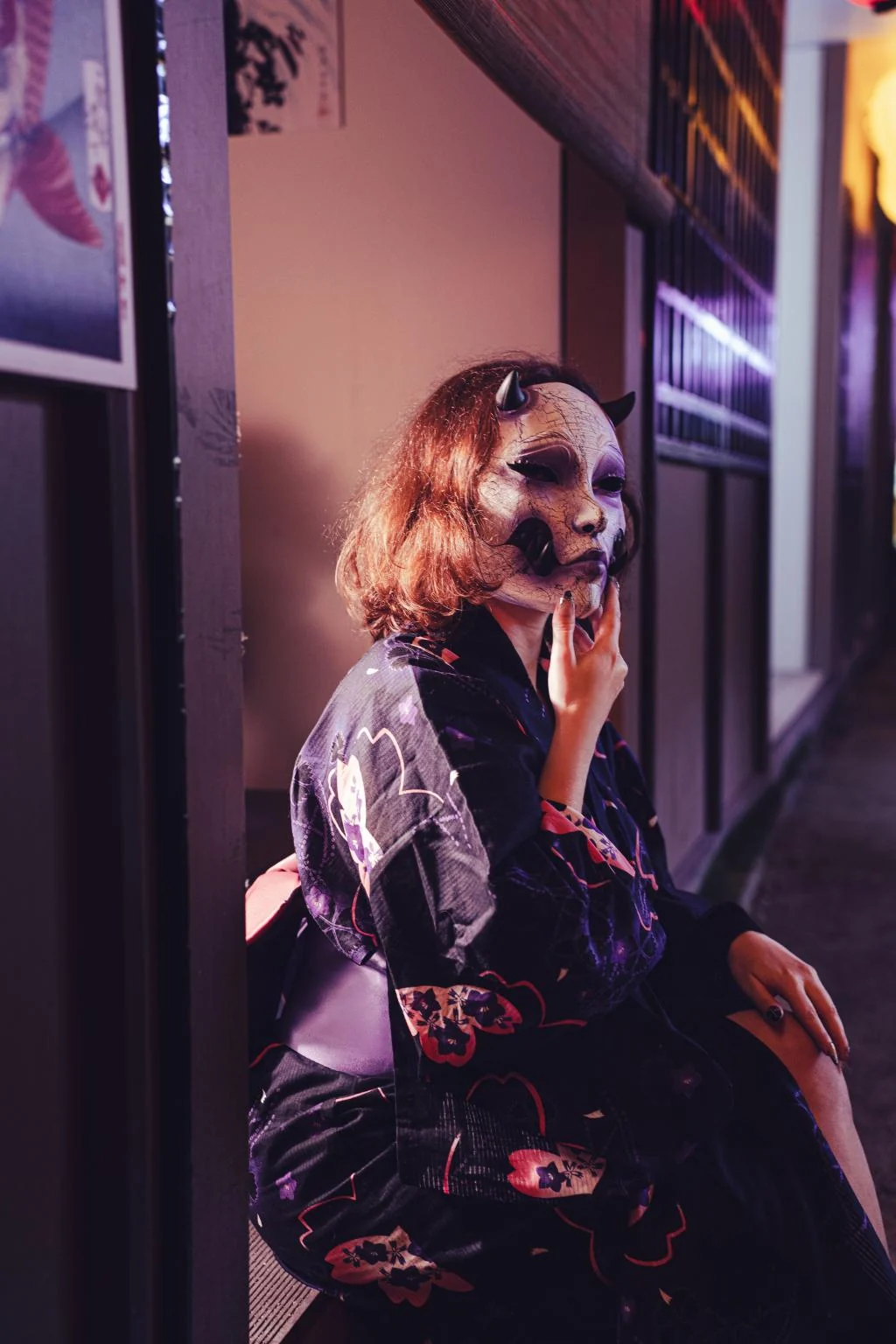
Kuchisake-onna has no single historical mask design. The legend describes a concealed face and a reveal, so contemporary artists interpret the surgical mask, the wound, the jaw and the expression in different ways.
For contemporary costume planning, see the Japanese Halloween mask guide, including two outfit directions and checks for personal hair, wigs and jaw clearance.
Dai Yokai pieces are contemporary handmade creations produced in Brittany, France. They begin with PETG 3D printing, then are sanded, primed, painted, varnished and finished by hand. The articulated Kuchisake-onna mask with hair uses a moving jaw to interpret the reveal. They are inspired by the urban legend and Japanese mask aesthetics, not presented as Japanese ritual objects.
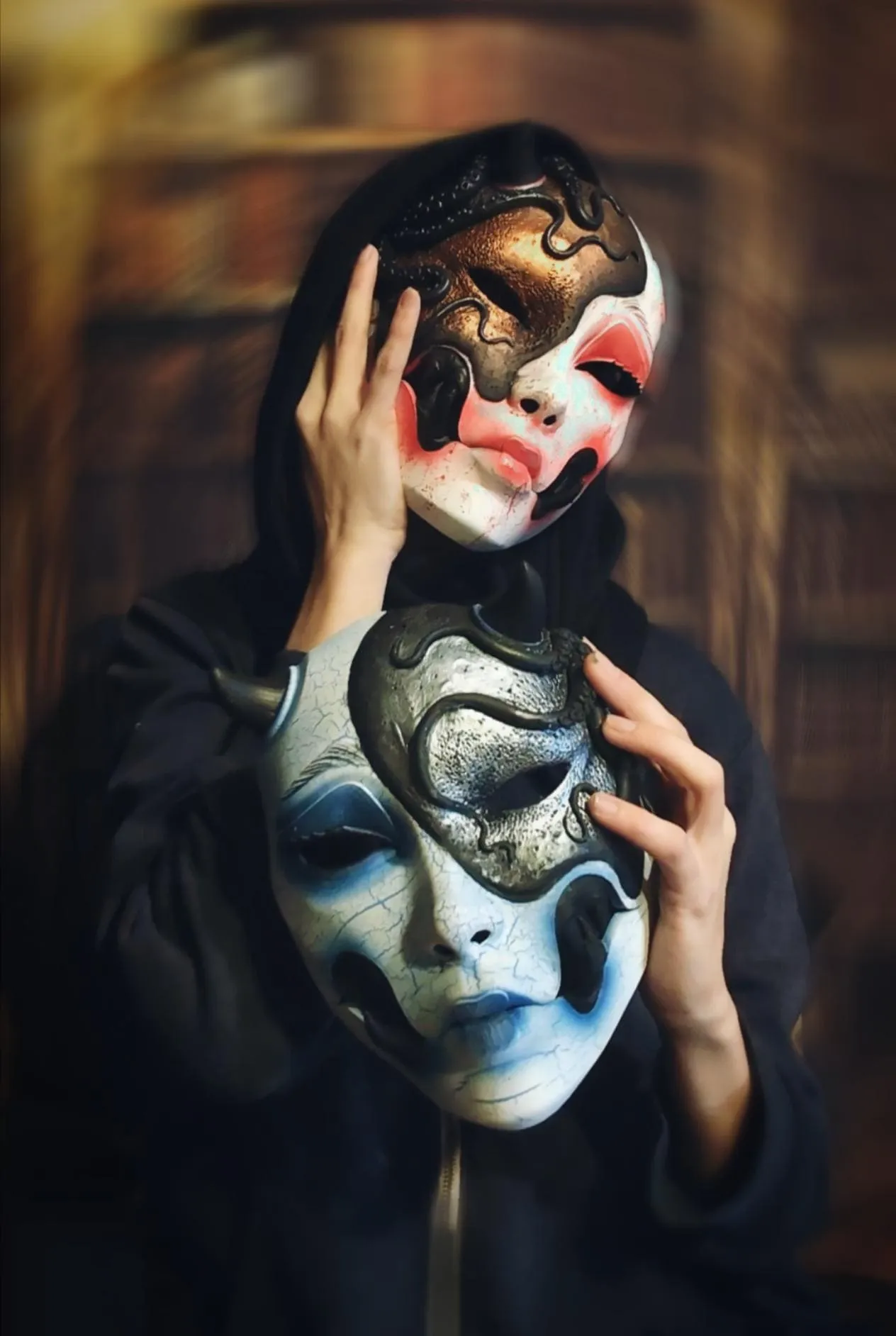
Browse the articulated moving-jaw masks for the commercial range, or see the wider handmade Japanese-inspired masks.
Conclusion
Kuchisake-onna has no single fixed biography. The 1978-1979 rumor wave is the best-documented core, while the samurai husband, weapons and escape rules vary between tellings. Contemporary Dai Yokai masks interpret the moment of concealment and reveal; they are not traditional Japanese ritual masks.
Sources and further reading
- Iikura Yoshiyuki: Japanese Urban Legends from the Slit-Mouthed Woman to Kisaragi Station
- Michael Dylan Foster: The Book of Yōkai
- CiNii Books: bibliographic record for Ehon Sayo Shigure, 1801
- USC Digital Folklore Archives: collected Kuchisake-onna variant
FAQ
Who is Kuchisake-onna?
Kuchisake-onna, the Slit-Mouthed Woman, is a Japanese urban legend that became a nationwide phenomenon in 1979. In the best-known versions, a woman wearing a face mask approaches a passer-by, asks whether she is pretty, then reveals a mouth slit from corner to ear and repeats the question.
What does Kuchisake-onna mean?
Kuchisake-onna is written 口裂け女 and translates as “Slit-Mouthed Woman.” The name describes the feature shared by the many versions of the legend: a woman whose mouth extends in a deep cut towards her ears.
Is Kuchisake-onna an ancient yōkai?
The best-documented Kuchisake-onna legend is modern and spread across Japan in 1979. Earlier Edo-period books contain women with slit mouths, but scholars have not established a direct line from those stories to the twentieth-century schoolyard rumor. She is best described as a modern urban yōkai or urban legend.
When did the Kuchisake-onna legend become popular?
The rumor appeared in Gifu Prefecture around the end of 1978 and spread nationwide during the first half of 1979. Folklorist Iikura Yoshiyuki links its rapid circulation to children sharing stories across school districts, especially through evening cram schools, followed by newspapers, magazines, radio and television.
What does Kuchisake-onna ask?
She usually asks “Watashi, kirei?” or “Am I pretty?” If the listener answers yes, she removes the mask and asks again, often as “Even like this?” The exact wording and outcome vary, but the repeated question and the concealed mouth are the legend’s most stable features.
How do people escape Kuchisake-onna in the stories?
There is no official answer. Regional and schoolyard versions mention replying “so-so” or “average,” distracting her with bekkō-ame candy, repeating the word “pomade,” or returning the question. These contradictions are evidence of a rumor changing as children and media retold it, not practical instructions.
Is Kuchisake-onna the same as Hannya or an onryō?
No. Hannya is a specific mask in Noh theater, while Kuchisake-onna is a modern urban-legend figure. Some retellings call her an onryō, or vengeful spirit, but that is one interpretation rather than a fixed classification shared by every version.
Is a Kuchisake-onna mask traditional?
Kuchisake-onna has no single traditional mask form comparable to a codified Noh mask. Modern masks, costumes and artworks interpret the face mask, slit mouth and reveal described in the legend. Dai Yokai pieces are contemporary handmade creations inspired by that imagery, not Japanese ritual objects.