Yūrei in brief
- A yūrei (幽霊) is the ghost or lingering spirit of a dead person in Japanese folklore.
- Yūrei are human dead; yokai is a broader category of supernatural beings and phenomena.
- An onryō is a vengeful spirit, but not every yūrei is vengeful or dangerous.
- White clothing, long hair, limp hands and a footless body are visual conventions, not universal rules.
- The kosodate-yūrei, or child-rearing ghost, shows that love and duty can hold a spirit near the living.
- Obon honours ancestral spirits and should not be reduced to a festival of wandering ghosts.
What is a yūrei?
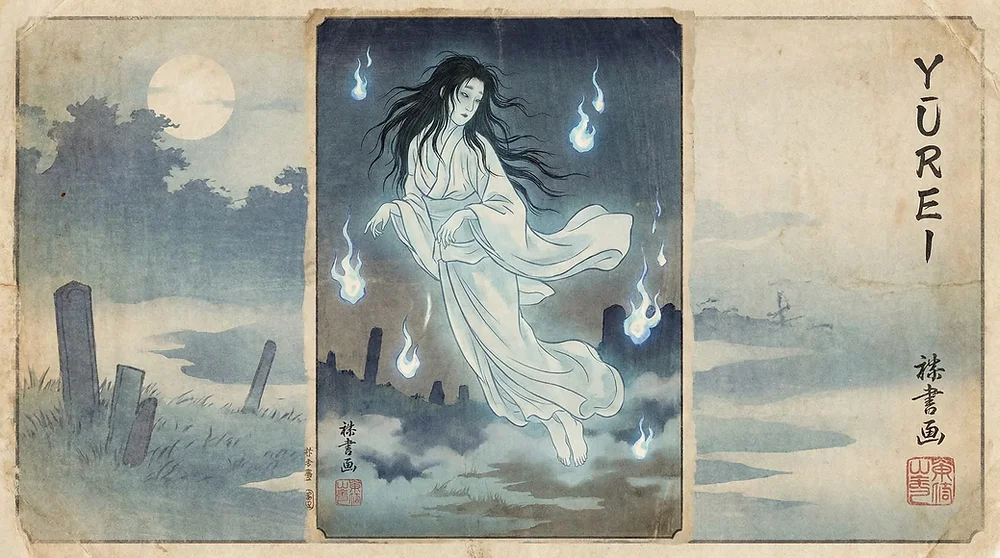
A yūrei is a Japanese ghost: the spirit of a dead person who appears among the living. Folklore may connect that appearance to an unjust death, grief, anger, love, an unresolved duty or words left unsaid. The word does not automatically mean an evil or vengeful spirit. Some yūrei terrify, while others mourn, warn or continue caring for someone.
An official guide to the ghost paintings at Zenshō-an explains that a spirit may remain because of a grudge, but also because of feelings it could not express to a loved one. This broader emotional range is essential: yūrei stories are not all revenge stories. See the Japan Tourism Agency guide to Enchō Matsuri and ghost paintings.
What does yūrei mean?
Yūrei is written 幽霊. The first character, yū (幽), suggests something faint, secluded or otherworldly; rei (霊) means spirit or soul. “Ghost” is the most useful English translation. The pronunciation is close to “yoo-ray.” The macron marks a long vowel, but yurei without the accent is common in search results and English writing.
The term describes the dead person’s spirit, not a biological monster or a single species with fixed powers. Details change across local legends, theatre, paintings, religion and modern horror. Treating every depiction as one rulebook makes the tradition seem tidier than it really is.
Yūrei, yokai, onryō and ancestors: what is the difference?
| Term | Plain-English meaning | Key distinction |
|---|---|---|
| Yūrei (幽霊) | Ghost of a dead human | Broad term; the spirit may be sorrowful, frightening, loving or vengeful |
| Yokai (妖怪) | Strange supernatural being or phenomenon | Wider category that includes creatures, shapeshifters, objects and uncanny events |
| Onryō (怨霊) | Vengeful or resentful spirit | Defined by harmful resentment; often discussed as a dangerous kind of ghost |
| Goryō (御霊) | Honoured powerful spirit | Often linked to an elite person who died unjustly and was ritually appeased |
| Ancestral spirit | A deceased family or community ancestor | Honoured through ritual and remembrance; not automatically a wandering yūrei |
The Metropolitan Museum of Art describes yūrei as a particular class of supernatural being within Japanese folklore, while yokai works as a more general classification. For the broader vocabulary, read our guide to yokai in Japanese folklore.
Why does a yūrei remain among the living?
Many stories give the ghost unfinished emotional or social business. A person may have died violently, been betrayed, lost a child, been denied justice or failed to deliver a final message. These narrative causes explain why the dead person appears, but they are not a universal religious formula for what happens after death.
Funeral rites and memorial practices can help restore order between the living and the dead, yet Japanese ideas about death draw from several religious and local traditions. It is therefore misleading to claim that every person follows one fixed path from reikon to sorei, or that incomplete rites automatically create a yūrei. Folklore, ritual and doctrine overlap without becoming identical.
How Japanese ghost imagery became recognisable
Modern audiences often picture a pale woman in white, with long loose black hair, hanging hands and no visible feet. That image owes much to Edo-period painting, kabuki theatre and later popular media. The traits communicate death and otherworldliness quickly, but a real legend does not need to contain every one of them.
| Visual trait | What it communicates | Important limit |
|---|---|---|
| White clothing | Association with death, burial and ritual purity | Not every ghost story specifies a white burial robe |
| Long loose hair | Disorder, mourning and a break from everyday appearance | Especially dominant in images of female ghosts |
| Limp hands | A suspended, powerless or floating body | A theatrical and pictorial pose rather than ghost anatomy |
| No feet | The figure no longer fully touches the material world | An artistic convention, not a universal folklore law |
| Hitaikakushi triangle | A shorthand sign of death in some modern images | Its history and use are not uniform across all periods |
A nineteenth-century ghost painting in the LACMA collection uses dishevelled hair and a footless body as identifying features. The museum traces this type of ghost painting to the eighteenth century and the influence of Maruyama Ōkyo. It is safer to call the missing feet a convention strongly associated with Ōkyo than to claim that one painter definitively invented every footless yūrei.
Main yūrei forms and related terms
English guides often present a rigid list of “types,” but Japanese ghost vocabulary is more fluid. Some words describe the ghost’s emotion, some its death or location, and others its later ritual status. The terms below are useful reading tools, not mutually exclusive species.
| Term | Common association | How to read it |
|---|---|---|
| Onryō | Resentment, revenge and harm | A spirit defined by powerful grievance; the model behind many horror antagonists |
| Ubume | A woman who died in pregnancy or childbirth | Stories centre on maternal grief, danger or care for a surviving child |
| Kosodate-yūrei | A child-rearing ghost | A dead mother returns to feed or protect her infant |
| Goryō | A powerful wronged person who is appeased | Historical and ritual category associated with calamity and pacification |
| Funayūrei | Ghosts at sea | Maritime apparitions that may approach boats and endanger sailors |
| Jibakurei | A spirit bound to a place | A modern and popular term for a ghost attached to the site of death or trauma |
The candy-buying mother: a kosodate-yūrei story
One of the most moving ghost-story patterns concerns a pale woman who visits a shop each night to buy sweets. When the shopkeeper follows her, she disappears near a grave. A living infant is then discovered beside its dead mother, sustained by the food she continued to provide after death. Love and duty, not hatred, keep this yūrei active.
Details vary by place and retelling. In an official version recorded by Kuwana City, the woman’s coins turn into leaves, the trail leads to a grave, and the child is found alive with the candy. The story family is commonly called kosodate-yūrei, the child-rearing ghost. Treating one version as the single original would erase those regional variants.
Famous yūrei in Japanese ghost stories
Oiwa, Okiku and Otsuyu are among the best-known names in Japanese ghost storytelling. Oiwa’s betrayal and disfigurement drive the revenge tragedy Yotsuya Kaidan. Okiku is linked to the well and the repeated counting of missing plates in Banchō Sarayashiki. Otsuyu belongs to the romantic and fatal Botan Dōrō, or Peony Lantern, tradition.
These stories survive through changing theatre scripts, prints, oral retellings, films and television. There is no single frozen version of each woman’s biography. What remains stable is their cultural role: the dead return because violence, betrayal, desire or injustice still affects the living.
Obon and ancestral spirits are not the same as yūrei
Obon is a period for welcoming and honouring ancestral spirits. Dates and customs differ, with observances in July in some areas and August in many others. Families may clean graves, make offerings and use welcoming and farewell fires. The atmosphere can be solemn, warm or communal rather than frightening.
The Association of Shinto Shrines’ overview of Obon describes ancestral welcome and send-off customs. This helps separate two ideas that English summaries often collapse: an honoured ancestor returning within ritual time is not automatically a restless yūrei. Both concern bonds with the dead, but their social meaning is different.
Does salt protect against yūrei?
Salt is associated with purification in several Japanese customs. It may appear near entrances, in ritual settings or after contact with death, depending on the tradition and context. Ghost fiction often turns this real symbolic association into a clear supernatural defence.
The accurate answer is therefore conditional: salt can function as a purifying or protective symbol, but Japanese folklore has no single universal rule stating that every yūrei is repelled by a pile of salt. Mori-shio, funeral customs and fictional exorcism should not be treated as one identical practice.
From ghost painting to J-horror
Modern J-horror inherited the yūrei’s pale face, dark hair, interrupted movement and unresolved grievance. Sadako in Ring and Kayako in Ju-On are contemporary screen figures shaped by the onryō tradition. Their technology, pacing and cinematic sound are modern, but their threat still comes from a wrong that death did not end.
That influence travelled far beyond Japan, which is why the long-haired female ghost now feels globally familiar. The visual code is powerful, but it should not replace the full tradition. Maternal ghosts, sea ghosts, theatrical heroines and honoured ancestors show a much wider relationship between memory and the dead.
Yūrei beside other Japanese supernatural figures
A yūrei begins as a dead human, which separates it from many famous yokai. The Yuki-Onna is usually treated as a supernatural snow woman rather than one named human ghost. Kuchisake-Onna is a modern urban legend whose origin changes between retellings. The Hannya mask represents a woman transformed by jealousy in Noh theatre; it is not a generic yūrei face.
Sources and further reading
- Japan Tourism Agency: Enchō Matsuri and Ghost Paintings, for yūrei-ga and the emotions that keep a spirit near the living
- LACMA: Ghost by Shibata Zeshin, for the footless figure and the influence of Maruyama Ōkyo
- The Metropolitan Museum of Art: Ghost in the Stacks, for yūrei within the wider supernatural vocabulary
- Association of Shinto Shrines: Obon, for ancestral welcome and farewell customs
- Kuwana City: the ghost candy story, for a documented regional kosodate-yūrei version
Conclusion
A yūrei is more than the long-haired ghost of modern horror. It is a dead human presence shaped by memory, injustice, grief, love or unfinished obligation. Paintings and theatre gave the yūrei a recognisable body; regional legends gave it many motives. Keeping those layers separate makes Japanese ghost folklore both clearer and more human.
FAQ
What is a yūrei?
A yūrei is the ghost or lingering spirit of a dead person in Japanese folklore. Stories often connect its presence to strong emotion, an unjust death, an unresolved obligation or a bond with the living. Yūrei are human dead, while yokai is a broader category of strange supernatural beings.
What does yūrei mean in Japanese?
Yūrei is written 幽霊. Yū suggests something faint, hidden or otherworldly, while rei means spirit or soul. In ordinary English, “ghost” is the clearest translation. The long vowel is shown by the macron in yūrei, although the spelling yurei is common online.
What is the difference between a yūrei and a yokai?
A yūrei is specifically the spirit of a deceased human. Yokai is a wider and less rigid category that includes animal shapeshifters, animated objects, monsters and unexplained phenomena. A kitsune or kappa is normally called a yokai; the ghost of a dead person is a yūrei.
Is an onryō the same as a yūrei?
An onryō is a vengeful spirit whose anger is believed to harm the living, so the term can describe a dangerous form of ghost. Yūrei is broader. A yūrei may be frightening, sorrowful, protective or simply attached to unfinished feelings; not every yūrei is an onryō.
Why are Japanese ghosts shown without feet?
The footless lower body is a visual convention strongly associated with Edo-period ghost painting and the influence of Maruyama Ōkyo. It helps viewers recognise that the figure does not belong fully to the physical world. It is an artistic code, not a universal rule in every yūrei story.
Are all yūrei dangerous?
No. Some tales concern vengeful spirits, but others focus on grief, love, duty or a message left unsaid. The kosodate-yūrei returns to care for a child, while other ghosts seek recognition or proper remembrance. Japanese ghost stories cover a wider emotional range than simple evil spirits.
Does salt repel yūrei?
Salt is used for purification in some Japanese religious and social customs, including practices connected with death. Folklore and popular media sometimes turn that association into a defence against ghosts. There is no single rule saying that every yūrei can be repelled by salt, and customs vary by context.
Do yūrei return during Obon?
Obon welcomes and honours ancestral spirits, usually through family and community customs. Those respected ancestors should not simply be treated as wandering yūrei. Ghost stories and Obon both concern relations between the living and the dead, but they belong to different ritual and narrative contexts.