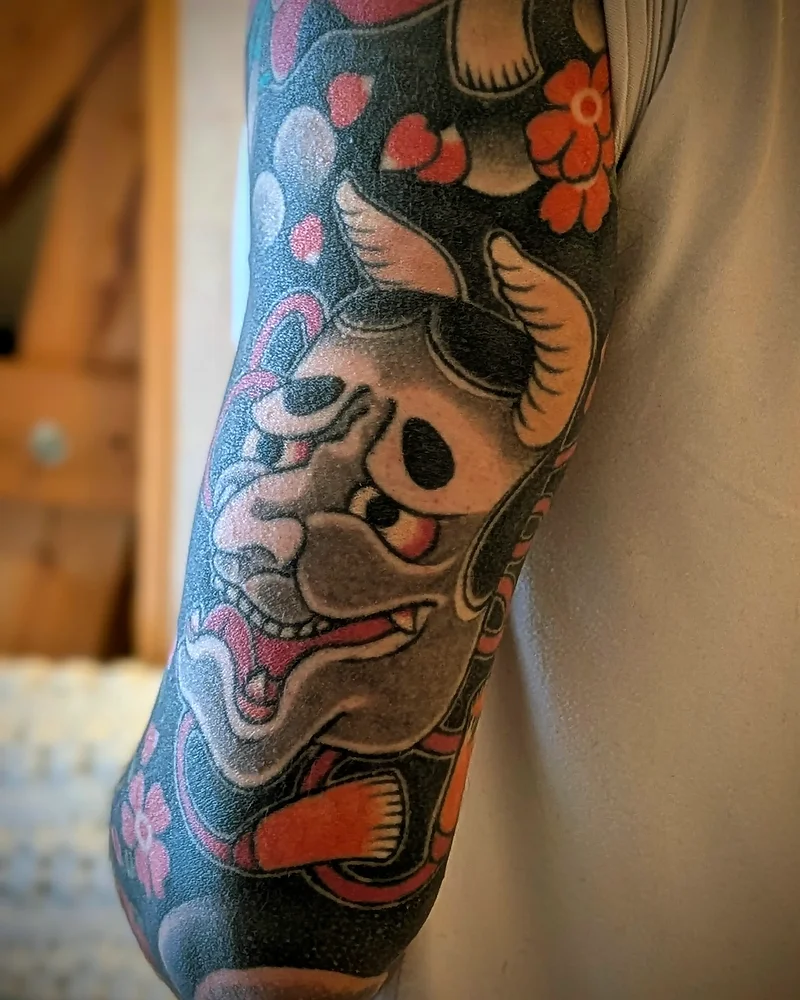
The Hannya is visually strong enough to survive many tattoo styles, but its horns and fangs are only half the story. The mask comes from Noh theater, where a female demonic spirit can remain furious and deeply sorrowful at the same time.
Start with the Hannya mask in Noh theater
Before assigning a tattoo meaning, identify the source motif. The British Museum describes Hannya as a woman transformed by jealous rage into a demon and records the mask in Aoi no Ue and Dōjōji. The horns, metallic eyes and teeth show danger, while the face can still communicate torment and grief.
The mask belongs to the female ghost and spirit category of Noh masks. The Noh mask overview and the Dai Yokai guide to Hannya mask meaning provide the theatrical context that should come before modern tattoo interpretations.
What can a Hannya tattoo mean?
A tattoo does not inherit one fixed definition. The most defensible readings begin with the character represented by the mask, then add the wearer’s own reason and the artist’s composition.
| Theme | How to read it carefully |
|---|---|
| Jealousy and resentment | Directly connected with female demonic spirits represented by Hannya in Noh |
| Grief and inner conflict | Supported by the mask’s ability to look threatening and sorrowful |
| Transformation | A modern personal reading based on the change from human emotion to demonic form |
| Warning | A possible reminder of what uncontrolled attachment or anger can become |
| Protection or self-mastery | A personal or tattoo-culture interpretation, not an automatic theatrical meaning |
Is a Hannya tattoo good, bad or protective?
The image is not satanic and it is not simply an evil face. It comes from Japanese theater, not Christian demonology. It also does not guarantee luck or protection. Some tattooers and wearers use Hannya as a protective-looking image or a symbol of mastering difficult emotions, but that interpretation should be stated as personal rather than presented as an ancient universal rule.
Do Hannya tattoo colors have fixed meanings?
No. Pale, red and darker Hannya masks have context within Noh, but the common online chart that turns every color into a precise stage or personality is too rigid. Modern tattoos also use blue, purple, black, gold and mixed palettes for contrast, skin tone, style or personal preference.
| Color choice | Useful question to ask |
|---|---|
| Pale or white | Is the design referencing a theatrical mask, contrast or a quieter emotional tone? |
| Red | Is red being used for intensity, the artist’s palette or a specific story? |
| Black and grey | How will the eyes, teeth and horns stay readable without color separation? |
| Blue, purple or gold | Is the color symbolic for the wearer or mainly part of the visual design? |
Hannya tattoo pairings: story before rules
There is no trustworthy list of universally approved and forbidden pairings. A snake, temple bell or flames can reference the Dōjōji story. Flowers can add season, contrast or personal meaning. Waves, koi and dragons can also work when the artist builds a coherent composition; they are not automatically “wrong” beside Hannya.
| Motif | Possible connection |
|---|---|
| Snake or temple bell | A direct route to the Dōjōji story |
| Flames | Intensity or the burning-bell episode, depending on the design |
| Flowers | Contrast, season or a personal association chosen for the composition |
| Waves, koi or dragon | A broader Japanese-style composition whose narrative should be discussed with the artist |
| Oni mask | A contrast between a broad ogre-like being and the specific female Noh spirit represented by Hannya |
Placement depends on scale and anatomy
A back, thigh, upper arm or chest can provide enough space for the eyes, teeth, horns and surrounding motifs. Smaller placements need a simpler drawing. There is no rule that a Hannya must face downward or sit on one specific body part. The artist should adapt the mask to movement, viewing direction and the rest of the tattoo.
Hannya tattoo versus Oni tattoo
Hannya is a specific female demonic mask from Noh. Oni is a broader category of ogre-like supernatural beings. A tattoo can stylize either face, but the source stories remain different. If the design loses the Hannya’s narrow face, two horns, metallic-looking eyes and female spirit context, it may read more like a generic Oni mask.
Before you book the tattoo
Choose an artist whose portfolio shows strong Japanese-style composition, then discuss the exact story, scale, palette and surrounding motifs. Ask which meanings come from Noh, which come from modern tattoo practice and which are personal. Do not copy another artist’s finished tattoo. Use museum objects, theater references or a physical mask to study form and shadow.
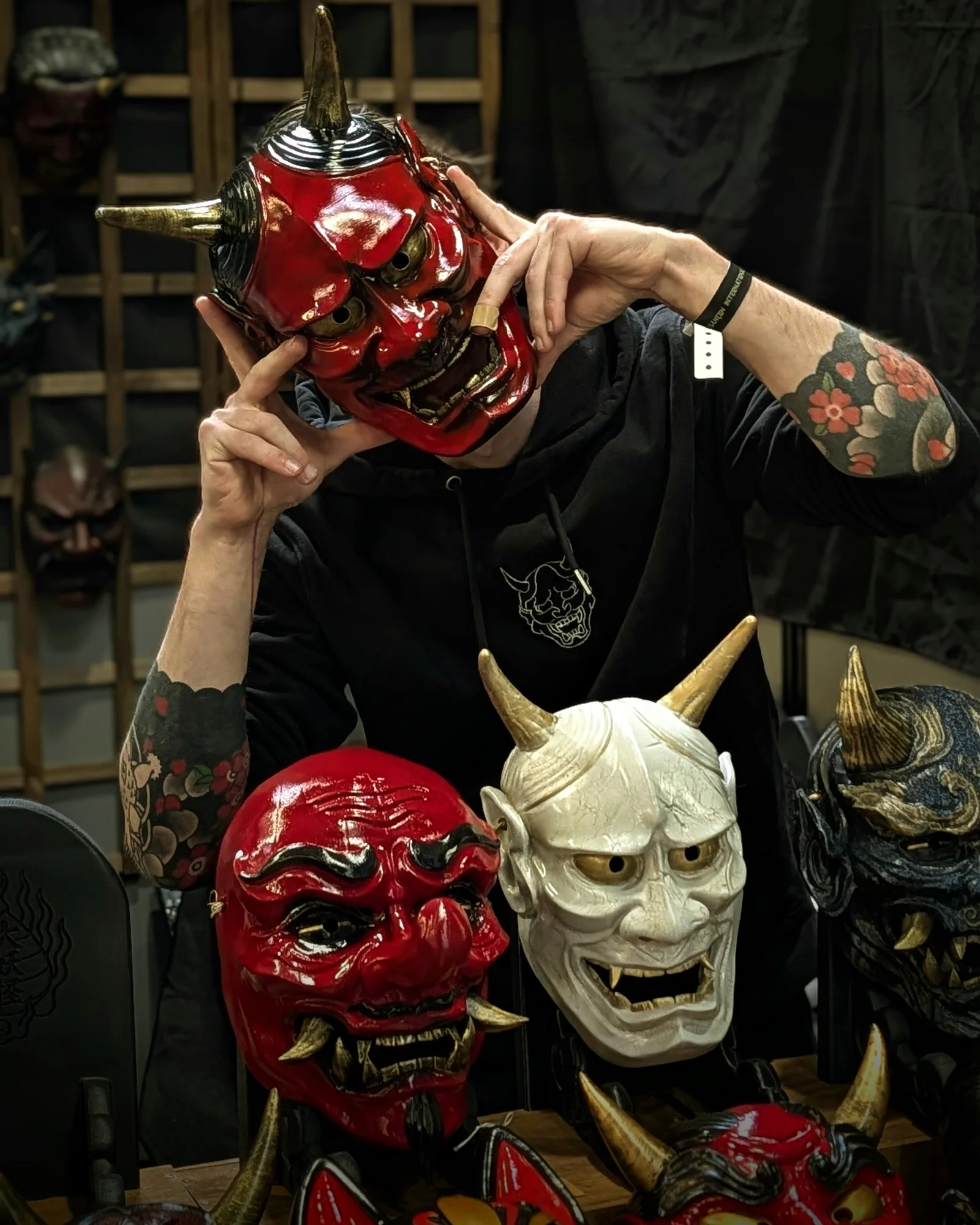
Dai Yokai makes contemporary Hannya masks in Brittany, France. PETG bases are sanded, primed, painted, varnished and finished by hand. They are Japanese-inspired craft pieces, not authentic Noh performance masks. Browse the handmade Hannya mask collection or the wider Japanese tattoo motif guide for visual context.
Sources and context
- The Noh, overview of Noh mask categories
- Aoi no Ue, roles and masks
- Dōjōji, roles and masks
- British Museum, Edo-period Hannya theater mask
- Dai Yokai, introduction to irezumi history and terminology
FAQ
What does a Hannya mask tattoo mean?
A Hannya mask tattoo usually draws on the Noh image of a female spirit transformed by jealousy, resentment or obsessive attachment. In tattooing, it can also express grief, inner conflict or personal transformation. Those later meanings depend on the wearer and artist; the mask does not carry one automatic message.
Is a Hannya mask tattoo good or bad?
It is neither automatically good nor bad. The theatrical Hannya is frightening, but her face also preserves suffering and humanity. A tattoo may focus on destructive emotion, warning, resilience or visual drama. The meaning comes from the composition and the wearer’s reason for choosing it, not from a universal moral label.
Is the Hannya mask a demon or a woman?
In Noh, Hannya is a female demonic or vengeful spirit, often understood as a woman transformed by overwhelming resentment or obsession. The horns and fangs show the demonic form, while the brow and eyes can still convey grief. That human and demonic tension is central to the motif.
Can a man get a Hannya tattoo?
Yes. The mask represents a female character in Noh, but a tattoo motif is not restricted to one gender. Men and women can choose it for its theatrical history, emotional complexity or visual form. What matters is understanding the source image and agreeing on a clear personal interpretation with the tattoo artist.
Does a Hannya tattoo bring bad luck or protection?
There is no reliable universal rule that a Hannya tattoo brings bad luck or guarantees protection. Some modern wearers and tattooers give it a protective or self-mastery meaning, while others focus on jealousy, grief or transformation. Treat those as personal interpretations, not an automatic power of the image.
Do Hannya tattoo colors have fixed meanings?
No single chart applies to every Hannya tattoo. Pale, red and darker Hannya masks have theatrical context, but modern tattoos also use blue, black, gold and other palettes for artistic reasons. Ask the artist what each color does in the specific composition instead of relying on a universal internet color code.
What can be paired with a Hannya tattoo?
Snakes, temple bells or flames can reference Dōjōji; flowers, waves, koi, dragons or other masks can create different visual stories. None of these combinations is automatically approved or forbidden. A specialist tattooer should make the scale, direction, season and surrounding motifs coherent across the whole design.
Where should a Hannya tattoo be placed?
Placement depends on the size of the mask, the level of detail and whether the design belongs to a sleeve, chest panel, back piece or smaller composition. Large areas preserve the eyes, teeth and horns more clearly. Let the tattoo artist adapt the drawing to your anatomy instead of forcing a fixed placement rule.