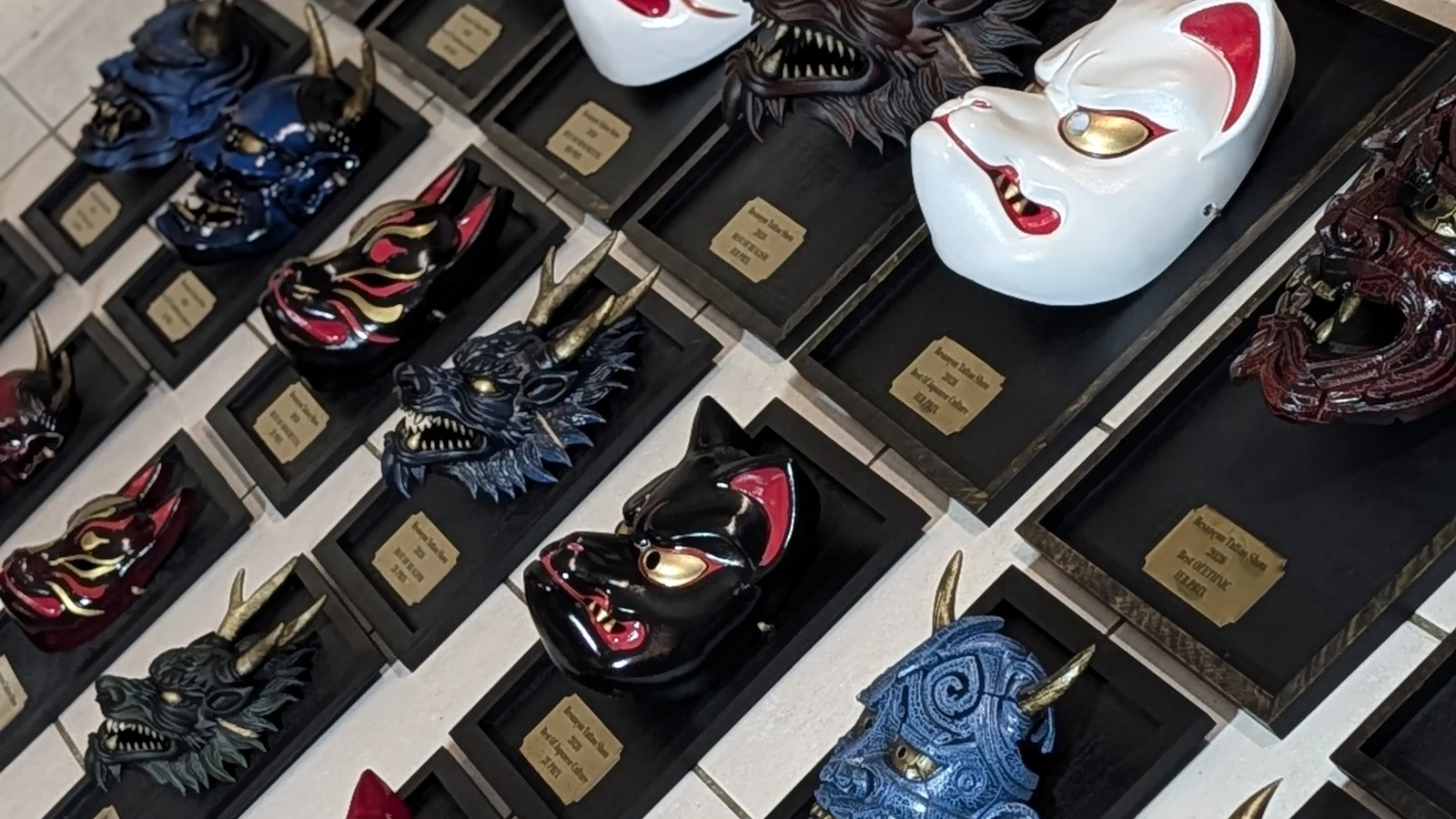
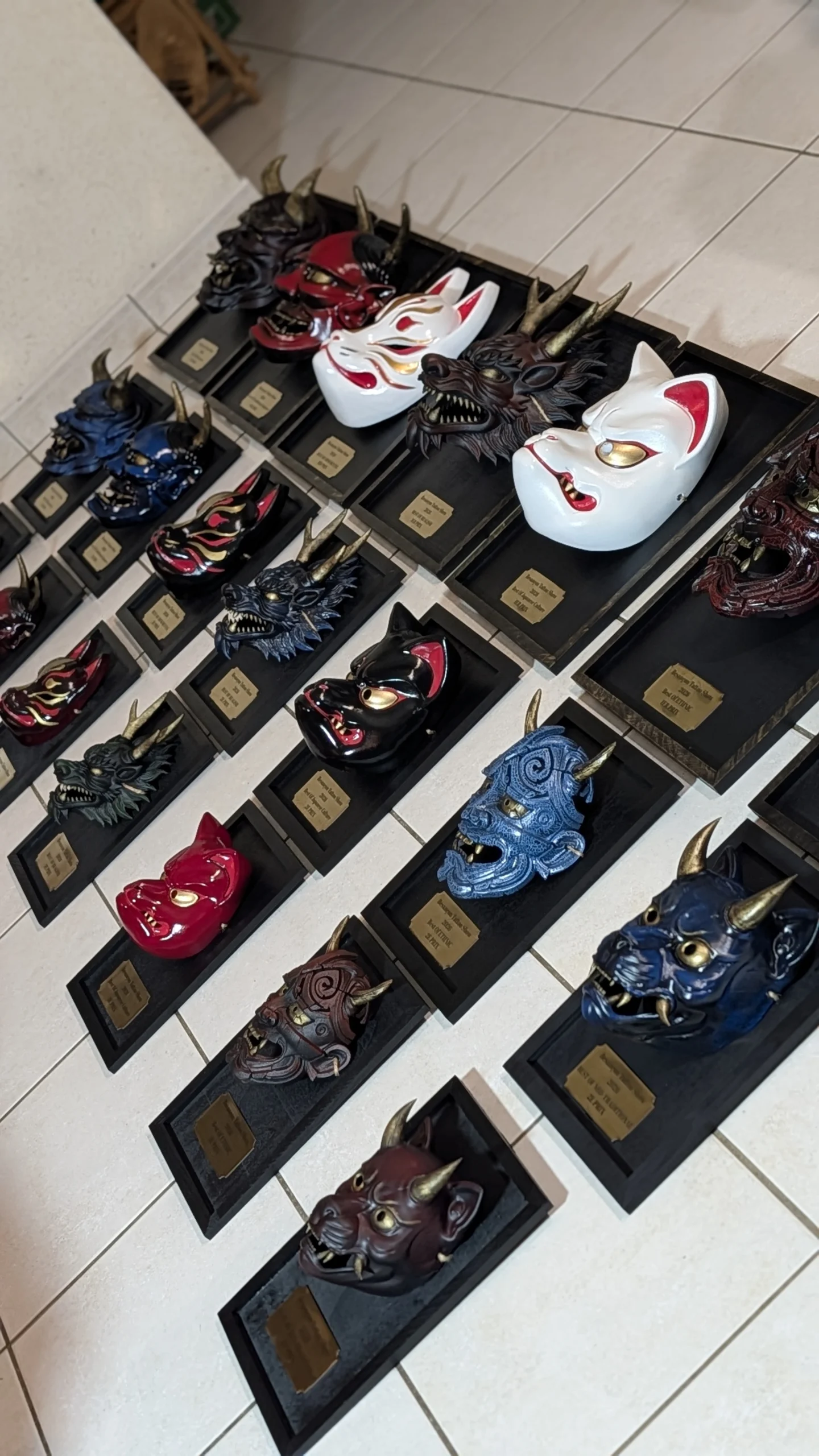
Dai Yokai produced 21 hand-finished mask trophies for seven selected BITS 2026 tattoo-contest categories, with first-, second- and third-place pieces for each design. The two-month commission combined PETG bases, hand sanding, acrylic paint, varnish, matte-black wooden frames and engraved brass plaques. This case study explains the scope, production sequence and information an organiser needs before requesting a similar batch.
| Project fact | Verified scope |
|---|---|
| Event | 13th Besançon International Tattoo Show |
| Dates and venue | 21-March 22, 2026, Micropolis in Besançon |
| Event scale | More than 270 tattoo artists announced by the organiser and venue |
| Dai Yokai commission | 21 trophies across seven selected categories |
| Placement system | First, second and third place |
| Workshop lead time | About two months |
What was BITS 2026?
The Besançon International Tattoo Show, usually shortened to BITS, held its 13th edition at Micropolis on 21 and March 22, 2026. The venue and organiser announced more than 270 tattoo artists. The official programme also stated that contest winners would receive a trophy specially created for the occasion.
That official programme is important because it separates the event schedule from the workshop commission. BITS announced several competition awards over the weekend. Dai Yokai did not make a three-piece series for every award on that list. The order covered seven selected style categories, with three placements for each one. That is how the total reached 21.
The commission: seven designs, three placements each
The project began after a conversation with Jean-Marc Bassand, connected with the organisation of BITS and the Lille Tattoo Convention. What sounded like a possible future collaboration quickly became a live order for the upcoming Besançon event. The practical challenge was not simply to paint 21 objects. It was to create a coherent award family that remained readable by category and placement while retaining the finish of an individual Dai Yokai piece.
| Selected BITS category | Assigned Dai Yokai design |
|---|---|
| Best of Japanese Culture | Traditional Kitsune |
| Best of Traditional Japanese | Traditional Hannya |
| Best of Ethnic | Hannya Kezurata |
| Best of Realism | Dragon |
| Best of Black Work | Hannya Wood |
| Best of Ornamental | New Kitsune |
| Best of Neo-Traditional | Oni |
The model-to-category mapping was a workshop design decision, not a claim that each figure historically represents that tattoo style. The Traditional Kitsune gave the Japanese Culture set an immediately recognizable visual reference. The Dragon offered detailed scales and surface depth for Realism. Hannya Wood used a dark ground with gold details for Black Work. The remaining models created contrast across the full display without breaking the family resemblance.
What made these trophies different from standard cups?
A conventional cup communicates rank efficiently, but it usually says little about the event itself. For BITS, the mask became the main visual object while the frame and plaque supplied the formal award information. The aim was a piece that could still work on a tattoo-studio wall after the ceremony, rather than an event prop designed only for the stage.
The Japanese-inspired imagery also connected with motifs frequently seen in tattoo culture, including Hannya, Kitsune, Oni and dragons. That connection is visual and contemporary. These trophies are not antique objects, reproductions of Noh masks or claims of traditional Japanese manufacture. They are Dai Yokai designs made and finished in Brittany for a French tattoo convention.
How the 21-piece batch was produced
A one-off mask can move through the workshop as soon as the next stage is available. A 21-piece order requires a queue. PETG base production, sanding, paint layers, drying, varnish, frames, plaques and final checks all have different durations. If one stage is started too late, the delay propagates through every piece that depends on it.
| Stage | Work completed | Batch-control point |
|---|---|---|
| 1. Scope | Confirm seven designs, three placements and delivery date | Freeze the quantity before production |
| 2. PETG bases | Produce each mask base, roughly 6-26 hours per model | Track model and intended placement |
| 3. Surface preparation | Hand-sand each base progressively | Check edges, horns and visible layer marks |
| 4. Color | Apply acrylic color in several coats | Keep repeated color treatments consistent |
| 5. Protection | Apply final varnish after drying | Inspect sheen and missed areas under direct light |
| 6. Mounting | Prepare matte-black wooden frames | Verify stability and visual alignment |
| 7. Identification | Laser-engrave brass plaques | Match event, category and placement to the correct mask |
| 8. Handover | Final inspection, packing and delivery to Micropolis | Count all 21 pieces before departure |
The workshop ran several stages at once: some bases were in production while other masks were being sanded or left to dry. The wooden supports were purchased, then sanded and painted matte black. Each brass plaque was engraved with an xTool laser engraver and matched to its event category and placement. The plaques were not decorative extras; they carried the information that turned a wall piece into an unambiguous award.
The main batch-production risks
The first risk was capacity. A model requiring 26 hours of machine time occupies more than a full day before sanding begins. The second was finish consistency: three placement sizes should look related even though their surfaces and handling differ. The third was identification. With seven categories and three ranks, a correctly finished mask can still become the wrong trophy if its plaque is paired incorrectly.
The response was to treat the order as a tracked series. Work was grouped by stage, drying time was planned instead of treated as idle time, and the category-placement pairing stayed visible through mounting. The project also required a rework buffer. A damaged finish near the deadline affects delivery, not only one item, because the ceremony cannot wait for a replacement.
What the project changed inside the workshop
Before BITS, most Dai Yokai work moved through the workshop as individual pieces or small groups. Twenty-one trophies forced a more systematic flow: preparing repeated materials together, anticipating drying windows, checking stock earlier and separating creative choices from repeatable operations. That does not make the objects industrial. It makes the handmade stages easier to control when a fixed event date cannot move.
Jérémy delivered the trophies to Micropolis and met the winners during the event. Several said they intended to display the masks in their studios. That is a workshop recollection, not a measured satisfaction study, but it supports the original design goal: an award that remains visible after the convention. Winners planning a permanent installation can use the guide to displaying a Japanese-inspired mask on a wall or stand.
What an event organiser should prepare before requesting a quote
A custom trophy enquiry is easier to assess when the operational information arrives with the visual idea. Quantity and deadline determine whether the batch is feasible. Categories, placement levels and dimensions determine how many variants must be tracked. Approved logo files and exact award wording reduce plaque errors. Delivery location and access dates determine packing and transport constraints.
| Information to provide | Why it matters |
|---|---|
| Event name, date and venue | Sets the fixed production and handover deadline |
| Total number of trophies | Determines capacity and batch size |
| Categories and placement levels | Defines the identification matrix |
| Target dimensions or display limits | Affects model choice, frame size and transport |
| Approved logo and exact plaque wording | Prevents branding and engraving errors |
| Preferred colors or event references | Clarifies what must be shared across the series |
| Delivery address and access window | Defines packing, shipping or hand-delivery constraints |
| Budget range | Keeps the proposed scope realistic |
BITS 2026 is evidence that a 21-piece series can be completed, not a promise that every quantity or deadline is automatically available. Organisers can contact the Dai Yokai workshop with the information above for a feasibility review. For the broader visual range, see the handmade Japanese-inspired mask collection.
Sources and verification
Event dates, edition number and artist count were checked against the official BITS presentation and the Micropolis event page. Contest scheduling and the statement that trophies were specially created for the occasion come from the official programme. Production timing, materials, category mapping and workshop observations come from Dai Yokai’s project record.
FAQ
How many trophies did Dai Yokai make for BITS 2026?
Dai Yokai made 21 trophy masks: seven commissioned category designs, each produced in three sizes for first, second and third place.
Why were there 21 trophies?
The commission covered seven selected contest categories with three placements per category. Seven multiplied by three produced a batch of 21 pieces.
Did the 21 trophies cover every contest category in the official programme?
No. The official BITS programme also listed Old School, Best of Day and Best of Show awards. The Dai Yokai commission covered seven selected style categories, not every award announced for the weekend.
Which mask models were used for the trophies?
The seven models were Traditional Kitsune, Traditional Hannya, Hannya Kezurata, Dragon, Hannya Wood, New Kitsune and Oni. Each model was assigned to one commissioned category.
What were the BITS trophies made from?
Each trophy combined a PETG mask base, hand sanding, acrylic paint and protective varnish with a matte-black wooden frame and an engraved brass plaque.
How long did the batch take to make?
The 21-piece batch took about two months from confirmation to delivery. Individual PETG bases required roughly 6 to 26 hours of machine time before the hand-finishing stages.
Are these reproductions of historical Japanese masks?
No. They are contemporary Japanese-inspired workshop pieces drawing on figures such as Kitsune, Hannya, Oni and dragons. They should not be described as historical artefacts or traditional theatre masks.
Can an event organiser request custom trophy masks?
An organiser can contact Dai Yokai to discuss feasibility. A useful request includes the event date, number of awards, categories, placement levels, desired dimensions, branding files, delivery location and budget range.