Gashadokuro is a Japanese giant skeleton yokai said to form from the bones and resentment of people who died in war, famine or isolation without proper burial. It hunts lone travellers at night. Despite its ancient-looking image, the named creature is modern: its description appeared in print in 1966, then borrowed visual power from an Edo-period Kuniyoshi skeleton.
Gashadokuro in short
| Question | Short answer | Important nuance |
|---|---|---|
| What is it? | A giant skeleton yokai made from many neglected dead | The familiar named creature is a modern creation |
| When did it appear? | An early description was published in 1966 | Older beliefs about restless dead people helped the idea feel traditional |
| What does the name mean? | Often read as rattling bones plus ‘skull’ | The spelling 餓者髑髏 is a later interpretive form |
| What is the Kuniyoshi link? | His giant skeleton became the visual model | The print itself is not an old Gashadokuro illustration |
| How does it attack? | It seizes lone travellers and crushes or bites them | Abilities vary between modern books and adaptations |
| What is the warning? | Ringing or buzzing in the ears | This belongs to modern popular lore, not a documented ancient rule |
What is a Gashadokuro?
Gashadokuro is imagined as a collective monster rather than the ghost of one person. Bones from people who died without burial gather into an enormous body, animated by resentment. Modern descriptions often name soldiers left on battlefields and victims of famine or abandonment.
The creature turns social death into physical scale. One forgotten body can disappear; thousands of forgotten bodies become impossible to ignore. This makes Gashadokuro visually simple but conceptually powerful: a human skeleton enlarged until neglect itself becomes the monster.
What does Gashadokuro mean and how is it pronounced?
A practical pronunciation is gah-shah-doh-KOO-roh. The name is commonly explained through gasha-gasha, an onomatopoeic rattling or clattering sound, and dokuro, ‘skull’. The image is therefore not just a large skeleton but one whose bones announce it as they move.
The kanji spelling 餓者髑髏, sometimes translated as ‘starving skeleton’, is not proof of an ancient written tradition. Sources use different spellings, including the phonetic がしゃどくろ. The sound and image became stable through twentieth-century publishing.
Was Gashadokuro invented in 1966?
The earliest documented form of the modern creature is usually traced to occult writer Morihiro Saito. A 1966 issue of Bessatsu Shōjo Friend included a description of a giant rattling skeleton assembled from people who died alone in fields. It already contains the core idea now associated with Gashadokuro.
Shigeru Mizuki illustrated the creature soon afterward, and yokai books of the late 1960s and 1970s spread the concept. Arifumi Sato's 1972 illustrated encyclopedia helped connect the description with Kuniyoshi's giant skeleton. This is why Gashadokuro feels traditional even though its publication history is recent.
Calling it modern does not make it culturally false. Yokai culture has always changed through oral tales, prints, books, stage performance, manga and television. The accurate distinction is between a recent named creature and the much older themes it recombines.
Kuniyoshi's skeleton is not originally Gashadokuro
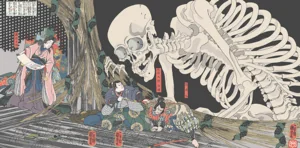
Around 1844, Utagawa Kuniyoshi created the triptych commonly called Takiyasha the Witch and the Skeleton Spectre. Princess Takiyasha, daughter of the rebel Taira no Masakado, summons a huge skeleton at the ruined palace of Sōma to threaten the warrior Ōya Tarō Mitsukuni.
The British Museum catalogues the scene as a skeleton spectre summoned by Takiyasha. It does not identify the creature as Gashadokuro. The print predates the 1966 name by more than a century. Later illustrators reused its anatomy and scale, and the association became so strong that the print is now frequently mislabeled online.
That correction matters. Kuniyoshi supplied the iconic visual language, but the modern writers supplied the name, origin from unburied bones and behaviour. Gashadokuro emerged when those two histories were joined.
Older ideas behind the modern giant skeleton
Japan had long-standing stories about vengeful spirits, haunted battlefields, improper death and the need to remember the dead. A person who dies violently or without ritual care can remain socially and spiritually unsettled in many tales. Those ideas made the new giant skeleton immediately legible.
Gashadokuro is still not simply a giant yūrei. A yūrei normally preserves the identity of one dead person. Gashadokuro removes individual identity and combines many deaths into one body. For that distinction, continue with the guide to Japanese yūrei and vengeful ghosts.
Gashadokuro powers, scale and warning signs
| Trait | Common modern description | Reliability |
|---|---|---|
| Size | Many times taller than a person, often ten metres or more | No single canonical measurement |
| Body | Bones and grudges of numerous unburied dead people | Core modern description |
| Movement | Night wandering with clattering bones | Common explanation of the name |
| Attack | Grabs, crushes, bites or drinks the blood of travellers | Varies by illustrated source |
| Warning sign | Ringing or buzzing in the ears | Repeated in modern retellings |
| Weakness | Usually none; escape is advised | Talismans and combat rules depend on the adaptation |
How do you survive a Gashadokuro?
The usual modern answer is to notice the ringing in your ears and flee. Unlike a Kappa, Gashadokuro is not built around a clever etiquette rule or obvious bargain. Its size makes direct combat pointless, and popular descriptions rarely provide one consistent weakness.
Claims about specific Shinto talismans, invisibility or guaranteed protective rituals should be treated cautiously unless tied to a named publication. Gashadokuro's lore changed quickly across books, manga, games and online summaries. Variation is part of the creature's modern history.
What does Gashadokuro represent?
Gashadokuro can be read as an image of mass death, failed remembrance and accumulated grievance. The monster is strongest when that interpretation remains connected to its publication history. It was not an ancient moral lesson passed unchanged for centuries; it is a modern image that reorganized older anxieties.
Its success also shows how visual culture creates folklore. One unforgettable Kuniyoshi composition, joined to a new name and story, became convincing enough to feel older than it was. Gashadokuro is therefore both a yokai and a case study in how yokai are made.
From the giant skeleton to a Hannya mask
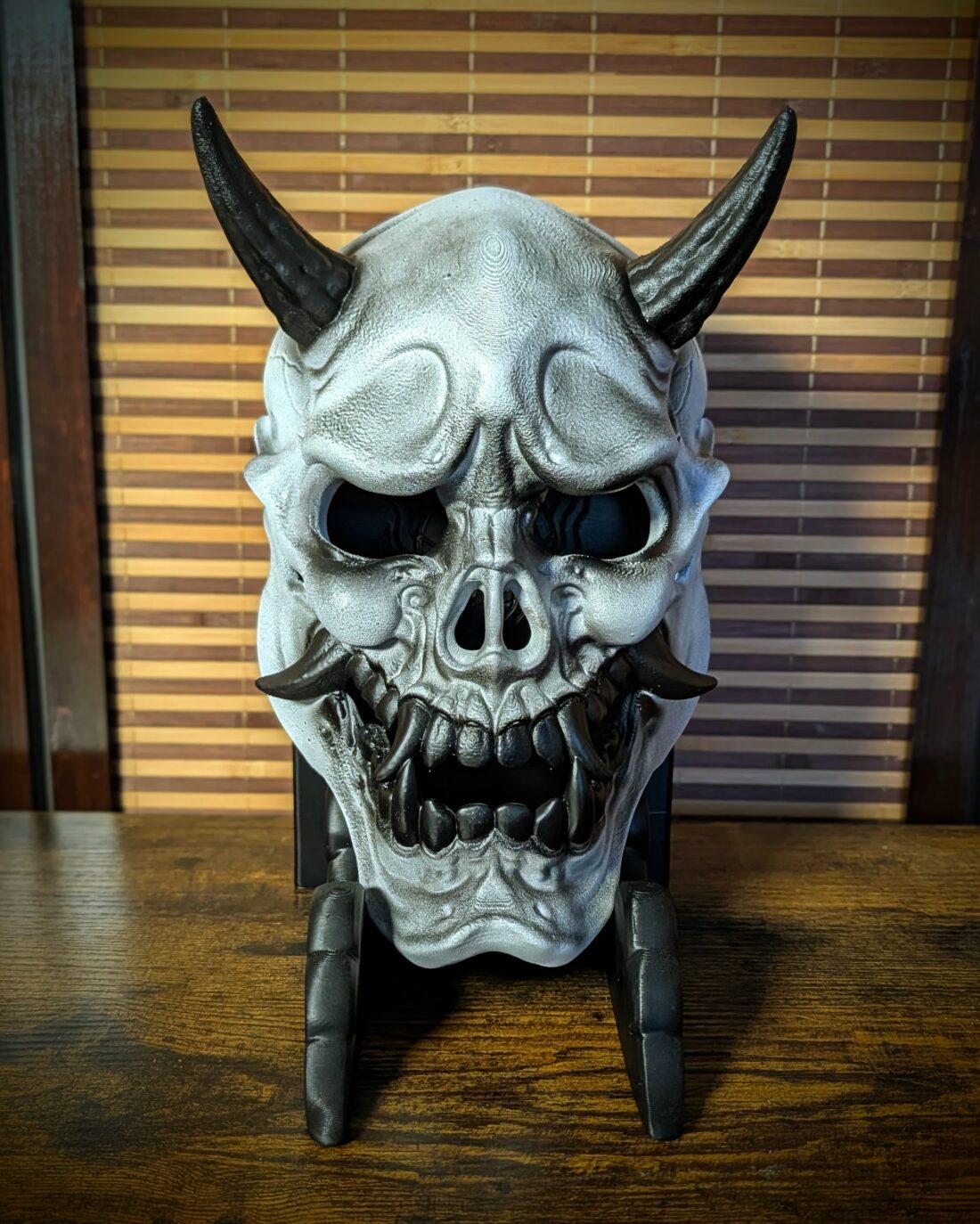
A Gashadokuro is not a traditional mask. It is a giant skeleton, defined by its scale and by the absence of a human face. The Gashadokuro Hannya Mask takes a different route: it keeps the horns and outline of a Hannya, then replaces its facial features with open eye sockets, exposed bone and a skeletal jaw.
This contemporary piece is not presented as an authentic depiction of the yōkai. Its name describes a visual meeting point between a Hannya mask and the skeletal imagery associated with the Gashadokuro.
Sources and historical references
The modern publication history is discussed in a Japanese Journal of Religious Studies article and summarized with source notes by the Yokai Encyclopedia. Kuniyoshi's original scene can be checked in the British Museum collection record and a Japan Foundation exhibition guide.
FAQ
What is a Gashadokuro?
Gashadokuro is a modern Japanese yokai imagined as a gigantic skeleton formed from the bones and resentment of people who died in war, famine or isolation without proper burial. It wanders at night and attacks solitary travellers. The familiar creature was shaped by twentieth-century yokai publishing, not an ancient regional legend.
How do you pronounce Gashadokuro?
A practical English pronunciation is gah-shah-doh-KOO-roh. The name is commonly linked to gasha-gasha, the rattling sound of bones, and dokuro, meaning skull. Spellings such as Gasha-dokuro also appear, but Gashadokuro is the standard form used in English-language searches.
Is Gashadokuro an ancient Japanese yokai?
No, not in the form known today. The name and basic description appeared in Japanese youth horror publishing in 1966 and spread through later illustrated yokai books. Older Japanese culture already contained ideas about restless dead people and battlefield spirits, but the named giant skeleton is a modern synthesis.
Who created Gashadokuro?
Research traces an early printed description to occult writer Morihiro Saito in a 1966 issue of Bessatsu Shōjo Friend. Shigeru Mizuki and later yokai encyclopedias helped establish its visual form and popularity. Because the creature developed through several publications, it is safer to describe a publication history than one isolated invention.
Is Kuniyoshi's giant skeleton a Gashadokuro?
Not originally. Utagawa Kuniyoshi's circa-1844 triptych shows Princess Takiyasha summoning a giant skeleton spectre at the ruined palace of Sōma. The print predates the name Gashadokuro by more than a century. Its dramatic skeleton later became the main visual model for the modern yokai.
How tall is Gashadokuro?
There is no canonical measurement shared by every source. Modern descriptions often call it many times taller than a person, sometimes about ten metres or more, and large enough to seize a traveller in one hand. Exact heights belong to individual books, games or adaptations rather than one fixed tradition.
What warning announces a Gashadokuro?
Modern retellings often describe ringing or buzzing in the ears before the giant skeleton appears. Escape, rather than combat, is the usual advice. This warning sign is part of the creature's modern popular lore and should not be presented as a rule documented in centuries-old Japanese folklore.
Is Gashadokuro a yurei?
Gashadokuro is usually classified as a yokai rather than one individual yurei. A yurei is generally the ghost of a specific dead person, while Gashadokuro combines many abandoned bones and grudges into one monstrous body. The creature still draws on older Japanese fears surrounding restless and neglected dead people.