What is a tanuki yokai?
A tanuki is a real Japanese raccoon dog. In folklore, its supernatural counterpart is called a bake-danuki: a shape-changing yokai that can imitate people, disguise objects and create deceptive sights or sounds. Some stories are comic and generous, while others are unsettling or violent. The smiling lucky statue is therefore one modern branch of a much wider tradition.
The real animal behind the folklore
The real tanuki is a raccoon dog, a small East Asian canid with a dark facial mask, short legs and a thick coat. It is not a raccoon and not a badger. Raccoon dogs are omnivorous and can live in forests, rural edges and areas close to human settlements.
Scientific naming is not completely uniform. The Integrated Taxonomic Information System lists the Japanese raccoon dog as Nyctereutes viverrinus, while the Tokyo Zoological Park Society uses Nyctereutes procyonoides viverrinus. “A Japanese raccoon dog in the genus Nyctereutes” is accurate without pretending the taxonomy is settled everywhere.
What is a bake-danuki?
Bake-danuki (化け狸) means a transformed or shape-changing tanuki. These supernatural animals appear in written sources and local legends across Japan. Their abilities can include taking human form, imitating a monk or woman, transforming objects, producing mysterious drumming and altering what a traveller thinks they see.
The Ohio State University Center for Folklore Studies describes the tanuki as both a real animal and a folklore figure famous for changing its own form and even the perceived landscape. This distinction matters: not every real tanuki is a yokai, and not every bake-danuki story gives the creature the same personality.
What powers are attributed to tanuki?
- Shapeshifting into people, animals or ordinary objects.
- Creating illusions that confuse travellers or merchants.
- Imitating voices, monks or familiar figures.
- Producing mysterious rhythms known as tanuki-bayashi or belly drumming.
- Using disguise for humour, survival, revenge or deception depending on the story.
- Appearing as named regional figures, especially in traditions from Shikoku and Sado.
Modern summaries often turn all of this into one cheerful trickster profile. Folklore is less tidy. A bake-danuki may embarrass someone, reward kindness, frighten a community or cause serious harm. Regional names and stories are more reliable than a single universal character sheet.
What does tanuki symbolize in Japan?
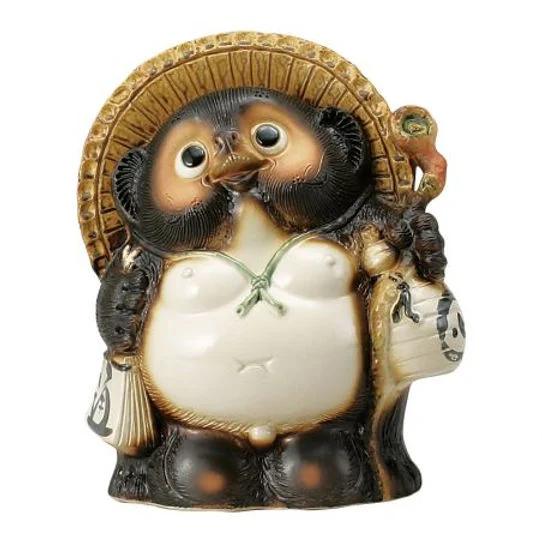
Today, tanuki imagery often suggests good fortune, hospitality, pleasure and commercial success. This positive reading is especially strong in the ceramic figures placed near restaurants, bars and shops. Their broad smile and rounded shape feel welcoming, while the account book and money pouch make the business association explicit.
That modern symbolism does not erase older stories. Earlier bake-danuki can be deceptive, uncanny or threatening. “Tanuki means good luck” is therefore useful for the Shigaraki statue, but too narrow as a definition of every tanuki in Japanese folklore.
The Shigaraki tanuki statue
Shigaraki in Shiga Prefecture is one of Japan’s historic pottery centres. Its kilns have an eight-century ceramic tradition, but the familiar round-bellied tanuki statue is not an unchanged ancient religious object. The modern figure became widely recognized in the twentieth century and gained national attention after Emperor Shōwa visited Shigaraki in 1951.
A 2026 feature from the Government of Japan documents the current Shigaraki interpretation of the statue and its eight auspicious features, called Hassō Engi. The list below follows that source rather than mixing it with unrelated modern symbolism.
The eight lucky symbols of the tanuki statue
| Feature | Auspicious meaning |
|---|---|
| Bamboo hat | Protection from trouble and misfortune |
| Large eyes | Careful observation of the surroundings |
| Smile | Warmth and comforting behaviour |
| Round belly | Calmness and decisive judgement |
| Sake bottle | Virtue and not lacking food or drink |
| Account book | Trustworthiness in business |
| Large tail | Seeing matters through to a good conclusion |
| Money pouch | Financial good fortune |
These features explain why the statue is placed at an entrance: it presents an ideal host who is observant, dependable, welcoming and fortunate. The meanings belong specifically to the modern Shigaraki good-luck figure, not to every historical picture of a bake-danuki.
Why are tanuki shown with large testicles?
The exaggerated scrotum is a long-established comic and auspicious motif in tanuki art. It appears in small sculptures and prints, sometimes stretched into a sail, blanket, drum or carrying cloth. The image is playful rather than pornographic, but it also developed associations with expansion and financial luck.
A Science Museum Group netsuke, dated broadly between 1701 and 1900, documents the enlarged-scrotum motif in a historical object. The popular gold-leaf explanation is widely repeated, but its exact development is difficult to reduce to one proven event. It is safer to present it as a traditional explanation, not an uncontested origin.
The motif is also separate from the eight features listed in the recent Government of Japan description, which uses a money pouch for financial fortune. Different lists and statue designs exist, so an article should name the source behind the version it presents.
Bunbuku Chagama: the tanuki tea-kettle
Bunbuku Chagama is the best-known tanuki and tea-kettle story, but there is no single version. A popular fairy tale tells of a tanuki transformed into a kettle, unable to endure the fire, then earning money by performing. Some retellings begin with a rescued tanuki; others emphasize a poor dealer, a priest or a showman.
Morinji Temple’s own tradition is different. It tells of Shukaku, a mysterious attendant associated with a kettle that could provide endless hot water during a large ceremony in 1570. After revealing an animal form, Shukaku eventually left the temple. Later popular publishing helped spread the familiar half-tanuki, half-kettle performer.
Calling Bunbuku simply “the teapot that spreads happiness” hides these layers. The story is better understood as a group of temple, literary and children’s-tale versions linked by an uncanny kettle and a tanuki or mujina figure.
Are tanuki always friendly?
No. Many modern tanuki are jolly, clumsy or generous, but older tales can be cruel. In Kachi-kachi Yama, a tanuki commits murder and is punished by a rabbit. Other local legends describe named bake-danuki that deceive travellers, lead people astray or command supernatural followers.
This range is useful for interpretation. The tanuki is not the permanent “good” counterpart to an evil fox. Both animals can help, trick, possess or frighten people depending on the source. Humour and danger often exist side by side in yokai traditions.
Tanuki and Kitsune compared
| Point | Tanuki / bake-danuki | Kitsune |
|---|---|---|
| Real animal | Japanese raccoon dog, a canid in the genus Nyctereutes | Fox, usually the red fox in Japanese contexts |
| Folklore ability | Shapeshifting, illusion, imitation and mysterious drumming | Shapeshifting, illusion, possession and fox-fire |
| Religious connection | Mostly regional folklore and later good-luck imagery | Strongly associated with Inari as fox messengers, though fox lore is broader |
| Typical modern image | Round, humorous, sake-loving and fortunate | Elegant, intelligent and mysterious |
| Historical range | Comic, helpful, deceptive or dangerous | Helpful, sacred, seductive, deceptive or dangerous |
| Are they fixed rivals? | No universal rivalry | No universal rivalry |
For the fox side of the comparison, read the sourced guide to Kitsune meaning, folklore and masks. For the broader category, see what yokai are in Japanese folklore.
Tanuki in art and popular culture
Tanuki have moved easily between folklore, prints, netsuke, ceramics, songs, animation and games because their identity is flexible. A realistic animal can become a monk, a kettle, a giant comic figure or a shop mascot while remaining recognizable through its face, belly and tail.
The Metropolitan Museum of Art’s late nineteenth-century painting Tanuki Viewing Its Reflection in Water connects the animal with transformation and beguiling disguise. Modern works such as Pom Poko continue that tradition by using shape-changing tanuki to address the loss of their habitat.
Tanuki imagery and Dai Yokai
Dai Yokai approaches tanuki as part of the wider visual world of Japanese folklore, not as an “authentic ritual” object. The workshop is based in Brittany, France, and its pieces are contemporary creations shaped, prepared, painted, varnished and finished by hand.
Browse the current collection of Japanese yokai-inspired figures for available creatures and decorative pieces. Availability changes, and the collection page remains the source for current models rather than this cultural article.
Sources and further reading
- Government of Japan: Shigaraki-yaki Tanuki, for the modern statue and its eight auspicious features
- Tokyo Zoological Park Society: Raccoon Dog, for the real animal
- Ohio State University Center for Folklore Studies, for shapeshifting and landscape-deception traditions
- Morinji Temple: Bunbuku Chagama, for the temple version of the kettle story
- Science Museum Group: Tanuki netsuke, for a historical enlarged-scrotum object
Conclusion
Tanuki means more than one smiling statue. It begins with a real Japanese raccoon dog, expands into regional bake-danuki stories, and later becomes a national symbol of hospitality and good fortune through Shigaraki pottery. Keeping those layers separate makes the folklore more accurate and the familiar figure more interesting.
FAQ
What is a tanuki yokai?
A tanuki is a real Japanese raccoon dog, while a bake-danuki is its supernatural folklore counterpart. Bake-danuki can change shape, imitate people and create strange sights or sounds. Their stories range from comic tricks to dangerous encounters, so the cheerful lucky statue is only one part of the tradition.
Is a tanuki a raccoon or a badger?
Neither. A tanuki is a raccoon dog, a member of the canid family. Its dark facial markings resemble a raccoon, and older translations sometimes used “badger” or the overlapping name mujina. Scientific references differ on whether the Japanese population is a separate species or a subspecies, but all place it in the genus Nyctereutes.
What does a tanuki symbolize in Japan?
Modern Shigaraki tanuki statues commonly symbolize good fortune, hospitality, sound judgement and business trust. Their hat, eyes, smile, belly, sake bottle, account book, tail and money pouch form eight auspicious features. Older bake-danuki stories are more varied and can portray the animal as funny, deceptive, helpful or dangerous.
Why do tanuki statues have large testicles?
The exaggerated scrotum is an old comic and auspicious visual motif found in Japanese art and small sculptures. It became associated with expansion and financial luck. A popular explanation links it with gold-leaf production using tanuki skin, but the exact development of the image should not be reduced to one fully proven origin story.
What are the eight symbols on a Shigaraki tanuki statue?
The eight auspicious features are a hat for protection, large eyes for observation, a smile for warmth, a round belly for calm decisions, a sake bottle for virtue and sustenance, an account book for trust, a tail for seeing things through, and a money pouch for financial fortune.
What is Bunbuku Chagama?
Bunbuku Chagama is a tanuki and tea-kettle story associated with Morinji Temple in Gunma. The temple tradition describes an inexhaustible kettle and a mysterious attendant named Shukaku. Later popular versions turned the story into a comic tale about a tanuki-shaped kettle that performs for an audience.
Are tanuki and kitsune rivals?
Not as a universal rule. Both appear as animal shapeshifters, and stories sometimes compare their powers, but Japanese folklore does not give them one fixed rivalry or opposite personality chart. Kitsune have strong links with Inari traditions; tanuki stories are often regional and include disguise, belly drumming, drinking, trickery and good fortune.
Are tanuki yokai dangerous?
Some stories are playful, but not all are harmless. Bake-danuki can deceive travellers, impersonate people or cause frightening events, and Kachi-kachi Yama presents a brutally dangerous tanuki. Modern statues and popular characters usually emphasize humour and luck. The safest answer is that their behaviour changes with the tale and region.