Japanese yokai include monsters, animal shapeshifters, strange presences and supernatural phenomena. This guide introduces ten famous figures: Oni, Kitsune, Hannya, Tengu, Kappa, Tanuki, Yūrei, Jorōgumo, Nekomata and Gashadokuro. Hannya and Yūrei are included as closely related folklore figures, not because every scholar places them inside the same category.
What is a yokai?
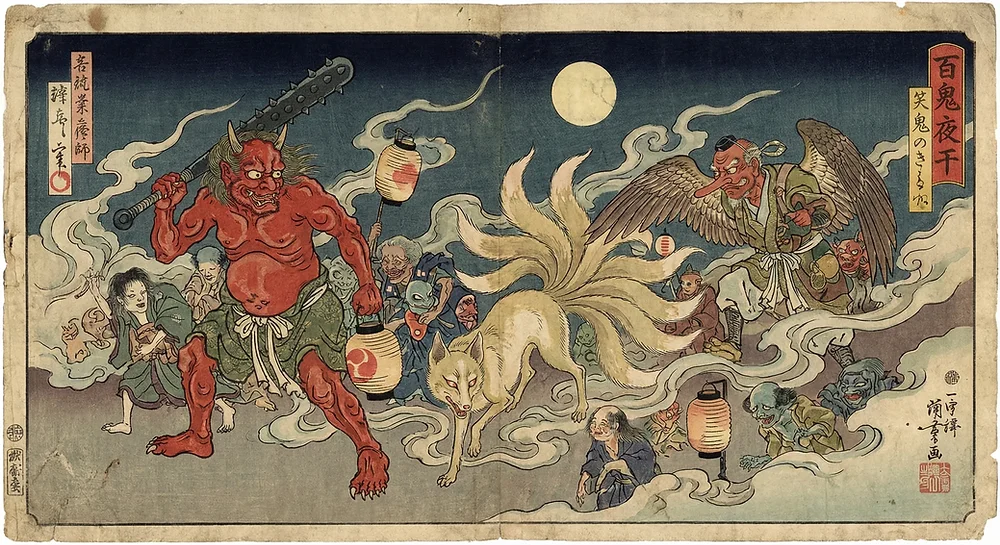
Yokai is a flexible Japanese term for uncanny beings, transformations and phenomena that do not fit ordinary explanation. It can cover river creatures, mountain beings, shapeshifting animals, animated objects and presences linked to particular places. “Monster,” “spirit” and “demon” each translate only part of the idea.
The category has never been a fixed scientific catalogue. Oral stories, local traditions, picture scrolls, Edo-period printed books, theatre, manga and television have all changed how yokai are named and pictured. The Japan Foundation’s Yokai Parade catalogue is a useful visual history of that development.
The 10 figures at a glance
| Figure | Type | Known for | Important nuance |
|---|---|---|---|
| Oni | Ogre-like supernatural being | Horns, iron club, punishment and protection | Not simply the Japanese version of a Christian devil |
| Kitsune | Shapeshifting fox | Transformation, intelligence and Inari associations | Shrine foxes are Inari’s messengers, not Inari itself |
| Hannya | Noh theatre mask | Jealousy, rage and suffering | A related folklore image, not technically a yokai species |
| Tengu | Mountain supernatural being | Pride, martial legends and sacred mountains | Bird-like and long-nosed forms have different histories |
| Kappa | Water yokai | Head dish, rivers, sumo and cucumbers | Behaviour and survival rules vary by region |
| Tanuki | Animal shapeshifter | Tricks, transformation and modern lucky statues | The tanuki is also a real Japanese raccoon dog |
| Yūrei | Human ghost | White burial clothing, grief and unfinished obligations | Related to yokai, but a more specific category |
| Jorōgumo | Spider-woman yokai | Seduction, music and entangling prey | No single version fixes every power or age |
| Nekomata | Cat yokai | Forked tail, speech and supernatural control | Related to but not simply a stronger Bakeneko |
| Gashadokuro | Modern giant skeleton yokai | Unburied dead and overwhelming scale | The named creature dates from twentieth-century publishing |
How this top 10 was chosen
There is no official ranking of the “best” or “strongest” yokai. This list favours figures that help an English-language reader understand the range of Japanese supernatural culture: monsters and ghosts, animals and masks, dangerous beings and protective ones, old regional traditions and a modern creation.
The order is therefore a reading path, not a power scale. Each entry links to a longer guide where the history is more complex than one paragraph can show.
1. Oni (鬼): the ogre that can punish or protect
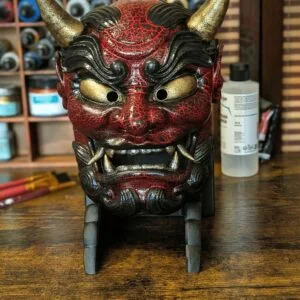
Oni are large, powerful beings usually shown with horns, fangs, wild hair and an iron club. They can punish the wicked, guard Buddhist hells or attack human communities. During Setsubun, people throw beans while calling for Oni to leave and good fortune to enter.
The English word “demon” is convenient but incomplete. Oni are not one-to-one equivalents of the Christian devil. Protective Oni faces also appear in architectural forms such as onigawara roof tiles. Read the full guide to Oni meaning, masks and folklore.
2. Kitsune (狐): the shapeshifting fox
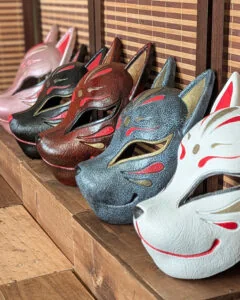
Kitsune are foxes whose folklore identities range from helpful messengers and intelligent companions to dangerous tricksters. Older or more powerful foxes may transform into human form, create illusions or gain several tails. The familiar nine-tailed fox is one branch of a much wider fox tradition.
Fox statues at Inari shrines represent the deity’s messengers; the fox is not automatically the god Inari. The simple split between “good Zenko” and “evil Nogitsune” also hides many local and literary variations. Continue with Kitsune mask meaning and fox folklore.
3. Hannya (般若): the Noh mask of jealousy and pain
Hannya is not technically a yokai species. It is a Noh theatre mask used for a woman transformed by jealousy, rage and suffering. Horns, metallic eyes and a divided mouth make the face look demonic, but the mask can also reveal sorrow when the performer lowers it.
Hannya belongs in this guide because it is constantly confused with Oni and appears beside yokai in tattoos, masks and popular culture. Its meaning comes from theatre rather than a catalogue of roaming creatures. See Hannya mask meaning, Noh and symbolism.
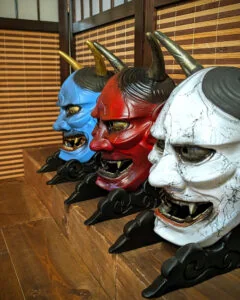
4. Tengu (天狗): the mountain being of pride and discipline
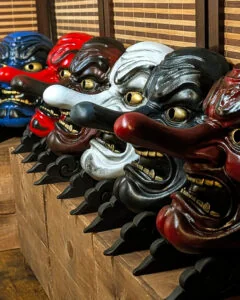
Tengu are associated with mountains, religious practitioners, pride and martial legends. Earlier forms are strongly bird-like; later Daitengu are often shown with a red face and long nose. Their role can shift from disruptive enemy of Buddhism to guardian, teacher or powerful mountain presence.
The famous story of Sōjōbō teaching the young warrior Minamoto no Yoshitsune helped connect Tengu with swordsmanship. That does not make every Tengu a benevolent swordmaster. Explore the distinctions in the Tengu mask and folklore guide.
5. Kappa (河童): the dangerous river child
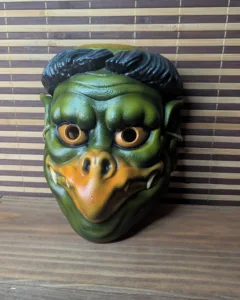
Kappa are water-dwelling yokai associated with rivers, ponds and the danger of drowning. A familiar modern image gives them a turtle-like shell, webbed limbs and a dish on the head that must stay wet. They are also linked to cucumbers, sumo and strict ideas of obligation.
The story that a polite bow makes a Kappa spill the water from its dish is well known, but it is not a universal rule in every region. Some Kappa are violent; others keep promises or teach useful knowledge. Read the Kappa yokai folklore guide.
6. Tanuki (狸): the real animal turned shapeshifter
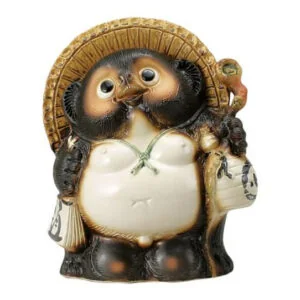
Tanuki are real Japanese raccoon dogs and also major figures in shapeshifting folklore. Tales describe them imitating people, objects, sounds or entire scenes, usually for mischief rather than pure cruelty. Their transformations can be clever, comic or unexpectedly melancholy.
The ceramic Tanuki outside restaurants is a modern lucky image, often carrying a sake bottle and promissory note. Its exaggerated anatomy is tied to visual wordplay around money and fortune, not a general rule for every older Tanuki story. Read more about Tanuki folklore and lucky statues.
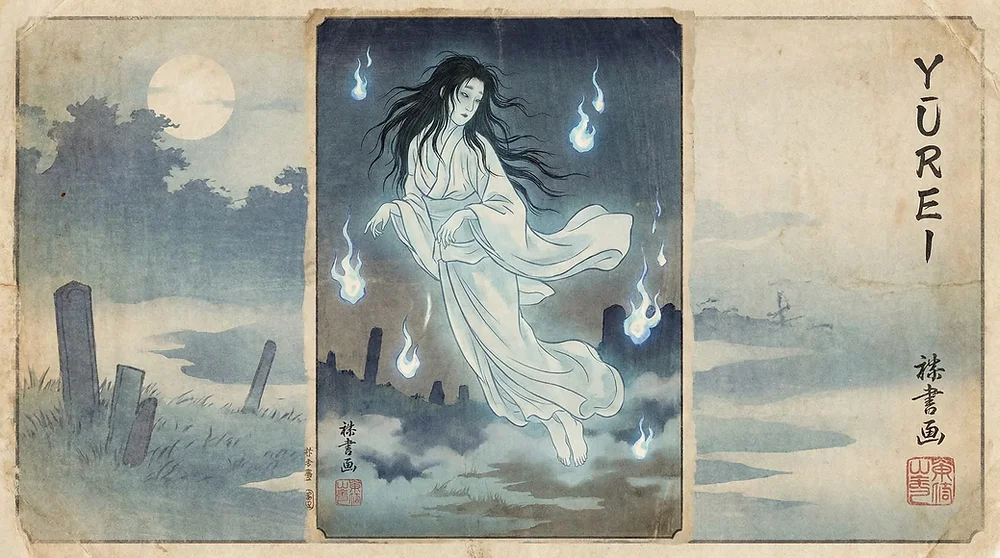
7. Yūrei (幽霊): the human ghost
A Yūrei is the spirit of a dead human being, often unable to leave because of grief, anger, love or an unfinished obligation. The white burial kimono, long black hair and floating body became a powerful visual convention through theatre and art, then shaped modern Japanese horror.
Yūrei are related to yokai culture but remain a more specific category: the dead person usually keeps an individual identity and story. Oiwa, Okiku and Otsuyu are famous examples. Continue with the guide to Yūrei and Japanese ghost folklore.
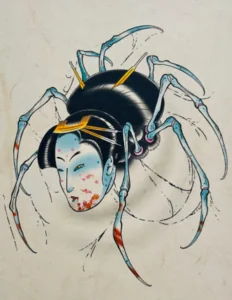
8. Jorōgumo (絡新婦): the spider-woman
Jorōgumo is a spider-woman yokai whose stories combine beauty, entanglement and concealed predation. She may appear as a woman, use music or conversation to distract a victim, then reveal the spider behind the disguise. The name is written with characters commonly read as “entangling bride.”
Online summaries often give her one fixed species, age and hunting method. The older material is less uniform, and Jorōgumo stories overlap with local spider legends. Read the sourced guide to Jorōgumo folklore and the spider-woman legend.
9. Nekomata (猫又): the fork-tailed cat yokai
Nekomata are supernatural cats often pictured with a forked tail in Edo-period and later imagery. This visual convention does not describe every earlier mountain-cat account. Domestic and mountain traditions describe them speaking, walking upright, creating strange fires or controlling the dead. Their behaviour ranges from vengeance to eerie independence.
Nekomata and Bakeneko overlap, but one is not simply the “stronger cousin” of the other. Bakeneko is a broad transforming-cat category, while the forked tail is the clearest visual marker of Nekomata. See the full comparison of Nekomata and Bakeneko cat yokai.
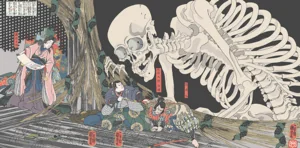
10. Gashadokuro (がしゃどくろ): the modern giant skeleton
Gashadokuro is imagined as an enormous skeleton formed from people who died without burial, especially through war, famine or abandonment. Modern retellings describe it hunting lone travellers at night. Its exact height, powers and weaknesses are not fixed.
The named creature is modern: an early printed description appeared in 1966. Utagawa Kuniyoshi’s circa-1844 giant skeleton supplied a powerful visual model, but the print was not originally a Gashadokuro scene. This correction is explained in the Gashadokuro origin guide.
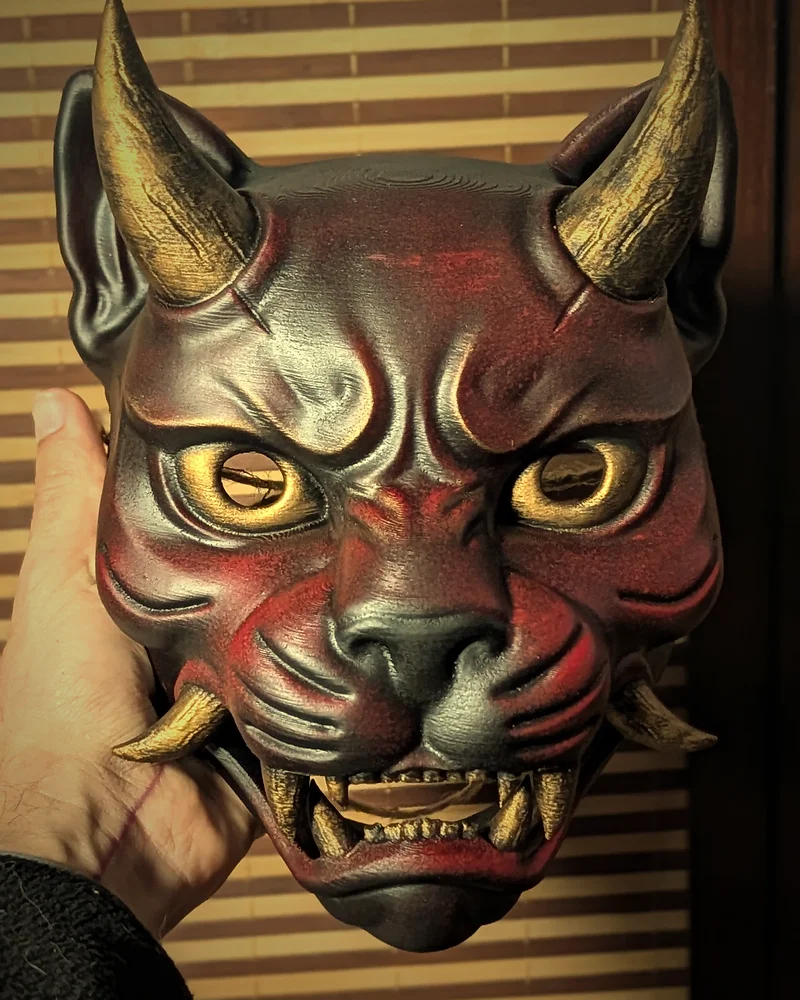
From folklore to contemporary handmade masks
Dai Yokai creates contemporary masks inspired by Japanese folklore, theatre shapes and visual culture. The pieces are designed in Brittany, printed in PETG, sanded, primed, painted, varnished and finished by hand. They are not Japanese ritual objects or historical reproductions.
Different figures produce different visual languages: handmade Oni masks emphasise force, Kitsune masks use fox geometry, Hannya masks balance rage and sorrow, and Tengu masks work through the long-nosed mountain figure.
Two confusions at the workshop stand
Jérémy often hears visitors call a Kitsune mask “Inari.” He explains that Inari is the deity and the fox its messenger. He also remembers confusing Oni and Hannya when he began: research taught him to distinguish a folklore figure from a mask used in nō theatre. He still encounters that confusion at conventions. These are observations from his own stand, not a survey of every visitor.
Sources and further reading
- Japan Foundation, Yokai Parade: Supernatural Monsters from Japan
- Museum of International Folk Art, Yokai: Ghosts and Demons from Japan
- Etnografiska museet, Yokai: Spirits of Japan
FAQ
What is a yokai?
A yokai is a strange supernatural being, presence or phenomenon in Japanese folklore. The category can include animal shapeshifters, monsters, animated objects and unexplained occurrences. It does not map neatly onto the English words “demon” or “ghost,” and different sources draw its boundaries differently.
What are the most famous Japanese yokai?
Oni, Kitsune, Tengu, Kappa and Tanuki are among the most widely recognised yokai. Yuki-onna, Rokurokubi and Nekomata are also common in modern lists. This guide includes Hannya and Yūrei as related folklore figures because English-language readers frequently encounter them beside yokai, although their categories are different.
Which yokai is the strongest?
Japanese folklore has no official power ranking. An Oni can represent overwhelming force, a Kitsune may win through transformation, and a Gashadokuro is enormous in modern descriptions. Comparing them as game characters removes the regional stories and different roles that give each figure its meaning.
Are yokai good or evil?
Yokai are not divided into one fixed good-versus-evil system. Some harm people, some play tricks, some protect places and some simply explain an unsettling event. Even one figure can change between regions and periods. Kappa, Tengu, Kitsune and Tanuki all have both dangerous and helpful traditions.
What is the difference between a yokai and a yūrei?
Yokai is a broad and flexible category for supernatural beings and phenomena. A yūrei is specifically the ghost of a dead human being, often held in the world by grief, anger, love or unfinished obligations. English summaries sometimes group them together, but the distinction is useful.
Are Oni and Hannya the same?
No. Oni are ogre-like supernatural beings found in legends, religious imagery and festivals. Hannya is the name of a Noh theatre mask representing a woman transformed by jealousy and suffering. Both have horns and fangs, which explains the confusion, but their histories and meanings are different.
Are yokai based on real animals or objects?
Some are. Kitsune and Tanuki grow from stories about real foxes and raccoon dogs, while Jorōgumo and Nekomata transform familiar animals into supernatural figures. Tsukumogami are everyday objects imagined as animate after long use. Other yokai give a face to weather, dangerous places or unexplained sounds.
Why are yokai still popular today?
Yokai were repeatedly reshaped through oral stories, scrolls, woodblock prints, illustrated books and theatre before moving into manga, film, anime and games. Their forms are recognisable but flexible, so artists can adapt them to new settings while keeping a link to older visual and narrative traditions.