| Question | Reliable answer |
|---|---|
| What does Daruma mean? | Perseverance, good fortune and commitment to a goal |
| Who does it represent? | Bodhidharma, called Daruma in Japanese |
| Why is it round? | It combines a seated figure with a self-righting doll form |
| Why are the eyes blank? | They let the owner mark the start and completion of a goal |
| What is the traditional color? | Red; other color meanings vary by maker and region |
What does Daruma mean?
Daruma is the Japanese name for Bodhidharma, a semi-legendary Indian Buddhist monk associated with the transmission of Chan Buddhism to China. Chan later developed into traditions known as Zen in Japan. The familiar doll is not a portrait in the modern sense, but its robe, beard, intense gaze and seated shape draw on centuries of Bodhidharma imagery.
As an object, a Daruma most often represents perseverance, good fortune and progress toward a wish or goal. It does not promise effortless success. The owner paints an eye, works toward the objective and completes the face after reaching it. This turns the doll into a visible reminder of commitment.
Bodhidharma: history, portrait and legend
Bodhidharma probably lived in the fifth or sixth century, but accounts of his life mix history with later religious legend. Museums describe him as an Indian monk linked with the development of Chan or Zen, while Japanese paintings often emphasize a piercing gaze, beard and heavy robe.
One famous legend says that he meditated facing a wall for nine years until his limbs withered. Another says he removed his eyelids to avoid sleep. These stories help explain later images, but they are not verified medical or biographical facts. The claim that he created Shaolin martial arts is likewise a later legend and is not needed to explain the Daruma doll.
Why does a Daruma always stand back up?
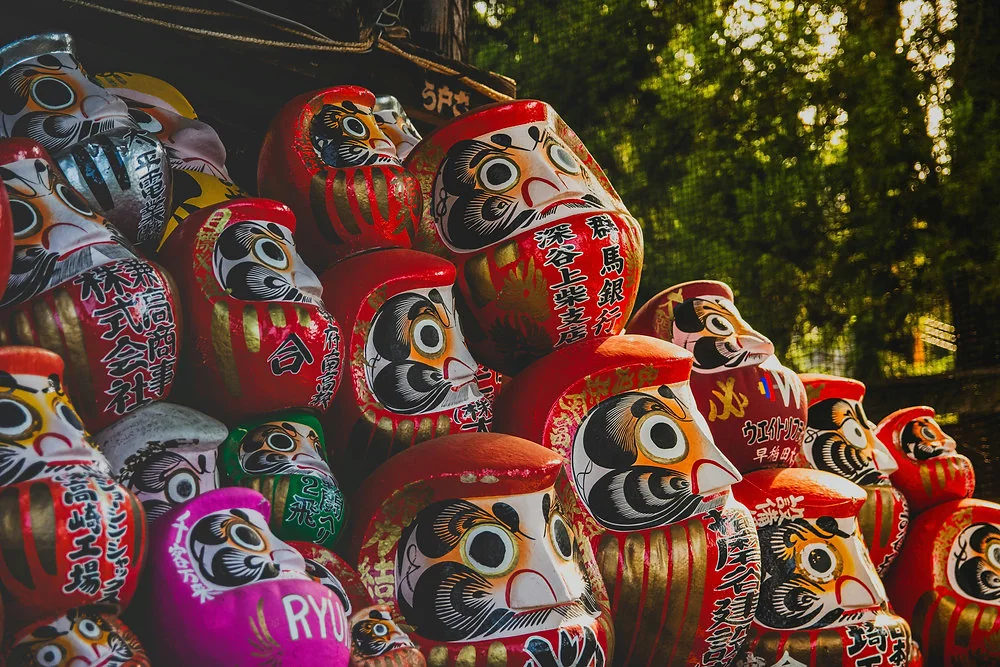
The classic papier-mache Daruma has a rounded, weighted base. When pushed, it rocks and returns upright. Its construction is related to the okiagari-koboshi, a self-righting Japanese figure whose name means “little monk who gets back up.” The form merges naturally with the seated, robed image of Bodhidharma.
This movement is connected with nanakorobi yaoki, commonly translated as “seven times down, eight times up.” The saying does not describe a literal count. It means that another attempt should follow every setback. The Daruma makes that idea physical and easy to remember.
| Feature | Meaning | Important nuance |
|---|---|---|
| Rounded weighted base | Recovery after setbacks | Traditional papier-mache Daruma are designed to self-right |
| Blank eyes | An unfinished wish or goal | Some decorative Daruma are sold with completed eyes |
| Crane-shaped eyebrows | Longevity | Especially associated with Takasaki Daruma |
| Turtle-like beard | Longevity | A visual convention, not a literal animal face |
| Kanji on the body | Luck, perseverance or a chosen wish | Characters vary by maker and commission |
How the Daruma eye ritual works
Many Daruma are sold with two blank white eyes. When you choose a specific wish or goal, paint one pupil in black. Display the figure where it can remind you of the work still to do. When the goal is reached, paint the second eye to complete the face.
| Stage | Action | Purpose |
|---|---|---|
| 1. Set the goal | Choose one clear wish or objective | Make the commitment specific |
| 2. Paint one eye | Common Takasaki custom uses the Daruma’s left eye first | Mark the beginning |
| 3. Keep it visible | Place it on a shelf, desk or appropriate home space | Remember the ongoing effort |
| 4. Complete the face | Paint the second eye after success | Recognize completion and gratitude |
| 5. Decide what comes next | Keep it or follow a local return custom | Close the cycle respectfully |
Which eye comes first is not universal. The common Takasaki sequence starts with the Daruma’s left eye, on your right as you face it. However, the Gunma Daruma manufacturers’ guidance says there is no single correct order. Regional practice, temple guidance and the maker’s instructions should take priority over a rigid internet rule.
Daruma color meanings: tradition versus modern guides
Red is the traditional and most widely recognized Daruma color. It is connected with Bodhidharma’s robe and with older protective uses of red in Japan. Modern makers now produce many colors for different wishes, but the associations are not one fixed ancient system. They can change by region, workshop and seller.
| Color | Common modern association | How to read it |
|---|---|---|
| Red | General good fortune and protection | Traditional and the safest all-purpose choice |
| Gold or yellow | Wealth and prosperity | Common modern commercial association |
| Black | Business success or protection | Meaning varies between makers |
| Pink | Love and relationships | Mostly a modern association |
| Green | Health, determination or well-being | No universal definition |
| Blue | Study, career, sport or victory | Check the maker’s own description |
| White | Harmony, balance or a new beginning | Meaning varies widely |
Choose a color because its maker’s explanation fits your purpose, or simply because you want to live with it. A color chart can guide a purchase, but it should not be presented as a timeless national code.
Takasaki Daruma and the craft behind the figure
Takasaki in Gunma Prefecture is Japan’s best-known Daruma center. The official Gunma tourism guide explains that one origin theory connects the modern craft with Shorinzan Darumaji Temple, where images of Bodhidharma were distributed as New Year charms. After a famine roughly two centuries ago, a temple monk reportedly provided farmers with a mold so they could make papier-mache figures as extra work.
Around 80 percent of Japan’s Daruma are now made in Takasaki. More than 50 cooperative workshops form and hand-paint the figures. On Takasaki examples, crane-shaped eyebrows and turtle-like facial hair refer to a longevity proverb: the crane lives one thousand years and the turtle ten thousand.
What happens after the wish or the year ends?
In Gunma, a Daruma may be returned after about a year to a Buddhist temple, a shrine or a New Year market for ceremonial burning, whether or not the wish was fulfilled. The owner can then choose another figure and renew the goal. This is a real regional custom, but it should not be turned into a universal obligation for every Daruma owner.
If returning the figure is not practical, keep it respectfully or follow the instructions provided by its maker or temple. Do not describe an ordinary decorative figure as if it automatically contains a deity or carries a ritual function.
Daruma in tattoos, decor and contemporary art
In tattooing, a Daruma can represent endurance, ambition and recovery after failure. The meaning comes from the self-righting form and the goal ritual, while the surrounding motifs and personal story shape the final interpretation. It can sit beside themes such as waves, peonies, flames or the repaired-crack symbolism explored in our kintsugi guide.
For a broader visual context, read the guide to Japanese tattoo motifs or the kintsugi and Hannya guide.
A contemporary Dai Yokai Daruma
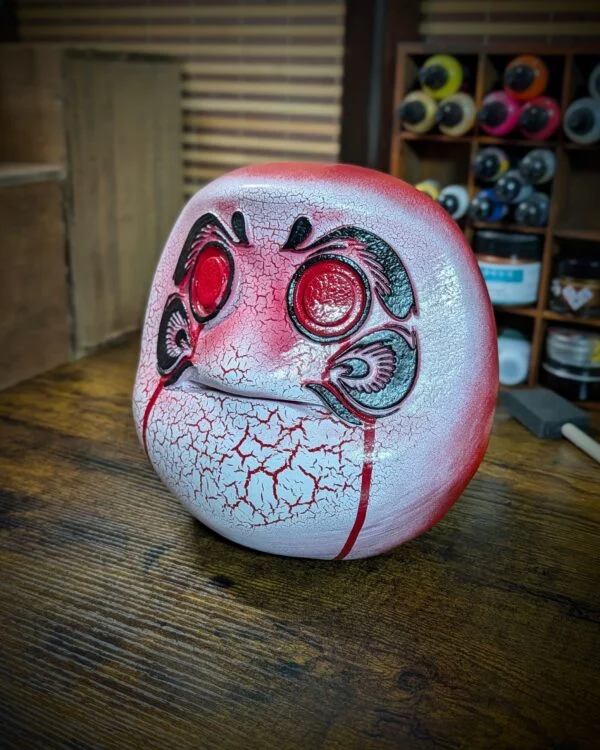
Traditional Takasaki Daruma are papier-mache wishing figures. The Dai Yokai Blood Rage Daruma is different: it is a contemporary decorative statue made in Brittany from a PETG base, then sanded, primed, painted, varnished and finished by hand. Its cracked finish and intense eyes reinterpret the Daruma silhouette without claiming to be a Japanese ritual object.
See the Blood Rage Daruma statue or browse the wider Japanese-inspired figure collection.
Sources and further reading
- Gunma Official Tourist Guide, Takasaki history, craft, symbolism, eye custom and annual return
- Gunma Official Tourist Guide, Takasaki Daruma features and cooperative makers
- Daruma.jp, maker guidance on the eye order and modern color variations
- Smithsonian Folklife Festival, Bodhidharma, papier-mache craft and perseverance
- Cleveland Museum of Art, Bodhidharma in Japanese painting and Zen iconography
FAQ
What does a Daruma mean?
A Daruma symbolizes perseverance, good fortune and commitment to a goal. Its rounded, weighted form returns upright after being tipped, which connects it with the saying “seven times down, eight times up.” Its blank eyes also let the owner mark the beginning and completion of a wish or objective.
Who does the Daruma doll represent?
The doll represents Bodhidharma, called Daruma in Japanese, a semi-legendary Indian Buddhist monk associated with the transmission of Chan Buddhism to China. Japanese portraits emphasize his intense gaze and robe. Stories of nine years of meditation later helped explain the doll’s round, limbless appearance.
Which Daruma eye do you paint first?
The common Takasaki custom is to paint the Daruma’s left eye first, which is on your right as you face it, when setting a goal. The second eye is painted when the goal is reached. However, the Gunma Daruma manufacturers’ guidance notes that there is no universally correct order.
What do Daruma colors mean?
Red is the traditional and most widely recognized color, associated with general good fortune and protection. Gold, black, pink, green, blue and other colors have modern associations, but these vary by maker and region. Treat color charts as useful buying guides, not one fixed ancient code.
Why does a Daruma have no arms or legs?
Its shape combines two ideas. It resembles the seated, robed figure of Bodhidharma, who supposedly lost the use of his limbs during prolonged meditation, and it borrows the self-righting structure of an okiagari-koboshi. The meditation story is legend, not a verified biography.
What does “seven times down, eight times up” mean?
Nanakorobi yaoki means that each setback should be followed by another attempt. A Daruma makes the proverb visible because its weighted base brings it upright after it is pushed over. The lesson is perseverance through repeated effort, not the promise that luck alone will solve a problem.
What should you do with a Daruma after one year?
In Gunma and other communities, people may return a Daruma to a temple, shrine or New Year market for a respectful burning ceremony, whether or not the wish was fulfilled. Customs vary, so returning it is not a universal obligation. If you keep it, treat it respectfully as a meaningful object.
Is a Daruma a god or a yokai?
No. A Daruma is a Japanese good-luck figure modeled on Bodhidharma and used in wish and goal-setting customs. It is not a yokai, and the doll itself is not simply a god. Religious, folk and modern motivational meanings overlap, so context matters.