What are Dogū figurines?
Dogū are small clay figures made in prehistoric Japan during the Jōmon period. Most are human-shaped, although animal forms also exist. Archaeologists associate many examples with ritual or spiritual activity, yet no written record explains exactly what they represented. Their meaning probably changed across communities, regions and several thousand years of production.
What does Dogū mean?
Dogū is written 土偶 and is commonly translated as “earthen figure” or “clay figurine.” In English-language archaeology and museum catalogues, the word normally identifies the small ceramic figures created during Japan’s Jōmon period. It describes a class of object, not the confirmed name of a goddess, spirit or single cult.
The accent in Dogū marks a long final vowel. “Dogu” is common in searches and informal writing, while “Dogū” is the more precise romanisation. Neither spelling changes the archaeological meaning.
When and where were Dogū made?
Dogū belong to the Jōmon period, a long prehistoric era whose exact boundaries vary between chronologies. A broad range of roughly 14,000 to 300 BCE is useful, but individual museums and archaeological sites may use slightly different starting and ending dates. The earliest known figures are tiny and abstract; later examples become larger, hollow and elaborately decorated.
The Sainsbury Institute’s archaeological resource reports more than 20,000 Dogū from Japanese sites. Finds are especially numerous in eastern and northern Japan. At Isedotai in Akita alone, the official Jōmon Prehistoric Sites guide records more than 200 figures in varied flat and hollow forms.
Jōmon communities were settled hunter-fisher-gatherers who also managed plants and practised limited cultivation. Dogū were created within this long and regionally diverse social world, not by one uniform culture following an unchanged ritual for millennia.
How were Dogū made?
Dogū were shaped from clay and fired. Early forms could be small, solid and abstract. Later makers built hollow bodies, added clay coils and projections, incised the surface, pressed cord patterns into it and sometimes applied red or black pigment. Some figures preserve details that may represent hairstyles, jewellery, clothing or body decoration.
A horned-owl Dogū in Japan’s e-Museum retains red color and modeled features interpreted as a comb, earrings and necklaces. These details make Dogū useful evidence for studying Jōmon craft and appearance, even when their ritual role remains uncertain.
Main Dogū styles and examples
There is no single Dogū silhouette. Archaeologists and museums group figures by period, construction, facial design and regional style. The labels below are useful guides, but they do not form one complete or universally fixed taxonomy.
| Style or example | Typical features | Context |
|---|---|---|
| Early abstract Dogū | Very small, simple human outline, often without developed limbs | Incipient and early Jōmon examples |
| Heart-shaped face | Heart or crescent-shaped facial outline, simplified body | Especially associated with eastern Japan |
| Mimizuku or horned-owl type | Round applied eyes, heart-shaped face and elaborate head details | Late to Final Jōmon, especially the Kantō region |
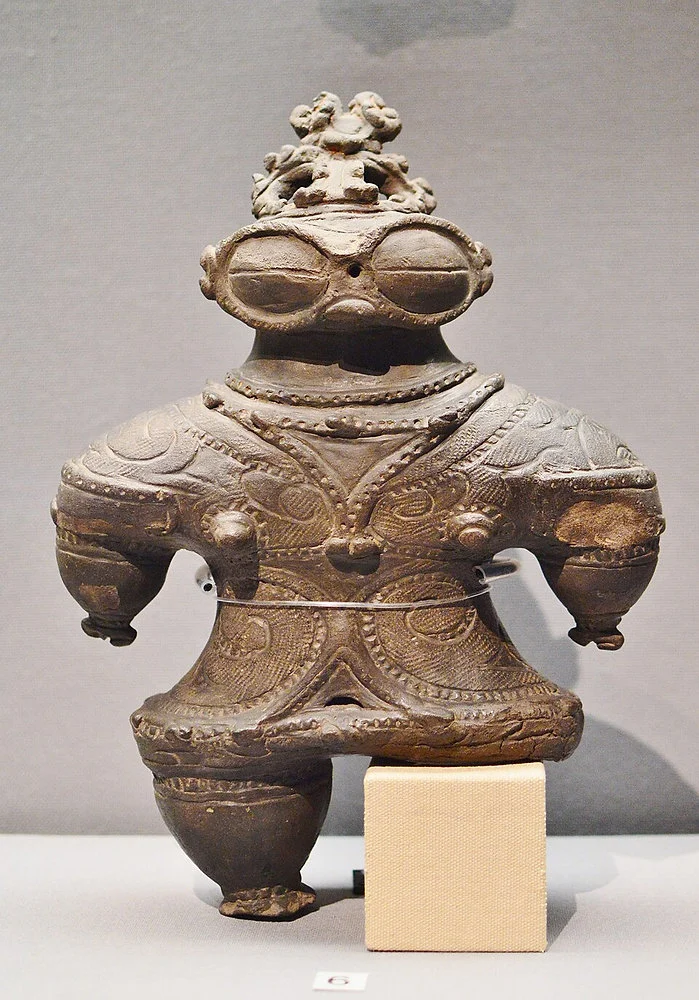
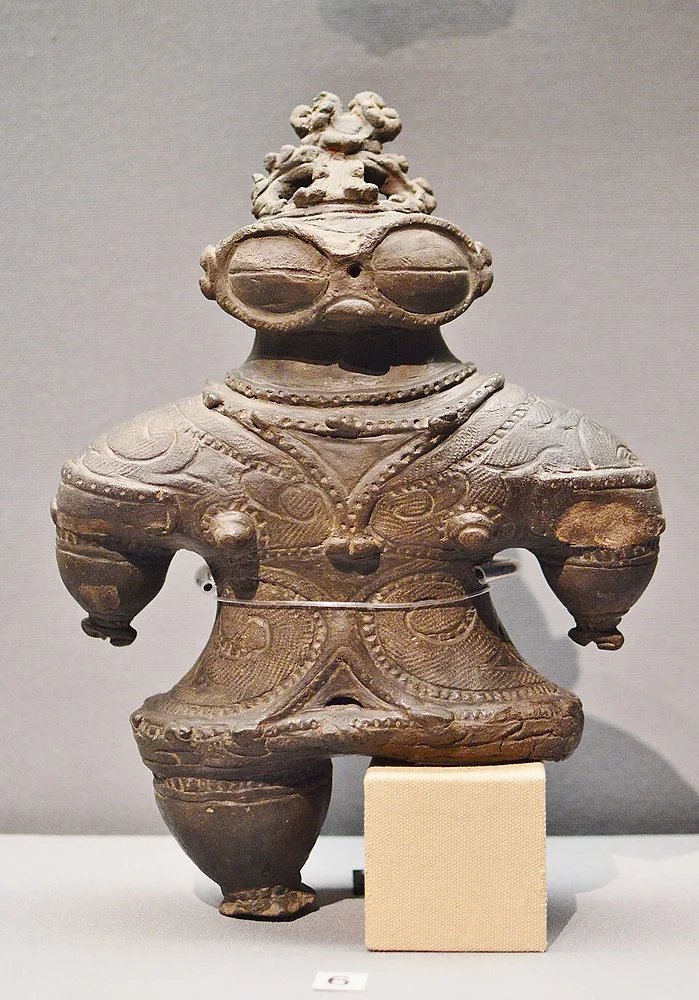
| Shakōki or goggle-eyed type | Large horizontal eyes, hollow body and dense cord-marked decoration | Final Jōmon, especially Tōhoku |
| Chūku or hollow Dogū | Thin-walled hollow construction, sometimes large and richly patterned | Several late regional traditions |
| Jōmon Venus type | Pronounced hips, abdomen and carefully modeled body | Named individual masterpieces, not every female-form Dogū |
Why do shakōki Dogū have large eyes?
The most recognizable Dogū type is the shakōki-dogū (遮光器土偶). Shakōki refers to a light-blocking device, and the name was inspired by the resemblance between the broad slit eyes and snow goggles used in Arctic regions. This is a modern descriptive label, not proof that Jōmon people represented snow equipment.
The Musée Guimet notes both the snow-goggle comparison and another interpretation in which the forms resemble closed eyelids. Japan’s National Institutes for Cultural Heritage describe the eyes as an exaggerated depiction. Archaeological evidence does not support claims that the figures wear spacesuits or depict extraterrestrials.
Other facial elements are deliberately reduced: the nose and mouth may be tiny, while the eyes dominate the entire head. The result is visually powerful, but its intended meaning remains open.
What were Dogū used for?
The honest answer is that no single function has been proven. Dogū appear in houses, pits, refuse deposits, ritual areas and some burial settings. Their bodies, find locations and patterns of damage support several interpretations, but the same explanation does not fit every object.
| Main interpretation | Evidence behind it | Limit |
|---|---|---|
| Fertility or safe childbirth | Many figures emphasize breasts, hips or pregnancy-like abdomens | Not every Dogū is clearly female or pregnant |
| Healing or sympathetic ritual | Some figures appear deliberately broken at limbs; later writers propose illness transfer | The specific ritual cannot be reconstructed from fragments alone |
| Prayer and community ceremony | Dogū occur with ritual deposits, stone circles and other ceremonial objects | Ceremonial use does not identify one prayer or belief |
| Burial or funerary role | Some examples occur near graves or in burial areas | Many others come from houses, pits or refuse deposits |
| Protection or prosperity | Body symbolism and repeated ritual treatment suggest desired outcomes | The exact requested benefit is rarely demonstrable |
The Tokyo National Museum presents Dogū as prominent objects of prayer and connects many female forms with childbirth and fertility. The University of East Anglia, however, stresses the lack of consensus and the broad range of archaeological contexts. Both points matter: ritual use is plausible, but certainty about one universal ritual is not.
Why are so many Dogū broken?
Many excavated Dogū are fragments: separate heads, arms, legs or torsos. At some sites, pieces from the same figure were widely dispersed, and certain bodies seem designed with weak joints. These patterns can support deliberate breaking as part of a ceremony, perhaps followed by sharing or scattering the pieces.
At Shakadō in Yamanashi, the Sainsbury Institute describes 1,116 fragments and notes that pieces from the same figure could be refitted in fewer than three percent of cases. Yet the same resource also documents complete figures and prehistoric repairs made with natural asphalt. Archaeologists still debate which breaks were deliberate and what they meant.
The Metropolitan Museum of Art presents healing ritual as a hypothesis: an affliction may have been symbolically transferred to a figure before it was broken and discarded. That is a useful interpretation, not a verified description of every damaged Dogū.
Dogū vs Haniwa: what is the difference?
Dogū and Haniwa are often confused because both are Japanese earthenware figures. They belong to very different periods and archaeological systems.
| Point | Dogū | Haniwa |
|---|---|---|
| Main period | Jōmon period, prehistoric Japan | Kofun period, roughly third to seventh centuries CE |
| Typical form | Small solid or hollow human and animal figures | Cylinders and larger figures of people, animals, buildings and objects |
| Find context | Settlements, pits, ritual deposits, refuse areas and some burials | Placed on and around elite burial mounds |
| Known function | Uncertain and probably varied | Closely tied to Kofun funerary monuments and ritual display |
| Common condition | Frequently fragmentary, with some complete or repaired examples | Often recovered as tomb sculpture fragments |
| Cultural sequence | Earlier | Many centuries later |
The Met’s Haniwa guide explains that Haniwa were arranged on burial mounds made for ruling elites. Calling Dogū “early Haniwa” erases the chronological gap and their different archaeological contexts.
Are Dogū yokai or kami?
Dogū should not automatically be labelled yokai, demons or named kami. They were produced long before the written sources used to classify later Japanese folklore and religion. Their makers may have understood them as beings, bodies, ritual tools, ancestors or something for which no modern label is exact.
For the later concepts, read what yokai are in Japanese folklore and the guide to kami in Shinto. Those categories help explain Japanese supernatural vocabulary, but they should not be projected backwards onto Jōmon objects as established fact.
Famous Dogū and National Treasures
Several Dogū have been designated National Treasures of Japan because of their rarity, craftsmanship and archaeological importance. Famous examples include the Jōmon Venus from Tanabatake, the Masked Goddess from Nakappara, the hollow figure from Chobonaino and the seated figure with clasped hands from Kazahari.
The Chobonaino hollow Dogū is 41.5 centimetres high and preserves traces of red and black pigment. The official northern Jōmon sites guide records its careful manufacture, excellent preservation and display at the Hakodate Jomon Culture Center. The goggle-eyed figure most often reproduced in textbooks is an Important Cultural Property, which is a different designation from National Treasure.
Dogū in modern visual culture
Dogū remain visually influential because their silhouettes are immediately recognizable. Goggle eyes, compact limbs and patterned surfaces reappear in museum design, public monuments, manga, animation and games. These modern references can introduce the archaeological originals, but they are interpretations rather than proof of prehistoric meaning.
Dai Yokai treats Dogū as part of the wider visual history that inspires contemporary Japanese-themed objects, not as a yokai and not as an authentic ritual reproduction. The workshop is based in Brittany, France, where pieces are prepared, painted, varnished and finished by hand.
For current decorative creatures and figures, browse the Japanese folklore-inspired figures collection. The collection page, rather than this archaeological guide, is the source for available models.
Sources and further reading
- Sainsbury Institute: Mystery of Dogu Figurines, for chronology, styles, fragment evidence and repaired examples
- University of East Anglia: Spirits of Clay, for the continuing debate over function
- Tokyo National Museum: Dogū, Objects of Prayer, for museum interpretation and dated examples
- Jōmon Prehistoric Sites in Northern Japan, for archaeological contexts and National Treasure examples
- Metropolitan Museum of Art: Dogū Clay Figurine, for the healing-ritual hypothesis
Conclusion
Dogū mean “earthen figures,” but their deeper meaning is not one solved code. They are evidence of changing Jōmon craft, bodies and ritual practices across thousands of years. The strongest interpretation keeps three things together: many were probably ceremonial, different communities may have used them differently, and the archaeological record still leaves important questions open.
FAQ
What are Dogū figurines?
Dogū are small clay figures made in prehistoric Japan during the Jōmon period. Most are human-shaped, although animal examples also exist. Their forms range from tiny abstract figures to hollow, highly decorated bodies. Archaeologists connect many Dogū with ritual activity, but there is no written record explaining one universal purpose.
What does Dogū mean in Japanese?
Dogū is written 土偶 and is commonly translated as “earthen figure” or “clay figurine.” In English, the term usually refers to Jōmon-period figures from Japan. The name describes the material and form, not a known deity or a single religious role.
What were Dogū used for?
Their exact function is unknown. Proposed uses include prayers for fertility or safe childbirth, healing rituals, protection, ceremonies linked to community life, and treatment of the dead. Different find contexts and styles suggest that Dogū may have served several purposes across regions and over thousands of years.
Why are so many Dogū broken?
Many Dogū survive as separate heads, limbs or torsos, and some archaeological sites show patterns consistent with deliberate breaking and dispersal. This may have formed part of a ritual, but accidental damage and later disturbance also have to be considered. Complete figures and prehistoric repairs prove that breaking was not the only possible treatment.
Why do shakōki Dogū have large eyes?
Shakōki Dogū are named for eyes that resemble light-blocking snow goggles. The resemblance gave the type its modern name, but it does not prove that the figures depict goggles. Museums also discuss closed eyelids, stylised facial features and other interpretations. The extraterrestrial-spacesuit claim is not supported by archaeological evidence.
Are Dogū the same as Haniwa?
No. Dogū belong to the much earlier Jōmon period and appear in varied settlement, ritual and burial contexts. Haniwa were made during the Kofun period and placed on or around elite burial mounds. Both are earthenware figures, but their dates, forms and archaeological settings are different.
Are Dogū yokai or kami?
Dogū should not automatically be called yokai or identified as named kami. They were made long before the written folklore and religious classifications used today. They may reflect Jōmon spiritual practices, but archaeologists cannot securely assign them the identities of later Japanese supernatural beings.
How many Dogū have been found?
The Sainsbury Institute and recent Japan Society teaching material state that more than 20,000 Dogū have been excavated in Japan. Counts can change as discoveries and catalogues are updated. Most finds come from eastern Japan, and many survive only as fragments rather than complete figurines.