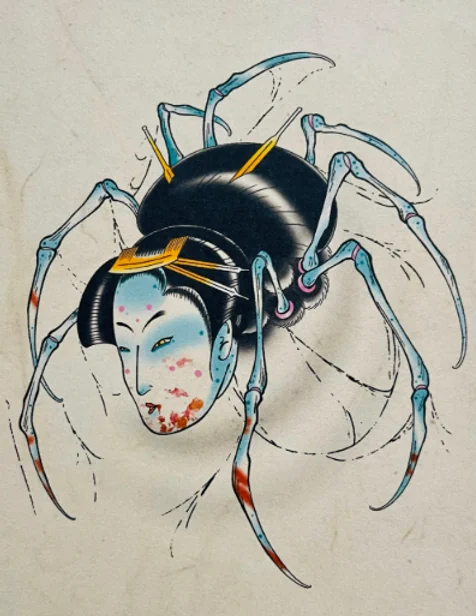
Jorōgumo is a supernatural spider from Japanese folklore that can take the form of a woman. This spider woman appears in stories and images in different guises: a deceptive encounter, entangling threads, an unsettling presence beside the water. Her name does not refer to one single legend with a fixed origin and set of powers.
Opening image: a contemporary illustration of the spider woman. A photograph of the Dai Yokai mask appears below.
The legend of Jōren Falls
Jōren Falls in Izu is associated with a Jorōgumo. The following local version is summarised from the Arts Council Shizuoka, which publishes it under the title “The Jorōgumo of Jōren Falls”.
A farmer passes near the waterfall when spider threads wind around his legs. He transfers them to a tree stump, which is immediately dragged into the pool. A woman's voice orders him to keep the encounter secret. He obeys and later forbids anyone to cut down the trees around the waterfall.
Many generations later, one of his descendants breaks this rule. His axe falls into the water. Diving to retrieve it, he meets a woman who promises to return it if he tells no one. But one evening during a festival, he recounts his adventure. Thunder breaks, a column of white fire tears through his house, and an enormous spider appears. His body is found in the pool.
In this version, the threads, the prohibition and the promise drive the story.
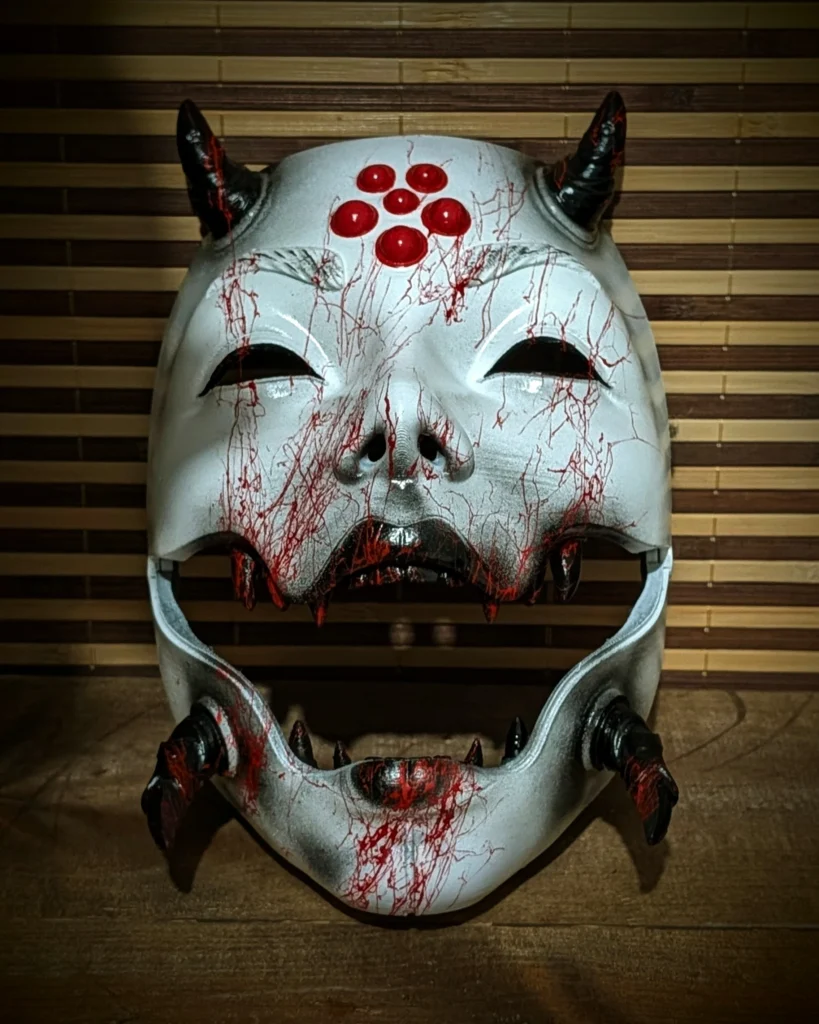
Painted version, jaw open.
Articulated Jorōgumo Mask
A contemporary Dai Yokai interpretation of the spider woman, with a moving jaw and a PETG printed base. The mask is made to order in Brittany, France.
The photograph shows a version prepared, painted and finished by hand. These stages distinguish a finished mask from a raw base that still needs preparation and painting.
What does the name Jorōgumo mean?
The name can be written 女郎蜘蛛 or 絡新婦, two spellings recorded in the Daijisen dictionary. The first combines jorō, an older word for a woman or a prostitute depending on the context, with kumo, meaning spider, pronounced gumo in this compound.
The spelling 絡新婦 has inspired the figurative translation “entangling bride”, often repeated online. It does not, on its own, establish the name's origin. “Spider woman” describes the figure in the stories more directly.
The real spider
In Japan, jorōgumo is also the name of a real spider, Trichonephila clavata, formerly classified as Nephila clavata. The animal and the yōkai share a name; the transformations and supernatural traps belong to the stories.
Edo-period stories and the image of the spider woman
The collections Tonoigusa (宿直草) and Taihei Hyakumonogatari (太平百物語) contain Jorōgumo stories. A Dōshisha University Library enquiry identifies the passages examined: “One must think even in an emergency”, in book II of the first collection, and the episode in which Magoroku is deceived by a Jorōgumo, in book IV of the second.
The enquiry did not find the exact story of a beautiful woman playing the biwa to seduce and then devour a man in those texts. Encounters with transformed spiders do exist, but their plots are not interchangeable.
Toriyama Sekien also depicts Jorōgumo in Gazu Hyakki Yagyō, published in 1776. The copy held by Kawasaki City Museum includes this figure in the Yō (陽) section. It is a visual reference, separate from the local Jōren story.
Jorōgumo and Tsuchigumo: what is the difference?
Both are supernatural spider figures, but their names are not synonyms. In the noh play Tsuchigumo, an ominous monk attacks the warrior Raikō with threads. Wounded, he disappears; his pursuers then confront the spider spirit at Mount Katsuragi. This plot is outlined by the Japan Arts Council.
| Point of comparison | Jorōgumo | Tsuchigumo |
|---|---|---|
| Example story | The encounter near Jōren Falls. | The battle with Raikō in the noh play. |
| Appearance in this example | A woman associated with the spider and the pool. | A monk, then a spider spirit. |
| Central elements | Threads, secrecy and a prohibition. | Attack, pursuit and confrontation. |
This comparison concerns two specific stories. It does not define the gender, size or every possible power of either creature.
Jorōgumo in tattoos and contemporary imagery
A woman's face paired with a spider or its web can suggest attraction and danger, control, patience or transformation. These are contemporary interpretations, not a fixed dictionary of Jorōgumo tattoo meanings.
When developing a design, start with the story you want to tell: a presence beside the water, an encounter with a woman, a trap made of threads, or an imagined transformation. The position of the web, the facial expression and the surrounding elements then shape how the image is read. The guide to Japanese tattoo motifs and composition offers other starting points to discuss with your tattoo artist.
Manga, games and films also draw on this figure and give her their own rules. A recent adaptation can be a useful visual reference, provided it is identified as such.
From folklore to a contemporary mask
The spider woman can also take shape as an object to wear or display. The Dai Yokai Articulated Jorōgumo Mask belongs to this contemporary creative context: its face and moving jaw give the figure a physical presence, without reproducing a historical character or a theatre mask.
Hannya, by contrast, belongs to the noh repertoire. Kuchisake-onna comes from modern urban legend. Keeping these contexts distinct lets us appreciate the creations without confusing their inspiration with a tradition.
Frequently asked questions
How do you pronounce Jorōgumo?
In Japanese, the name is written じょろうぐも. The mark over the ō indicates a long “o”: hold that sound in “jo-rō-gu-mo”. The spelling “Jorogumo”, without the mark, refers to the same figure.
Does she become a yōkai after 400 years?
This age appears in modern accounts. The Jōren version told here does not give that rule. A specific age should therefore be linked to its source, rather than applied to every story.
Is she always a woman who seduces men?
No. In the Jōren version presented here, the danger begins with spider threads and develops around a promise of silence. Seduction does not drive every version.
Is a Jorōgumo mask a traditional Japanese mask?
The Dai Yokai model is a contemporary interpretation, with a PETG base and a moving jaw. It is neither a noh mask nor a historical reproduction.
Sources and references
- Arts Council Shizuoka, “The Jorōgumo of Jōren Falls”: the local version summarised in this article.
- Daijisen, 女郎蜘蛛 entry on Kotobank: the name, spellings and distinction from the real spider.
- Dōshisha University enquiry, preserved by the National Diet Library: passages in the collections and the limits of the biwa story.
- Kawasaki City Museum, Gazu Hyakki Yagyō, Yō section, 1776: the depiction of 絡新婦.
- Japan Arts Council, Tsuchigumo: synopsis of the noh play.
- NCBI, Trichonephila clavata: the spider's scientific name.