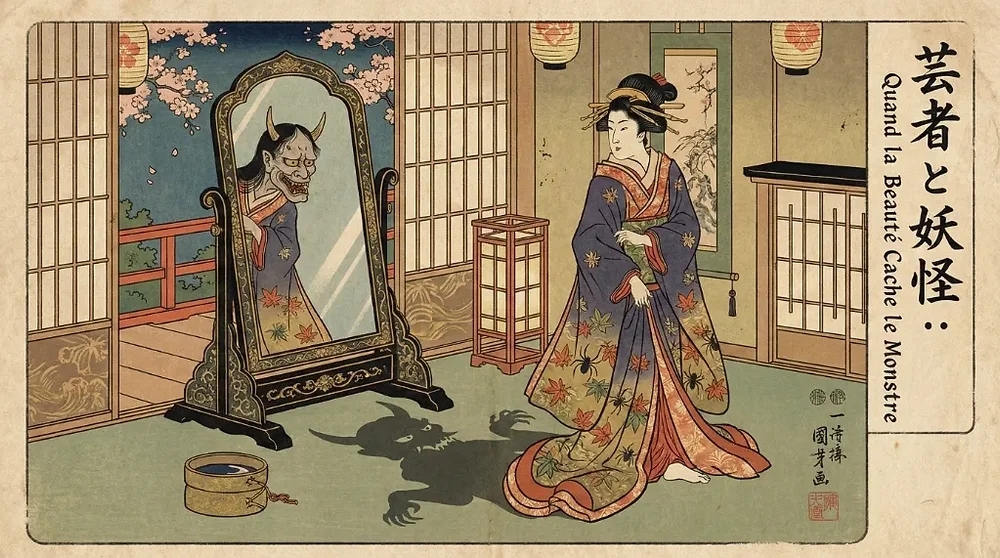
A geisha is not a yokai. Geisha are professional entertainers trained in music, dance and conversation, while yokai are supernatural or uncanny beings found across Japanese traditions. The phrase “geisha yokai” mainly describes a modern horror fusion: a human face styled with geisha-inspired visual codes, then transformed by monstrous features.
| Quick question | Accurate answer |
|---|---|
| Is a geisha a yokai? | No, geisha is a profession |
| Is there one traditional “geisha yokai”? | No established creature has that exact identity |
| Why does the phrase exist? | Modern horror, cosplay and mask design |
| Closest folklore context | Female-presenting yokai, ghosts and transformed characters |
| Dai Yokai interpretation | A contemporary articulated horror mask |
What is a geisha?
A geisha is a professional entertainer. In Kyoto, the term geiko is commonly used, while maiko refers to an apprentice. Training can include dance, singing, shamisen, conversation, etiquette and the arts of hosting. Japan’s government describes geiko as women trained to entertain guests with music, conversation and dance at banquets.
That role is human, historical and professional. It should not be treated as a supernatural species, a demon or a shorthand for sexual danger. White makeup, elaborate hair and kimono are visible cultural codes, but appearance alone does not make a geisha a yokai.
Geisha, maiko, courtesan and yokai are different terms
| Term | What it means | Supernatural? |
|---|---|---|
| Geisha or geiko | Professional entertainer trained in traditional arts | No |
| Maiko | Apprentice geiko in Kyoto | No |
| Oiran or courtesan | Historical high-ranking courtesan in a licensed pleasure district | No |
| Yokai | Broad term for supernatural, uncanny or strange beings and phenomena | Yes, by definition |
| Yurei | Ghost of a deceased person in Japanese tradition | Yes |
| Hannya | Noh mask type for a female demon or woman transfigured by resentment | Theatrical character type |
Geisha and courtesans also should not be collapsed into one role. Edo-period prints portrayed entertainers, actors and courtesans, sometimes using overlapping ideals of beauty. Museums catalogue these figures separately because their work and social position were not the same.
Why do geisha and yokai get combined in modern horror?
Modern horror design often starts with a recognisable human face and reveals something impossible beneath it. Geisha-inspired makeup, an arranged hairstyle and an ornate kimono create an immediately readable visual surface. A split mouth, fangs, horns, extra eyes or an articulated jaw then break that surface.
This is a contemporary visual device, not proof of an old folklore category. Film, manga, games, tattooing and cosplay regularly recombine historical clothing, theatre masks and supernatural characters. The result can be effective art, but the influences should still be named accurately.
Five figures often confused with a geisha yokai
| Figure | More accurate category | Why the confusion happens |
|---|---|---|
| Jorogumo | Spider yokai that may appear as a woman | Modern art emphasises seduction and transformation |
| Yuki-onna | Snow-woman figure from regional tales | She is often depicted as a pale, beautiful woman |
| Tamamo-no-Mae | Legendary court woman linked to a nine-tailed fox | Courtly beauty is mislabelled as geisha styling |
| Hannya | Female demon or transformed woman in Noh | The mask is widely reused in tattoo and horror imagery |
| Kuchisake-onna | Modern urban legend | A hidden mouth creates the beauty-to-horror reveal |
Jorogumo
Jorogumo belongs to spider-yokai traditions. Stories and modern retellings often give the creature a woman’s appearance, but “woman” does not mean “geisha.” The biwa-playing seductress common in modern summaries is one narrative image, not a definition of the geisha profession.
Yuki-onna
Yuki-onna appears in snow-country stories, with details that vary across regions and retellings. Her pale appearance is sometimes borrowed for geisha-style horror art. She is nevertheless a snow-woman figure, not a supernatural geisha.
Tamamo-no-Mae
Tamamo-no-Mae is associated with a nine-tailed fox that appears as a beautiful court woman. The setting matters: museum descriptions identify her as a favourite concubine of Emperor Toba, not a geisha. Modern illustrations may blur court dress, courtesan imagery and geisha styling, but the roles are not interchangeable.
Hannya
The Nohgaku Performers’ Association defines Hannya as a mask for a female demon or a woman transfigured by resentment. It is not a geisha mask and not the universal face of a jealous woman. Contemporary masks and tattoos often reuse its horns, fangs and emotional tension.
Kuchisake-onna
Kuchisake-onna is a modern urban legend centred on a concealed, slit mouth and a dangerous question about beauty. She is not an Edo-period geisha or courtesan. The connection comes from the visual rhythm of concealment and revelation, especially in articulated horror masks.
Female yokai are a separate subject
Readers looking for broader context can start with the guide to yokai, spirits and demons in Japanese folklore, then use the dedicated Jorogumo, Yuki-onna and Kuchisake-onna articles linked above. This page answers the narrower question behind “geisha yokai”: why a historical profession is repeatedly mixed with folklore and horror imagery.
The Dai Yokai Geisha Horror mask
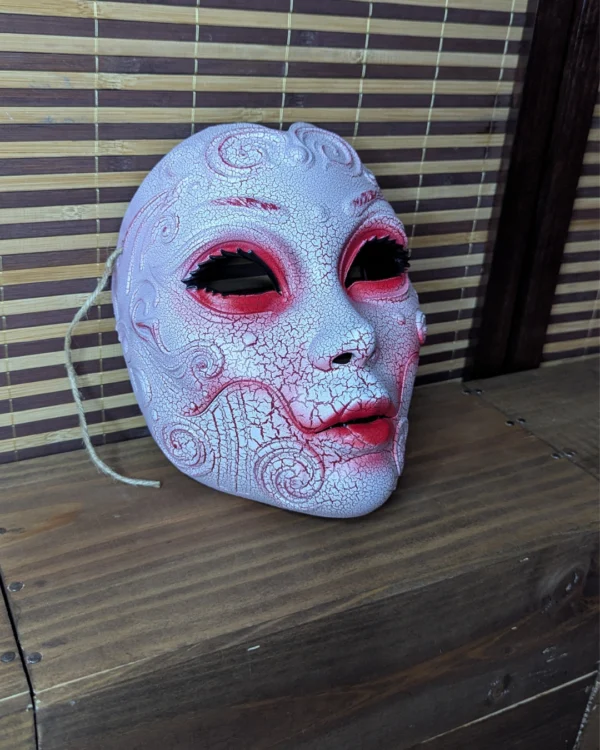
The articulated Geisha Horror mask uses the modern contrast deliberately. Its painted face and ornate details create a composed first impression, while the movable jaw introduces the horror reveal. It is a Dai Yokai creation inspired by Japanese visual culture, not a reconstruction of historical geisha equipment and not a ritual object.
Jérémy does not claim authorship of the original Geisha Horror design or its jaw mechanism. His work on this piece is the PETG printing, preparation, painting and hand finishing in Brittany.
The base is 3D printed in PETG in the Dai Yokai workshop in Brittany, France. It is cleaned, sanded, primed, painted by hand with acrylic layers and varnished. The articulated structure is designed for visual effect in display, photography and careful cosplay styling. It is not intended for rough long-wear use.
| Design element | Source or function |
|---|---|
| Painted face and ornate styling | Geisha-inspired visual language |
| Opening jaw | Contemporary horror transformation |
| PETG base | Modern fabrication material |
| Hand-painted finish | Individual workshop variation |
| Cultural status | Japanese-inspired contemporary mask art |
Sources and further reading
- Government of Japan: geiko, maiko and their training
- The Metropolitan Museum of Art: pleasure quarters and ukiyo-e
- Nichibunken: Database of Folktales of Mysterious Phenomena and Yokai
- Nohgaku Performers’ Association: Noh masks
- The Metropolitan Museum of Art: Tamamo no Mae
FAQ
Is a geisha a yokai?
No. A geisha, or geiko in Kyoto, is a professional entertainer trained in arts such as music, dance and conversation. Yokai are supernatural or uncanny beings in Japanese traditions. Modern horror art may combine geisha-inspired styling with supernatural features, but that does not turn the historical profession into a yokai category.
What does “geisha yokai” mean?
“Geisha yokai” is mainly a modern search and design phrase. It usually describes a horror character or mask that combines geisha-inspired makeup, hair or costume with a monstrous transformation. It is useful as a visual label, but it is not the established name of one traditional Japanese creature.
Are geisha and oiran the same?
No. Geisha are professional entertainers trained in performance and hospitality. Oiran were high-ranking courtesans within licensed pleasure districts during the Edo period. Their clothing and hairstyles can look similar to an unfamiliar viewer, but their roles, training and social histories were different.
Is Hannya a geisha?
No. Hannya is a Noh mask type used for a female demon or a woman transfigured by resentment. It belongs to a theatrical mask tradition, not to the geisha profession. Contemporary artists sometimes combine Hannya features with geisha-inspired styling, but that fusion is a modern design choice.
Was Tamamo-no-Mae a geisha?
No. Tamamo-no-Mae is a legendary court woman associated with a nine-tailed fox spirit in later retellings and artworks. She is described as a court favourite or concubine, not a geisha. Calling her a geisha removes the specific court setting that shapes her story.
Which female yokai can appear as a woman?
Jorogumo and Yuki-onna are two well-known examples, although stories vary by period and region. Jorogumo is associated with a spider taking a woman’s form, while Yuki-onna appears as a woman in snow-country tales. Neither figure is automatically a geisha or courtesan.
Is the Dai Yokai Geisha Horror mask traditional?
No. It is a contemporary Dai Yokai horror creation inspired by Japanese visual culture. Its painted face and moving jaw create a staged transformation, but it is not a historical geisha object, a Noh mask or a ritual artefact. It should be presented as modern mask art.
How is the articulated Geisha Horror mask made?
The base is 3D printed in PETG in the Dai Yokai workshop in Brittany, France. It is then cleaned, sanded, primed, painted by hand with acrylic layers and finished with varnish. The articulated construction is intended for visual effect, photos, careful cosplay styling and display.
A modern horror fusion, not a folklore category
“Geisha yokai” works as a description of contemporary horror imagery, but it should not rewrite the geisha profession or merge unrelated figures into one myth. Accurate labels make the design stronger: geisha-inspired styling, a modern transformation, and clearly identified references to yokai, Noh or urban legend.