In Japanese folklore, the wolf is not one fixed deity or yōkai. Ōkami simply means wolf, while regional stories and shrine traditions give the animal different roles: mountain guardian, crop protector, divine messenger or dangerous escort on a night road. The real wolves behind those traditions are now extinct.
Okami meaning: what does Ōkami mean in Japanese?
Ōkami, written 狼, means wolf. You may also see it romanized as ookami or okami when long vowels are omitted. A second word, ōkami written 大神, means great deity. The two forms look identical in simplified romanization, but the kanji and the sentence make the intended meaning clear.
That resemblance is useful in modern wordplay, especially in the video game Ōkami, but it is not enough to prove that wolf worship began as a pun. Shrine histories, local livelihoods and mountain beliefs provide more reliable context.
| Form | Japanese | Meaning | Important distinction |
|---|---|---|---|
| Ōkami | 狼 | Wolf | The ordinary Japanese word for the animal |
| Ōkami | 大神 | Great deity | A different word written with different kanji |
| Ōkuchi no Makami | 大口真神 | A deified wolf name | Used in specific religious and legendary contexts |
Is the Japanese wolf a god, a messenger or a yokai?
All three labels appear online, but they should not be merged. A living wolf was an animal. At some shrines, the wolf became a divine messenger or protective attendant. In folktales, a wolf-like being could behave as a supernatural presence. The role changes with the place and story.
This regional approach matters. Japan does not have one official wolf mythology shared unchanged from Hokkaido to Kyushu. Beliefs grew around local mountains, farming, travel and religious institutions.
Wolf worship at Mitsumine and Musashi Mitake
Mitsumine Shrine's official guidance describes the wolf as the messenger of its deities. It connects the animal with the legend of guiding Yamato Takeru through the mountains and calls the sacred figure Ōkuchi no Makami. The shrine's wolf talisman is traditionally sought for protection from fire, theft and other dangers.
Musashi Mitake Shrine likewise enshrines Ōkuchi no Makami, affectionately called Oinu-sama. Its official history presents the Japanese wolf as a protective sacred figure within a specific mountain tradition. These examples support a regional religious link, not the claim that every Japanese wolf was universally worshipped.
| Place | Wolf role | What the official source says |
|---|---|---|
| Mitsumine Shrine, Saitama | Divine messenger and guardian | The wolf guided Yamato Takeru and protects through the shrine's talisman tradition |
| Musashi Mitake Shrine, Tokyo | Ōkuchi no Makami, or Oinu-sama | The Japanese wolf is enshrined as a sacred protective figure |
| Folklore beyond shrines | Animal, helper or threat | Meanings change by region and story |
Why did farmers see wolves as protectors?
In some farming and mountain communities, wolves could be useful neighbors because they preyed on deer and wild boar. Those animals damaged fields, so a predator that limited them could be associated with crop protection. This practical relationship helps explain why fear and respect could coexist.
It would still be misleading to say that Japanese people always viewed wolves positively, or that the animal was the opposite of every European wolf story. Wolves could threaten people and livestock, and attitudes changed with time, disease, hunting and local economics.
Okuri-okami: the escorting wolf on the night road
The okuri-ōkami, literally escorting wolf, is one of the best-known wolf motifs in Japanese folklore. A traveler senses a wolf or wild dog following along a mountain path after dark. In some versions, the presence keeps other dangers away until the traveler reaches home.
The story is not simply benevolent. Folklorist Akiko Hishikawa collected 149 related tales with regional differences, as summarized by The Japan Times. Some wolves guide or protect; others may attack if the traveler trips, shows weakness or behaves without respect. Customs for thanking or repelling the animal also vary.
That ambiguity is the point. The escort is close enough to guard the road and dangerous enough to demand composure. Calling it only a friendly spirit removes the tension that gives the story its force.
The two extinct wolves of Japan
Historic Japan had two recognized wolf forms. Research from Japan's National Museum of Nature and Science records the Honshu wolf across Honshu, Shikoku and Kyushu, with the last confirmed specimen in 1905. The Ezo or Hokkaido wolf lived farther north and disappeared by the end of the nineteenth century.
| Historic wolf | Scientific name | Main range | Extinction record |
|---|---|---|---|
| Honshu or Japanese wolf | Canis lupus hodophilax | Honshu, Shikoku and Kyushu | Last confirmed record in 1905 |
| Ezo or Hokkaido wolf | Canis lupus hattai | Hokkaido and neighboring northern islands | Extinct by the end of the 19th century |
The Honshu wolf was notably small, while the Ezo wolf was closer in size to northern continental wolves. Their disappearance did not have one identical cause. Disease, organized killing, livestock policy, habitat pressure and wider modernization all played roles, with the balance differing between regions.
Japanese wolf, Kitsune and Komainu: what is the difference?
| Figure | Basic identity | Religious or folklore role |
|---|---|---|
| Ōkami | Wolf | Animal, mountain presence, shrine messenger or folklore figure depending on context |
| Kitsune | Fox | Folklore shapeshifter or messenger of Inari in shrine context |
| Komainu | Guardian lion-dog statue | Paired architectural guardians placed at many shrine entrances |
For more context, read the Kitsune mask meaning guide, the guide to kami in Shinto and the article on Komainu guardian statues.
Does the game Okami describe traditional mythology?
The game Ōkami reimagines the sun deity Amaterasu as a white wolf in a world built from Japanese myths, legends and visual art. It is an influential modern interpretation, not a direct record of classical Shinto belief. Traditional accounts do not define Amaterasu as a wolf.
The title also benefits from the visual resemblance between romanized ōkami for wolf and ōkami for great deity. That creative choice is worth mentioning, but the game should not be used as historical proof for shrine worship or folklore.
A contemporary Okami mask made in Brittany
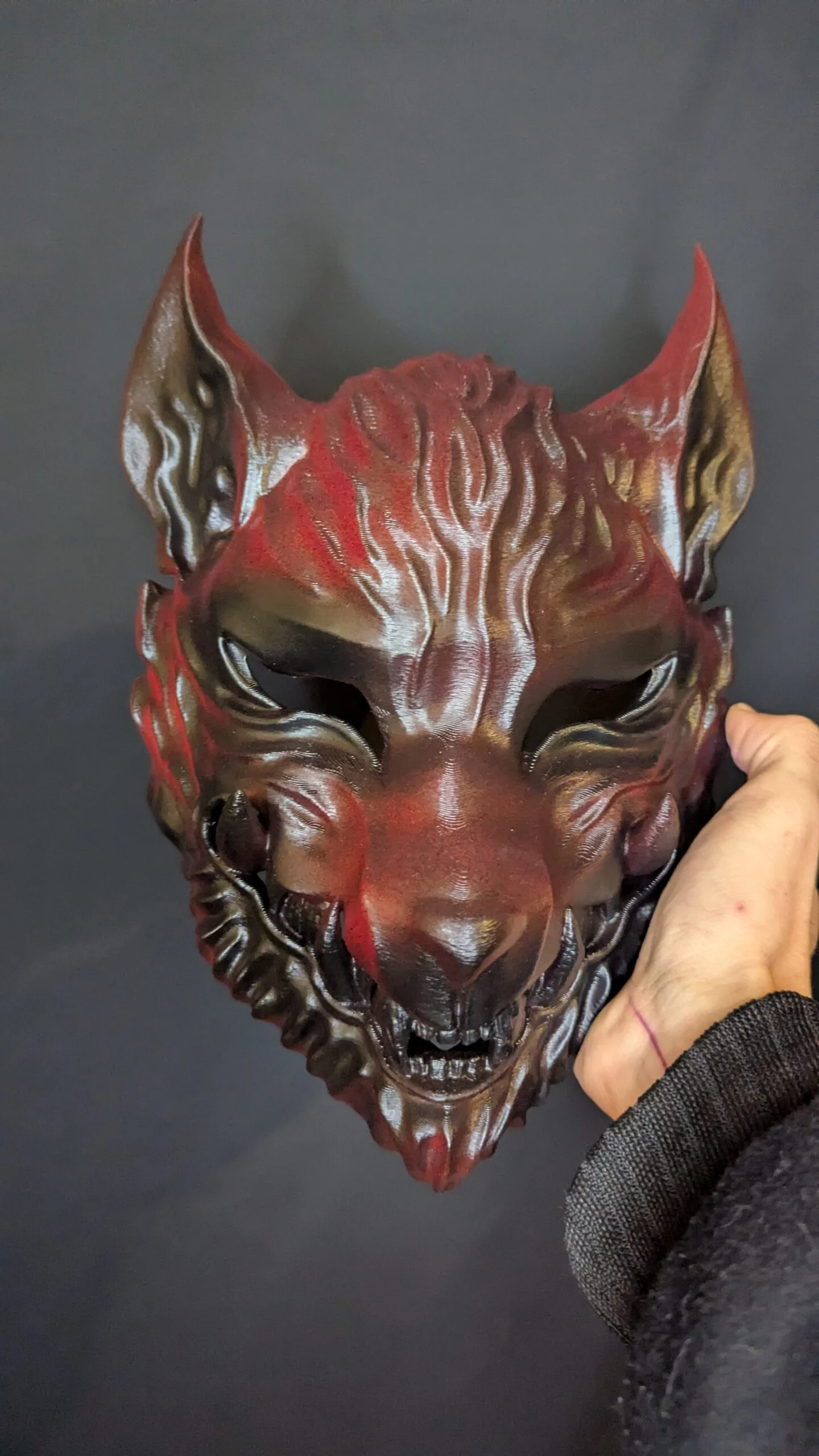
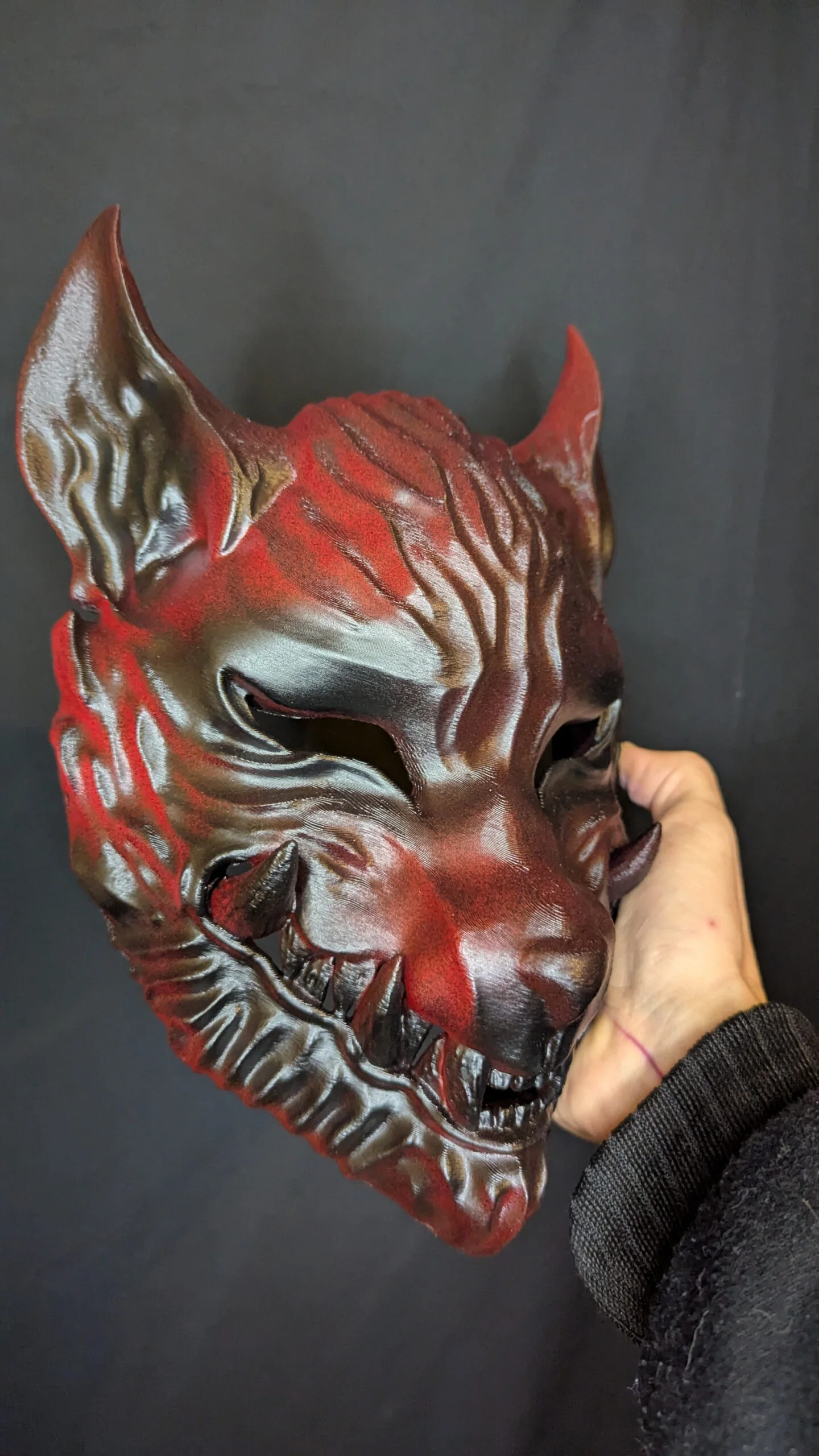
My Ōkami mask takes its visual direction from the quiet vigilance of a mountain guardian. The long animal face and controlled expression are meant to feel watchful rather than demonic. This is a contemporary design inspired by Japanese wolf imagery, not a copy of a sacred statue or historical mask.
Each piece is made to order in my Brittany workshop. The PETG base is sanded, primed, painted with acrylic layers and varnished by hand. It is intended for wall display, photo shoots, conventions and short event wear with a suitable fixing system.
In the workshop
See the handmade Ōkami mask
The Ōkami Japanese Wolf Mask is made to order in PETG, then sanded, painted and varnished by hand in Brittany. It is a contemporary art piece for display, photos or events, not a ceremonial object.
Conclusion
Ōkami begins as the Japanese word for wolf, but its cultural meaning depends on context. Shrine messengers, crop-protecting predators and the dangerous escort of night-road folklore are related images, not one universal character. Keeping those differences visible makes the Japanese wolf more interesting, and more accurate, than a simple guardian-god label.
Sources and further reading
- Mitsumine Shrine, official account of the wolf messenger and protective talisman
- Musashi Mitake Shrine, official history of Ōkuchi no Makami and Oinu-sama
- National Museum of Nature and Science, research on the Honshu wolf and its 1905 record
- The Japan Times, regional okuri-ōkami traditions and modern wolf research
FAQ
What does Okami mean in Japanese?
Ōkami, written 狼, means wolf in Japanese. The romanization looks the same as ōkami written 大神, which means great deity, but they are different words with different kanji. Japanese spelling and context show which meaning is intended.
What does the wolf symbolize in Japanese mythology?
There is no single national meaning. In several mountain traditions, wolves were feared wild animals but also protectors, guides or divine messengers. Some farming communities valued them because wolves preyed on deer and wild boar that damaged crops.
Is Okami a god or a yokai?
Ōkami simply means wolf, so it is not automatically a god or a yōkai. At shrines such as Mitsumine, the wolf is a divine messenger or protective attendant. In folktales, an okuri-ōkami can behave like a supernatural wolf or dog.
What is the okuri-okami?
The okuri-ōkami, or escorting wolf, follows a traveler on a mountain road at night. Stories vary by region. Some describe protection, while others warn that the animal may attack if the traveler falls or behaves carelessly.
Why are wolves important at Mitsumine Shrine?
Mitsumine Shrine identifies the wolf as the messenger of its deities and links it with the legend of guiding Yamato Takeru. The shrine's official account calls this figure Ōkuchi no Makami and associates its protective talisman with fire, theft and other dangers.
Are Japanese wolves extinct?
Yes. The Honshu wolf, Canis lupus hodophilax, is treated as extinct after the last confirmed record in 1905. The larger Ezo or Hokkaido wolf, Canis lupus hattai, disappeared by the end of the nineteenth century.
Is Amaterasu really a wolf in Japanese mythology?
Not in classical Shinto mythology. The video game Ōkami depicts the sun deity Amaterasu as a white wolf for its own artistic story. That famous image belongs to the game and should not be treated as a traditional description of Amaterasu.
Is the Dai Yokai Okami mask a traditional shrine mask?
No. It is a contemporary Dai Yokai art piece inspired by Japanese wolf and mountain guardian imagery. It is made from PETG, sanded, painted and varnished by hand in Brittany, and is not a ritual object or replica of a shrine artifact.