The baku (獏) is an imaginary creature said to devour bad dreams. Its form appears in miniature carvings, while its name can be written on the sail of a treasure ship picture.
A creature assembled from several animals
The LACMA entry connects the baku with Chinese folklore and records its presence in Japan by the fifteenth century. It lists possible features: an elephant’s trunk and tusks, rhinoceros eyes, an ox’s tail and tiger paws. Individual images may use only some of them.
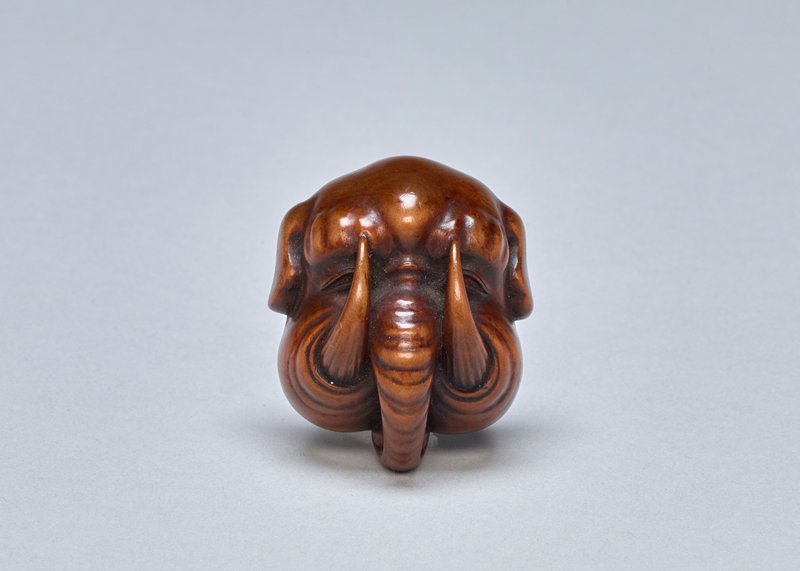
A netsuke in the form of a baku mask
Netsuke act as anchors for objects hanging from a kimono’s obi sash, including small inrō containers. The Met explains how the ensemble works.
The Minneapolis Institute of Art (Mia) holds a wooden netsuke by Sōkyū (藻丘), a miniature mask 3.9 cm high. Two long tusks frame a central trunk.
At the Linden-Museum Stuttgart, another baku is carved from antler and dated to the eighteenth century. The 6 cm figure sits on a small round platform, its trunk curled. Comparing the objects reveals different choices of material, pose and proportions.
The baku on a treasure ship's sail
The Osaka Museum of History explains that a treasure ship picture (宝船, takarabune) placed under the pillow at New Year or Setsubun was meant to encourage a good first dream. In a design by Ossandō dated 1931 (Shōwa 6), a gondola becomes a treasure ship. The character 獏 appears on its sail, associated with the eater of bad dreams. Look for it in the reproduction on the museum’s page.
Another treasure ship picture, described by the International Research Center for Japanese Studies (Nichibunken), likewise connects the 獏 written on its sail with bad dreams.
Other objects and symbols of good fortune, each with its own uses, are covered in our guide to Japanese good luck symbols and objects.
Sources
- LACMA, Baku: Monster that Eats Nightmares, unknown artist, 18th century, M.91.250.270
- Minneapolis Institute of Art, Sōkyū, Netsuke of Baku mask, 1850s, 2023.62.19
- Linden-Museum Stuttgart, baku netsuke, 18th century, OA18985, entry by Patrizia Jirka-Schmitz
- Osaka Museum of History, treasure ship pictures, exhibition notice, 2014
- Nichibunken, entry for a treasure ship picture (宝船)
- Terry Satsuki Milhaupt, Netsuke: From Fashion Fobs to Coveted Collectibles, The Metropolitan Museum of Art, 2009