Rokurokubi can refer to Japanese figures with extraordinarily long necks, but some stories use the name for beings whose heads leave their bodies. Nukekubi often identifies the detached-head form. Comparing a print with a particular tale makes the distinction clearer than a universal list of supernatural abilities.
Hokusai’s figures keep their heads attached
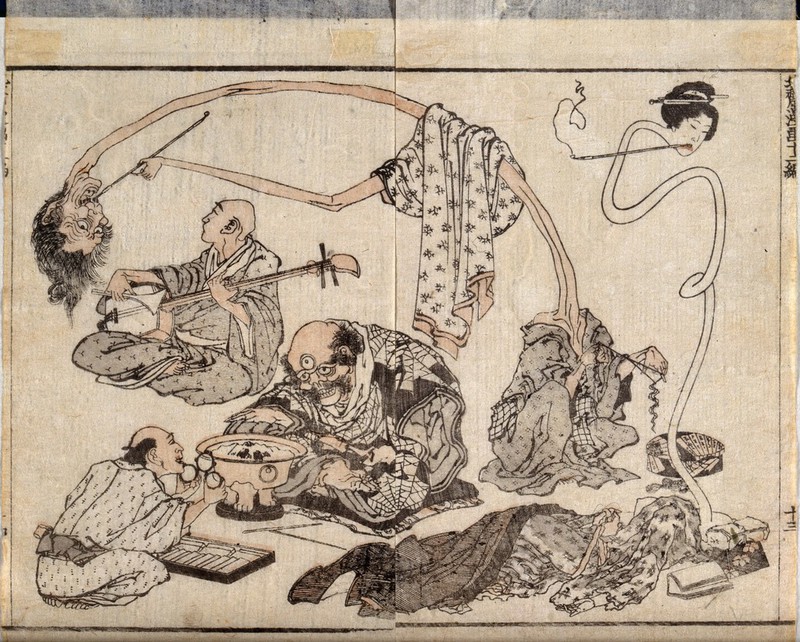
In the print shown here, a man’s neck bends sharply and his head hangs beside his body. On the right, a reclining woman’s neck forms a sweeping curve. Both smoke pipes. Their bodies remain visible: the striking feature is the distance between each face and its shoulders.
The Wellcome Collection attributes this coloured woodcut to Katsushika Hokusai and dates it [1834]. The brackets are part of the catalogue’s dating. A three-eyed figure being fitted with spectacles and a shamisen player share the scene.
Hearn tells a detached-head story
The Lafcadio Hearn Memorial Museum in Matsue traces “Rokuro-Kubi”, published in Kwaidan in 1904, to volume 4 of Jippensha Ikku’s Kaibutsu Yoron, from 1803. This identifies the source of one story, rather than an origin for every rokurokubi.
In Hearn’s tale, the monk Kwairyō finds five headless bodies in an isolated house and discovers their heads in the woods. He moves his host’s body to prevent its head from returning. Separation creates the danger here. The tactic belongs to this narrative; it does not establish a weakness shared by every rokurokubi.
When is nukekubi the more useful name?
Nippon.com’s overview distinguishes elongated necks from detached heads, which may be called nukekubi. That distinction helps describe an image. Yet Hearn’s detached-head story is titled “Rokuro-Kubi”, which shows why applying the distinction rigidly to every older text would be misleading.
When identifying a figure, ask whether its head remains attached, what name the document uses, and which work and date are involved. Its outline gives you a starting point. The title and context help test that first impression.
Dates belong to particular documents
The Museum of Fine Arts, Boston holds another print titled Rokurokubi, by Kikurensha Kyosen, dated 1765. This dates a catalogued artwork, not the invention of the motif. Likewise, 1904 dates Hearn’s book, not the first Japanese story about a flying head.
For a different visual effect, compare the noppera-bō, the faceless yōkai. An absent face produces unease without an elongated neck or a detached head. This is a useful visual comparison, rather than a claim that the figures share a documented historical origin.
Sources and documents
- Wellcome Collection, print 565230i: attribution, date and image.
- Lafcadio Hearn Memorial Museum, supernatural exhibition: the story’s transmission.
- Kwaidan, “Rokuro-Kubi”: the 1904 text, transcribed on Wikisource.
- Nippon.com, “Rokurokubi: Long Necks and Flying Heads”: overview of both forms.
- MFA Boston, 21.7174: Kyosen’s print.