The ubume is a mother ghost in Japanese tradition, associated with death during pregnancy or childbirth. She appears carrying a child. Depending on the story, handing it to a passerby leads to a reward or an unsettling discovery.
A child handed to a stranger
The Hyōgo museum describes holding the child as a test followed by strength or wealth. It cites an early form in the Konjaku monogatarishū (twelfth century), not the story’s invention.
Not every version ends with a gift. Nichibunken entry 0780081 summarizes a tale published in 1939 and located in Niigata: near a wooden bridge, a woman asks someone to hold her child. She vanishes, the child grows slightly heavier and turns out to be a stone.
Both begin with an entrusted child, but the Niigata entry ends with the stone and mentions no reward.

The mother who returns to feed her child
The Hyōgo museum also connects these tales with kosodate-yūrei, mother ghosts who buy ame, a sweet confection, for their infants.
The central action differs: handing over a child or seeking food for it. Our guide to Japanese yūrei places these figures alongside other stories of the dead.
Looking at Sekien’s ubume
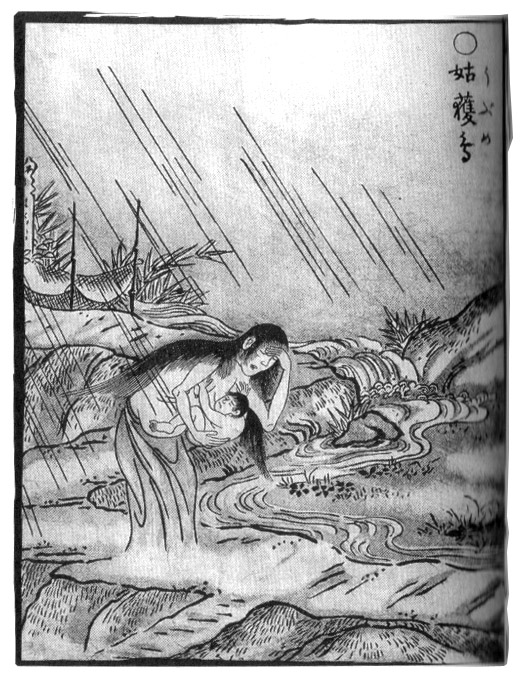
Toriyama Sekien depicted the ubume in the Gazu hyakki yagyō, first published in 1776 according to Yasui Manami’s study.
The monochrome reproduction shows a long-haired woman leaning toward the baby in her arms. Slanting lines of rain cross the scene, and a winding stream passes behind her. On the left are reeds and a frame with a cloth stretched across it. Her posture brings the faces together; her arms hold the child in front of her bent body.
The drawing alone does not give a story’s ending. An infant in the image cannot tell us whether it will be entrusted to someone, fed by its mother or revealed as something else. The accompanying text still matters.
Why do some images have bird features?
Both 産女 and 姑獲鳥 occur. Yasui traces Chinese guhuoniao influences in some Japanese bird-woman images, notably Kyōsai’s. This is not a universal form.
Sources
- Hyōgo museum, mother-ghost legends.
- Nichibunken, entry 0780081: summary of a 1939 article, 高志路, 5(3), p. 42.
- Yasui Manami, Japan Review 35 (2020), pp. 91-112.
- Toriyama Sekien, reproduction on Wikimedia Commons.