Umi-bōzu (海坊主) is a large maritime apparition in Japanese stories. Its head recalls a monk’s shaved scalp. In Kuniyoshi’s print, the sailor Tokuzō faces it with an answer rather than a fight. Other records give the figure different faces and behaviours.
A name that describes a silhouette
The Daijisen dictionary on Kotobank describes a large, monk-like creature in sailors’ and fishermen’s traditions. That resemblance does not establish a story about a drowned or transformed priest.
Tokuzō in two museum accounts
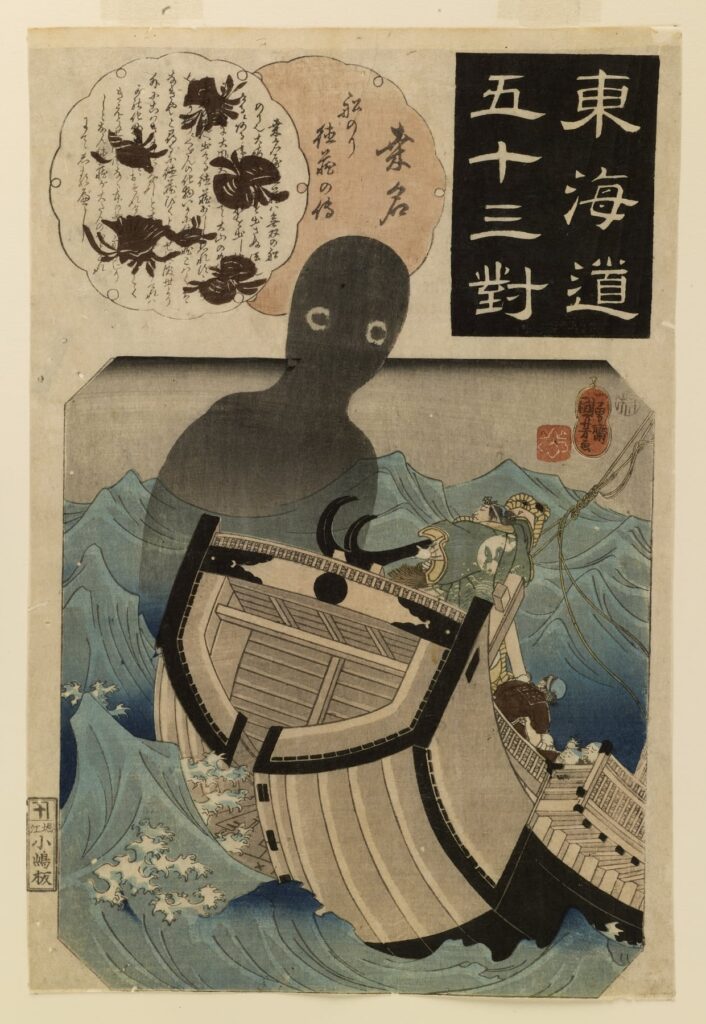
The Walters Art Museum dates this Kuniyoshi print around 1845-1846. Its account describes Tokuzō sailing on the last day of the year. A storm and a monster appear. Asked what is most horrible, he names his trade; they disappear.
The Ōta Memorial Museum of Art presents the same composition in its archive of a 2019 exhibition, published online in 2021. Its account describes an Osaka boatman breaking a prohibition on sailing. Asked about fear, he replies that making his way in the world is more frightening still.
Both accounts turn on a differently worded reply. The ranges 1845-1846 and 1844-1847 date the catalogued sheets, rather than the origin of the folklore.
Reading the print: a great shadow at sea
The sheet is vertical. The boat tilts on a steep diagonal across angular blue waves. Near the front, the sailor looks up at a large dark figure without hair, marked by two pale, ring-shaped eyes. Cartouches of Japanese text occupy the upper part of the sheet.
The face has very few features, and no monk’s robe is visible. The figure reads first as a mass. Its drawn size contrasts with the vessel; it is not a measurement of umi-bōzu. The tilted hull and the waves reinforce the imbalance of the encounter.
Other traditions, other images
Nichibunken entry 0780067 summarizes a Niigata tradition published in 1937: people said that scattering miso on the sea drove umi-bōzu away. No town is specified. This is a recorded local belief, rather than a universal weakness or advice for anyone at sea.
The Heibonsha encyclopedia, also on Kotobank, describes versions in which the creature demands a ladle to fill the boat with water. It is given a bottomless ladle instead. This is a different episode from Tokuzō’s reply.
A Nichibunken image record describes Toyosada’s bald-headed figure with yellow eyes and a red tongue. Those features differ from Kuniyoshi’s sparsely detailed face. The digital entry’s “2010” field should not be used to date the older artwork.
Fresh water also has its stories. The river kappa belongs to a different body of tradition. Comparing aquatic encounters helps show their differences without making one creature a smaller version of the other.