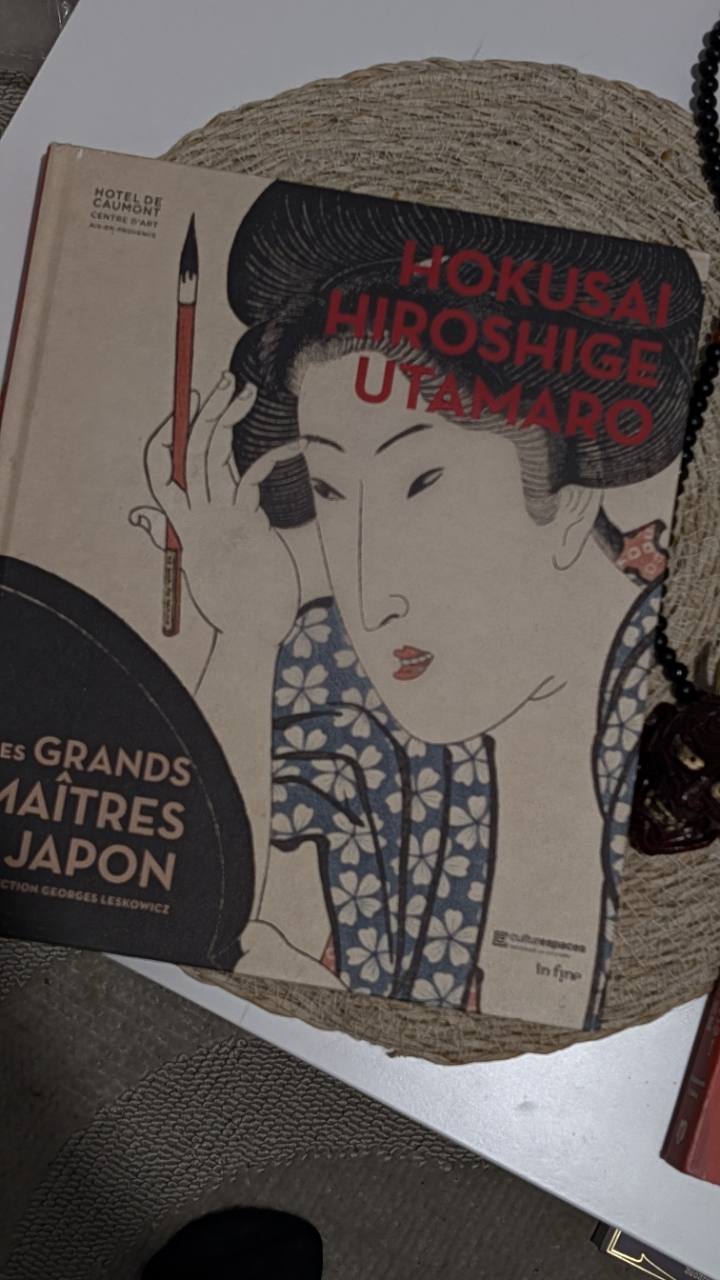
Hokusai, Hiroshige, Utamaro. Les grands maîtres du Japon. Collection Georges Leskowicz is a French-language Japanese art catalogue. It approaches Edo imagery through faces, landscapes, patterns and everyday scenes. The three names in the title identify represented artists, while Georges Leskowicz is the collector. The volume’s focus is a route through a particular collection, with several subjects and ways of looking.
One collection, several ways of looking
The cover places a face beside an elaborate hairstyle and patterned clothing. Start by following the facial lines towards the dark shapes of the hair, then notice how the fabric’s decoration animates another part of the image. The portrait becomes a composition to examine beyond the identity of its subject, with different kinds of line and surface working together.
The contents published by In Fine offer several entry points: landscape, nature and poetry, everyday life, New Year rituals, legends and stories, beauties and courtesans, and kabuki actors. They also announce an introduction to surimono. This organisation helps define a reading question around a place, character, practice, or relationship between image and text.
Face, framing and pattern: three practical questions
With a portrait, start by noting the turn of the face, the position of the eyes and the space around the head. This describes a composition without assigning it a universal emotion. A mouth or an eyebrow does not automatically carry the same meaning in every setting. A work’s collection record should identify a character or theatrical role when that information is known.
Then look at a pattern across the clothing instead of treating it as an isolated sign. Where does it repeat? Does it follow a curve or meet a quieter area? These questions can support visual research without making the catalogue a tattoo manual. The history of irezumi treats that context separately. Likewise, the families of Japanese masks should not be confused with every face represented on stage or in a print.
Its place beside books about yōkai
The volume may suit a reader interested in Edo visual culture beyond supernatural figures. To identify a creature or investigate its variants, begin with a dedicated reference instead. The yōkai library guide separates those needs: an art catalogue and a folklore dictionary do not organise a search in the same way or promise the same information.
To find an entry point, start with a concrete question: examining a theatrical face, following a landscape’s line, or comparing the role of a pattern within a composition. The contents provide a way to locate that enquiry before browsing the images. The three familiar names in the title give orientation within a collection whose range extends beyond a single genre.
The French edition being presented
In Fine presents the French edition published on November 21, 2019 under the direction of Anna Katarzyna Maleszko and Geneviève Aitken. Hôtel de Caumont-Centre d’art, Culturespaces and In Fine éditions d’art are the co-publishers. Its ISBN is 9782902302413. This 208-page hardback, measuring 24 × 28 cm, accompanies the exhibition devoted to the Georges Leskowicz collection.
This edition is in French. I may earn a commission from this link. Find this edition on Amazon.fr (France).
The publisher lists short artist biographies, an ukiyo-e print glossary and a chronology of the Edo period among the appendices. These references extend the images: placing a name, clarifying a term or comparing the working dates of different artists. They complement a thematic approach and help organise the references gathered while exploring the catalogue’s subjects.
For faces in another medium, the handmade Dai Yokai masks are contemporary creations made in Brittany. Printed in PETG, prepared and painted by hand, they offer an expression in three dimensions and a way to consider its presence in a room, studio or display space.
Sources
Documentary overview based on the cited records and the photographed copy.