Hitotsume-kozō (一つ目小僧) is a one-eyed yōkai. Local traditions connect it with baskets hung at the entrance to homes. Its appearance and role vary between records. Our guide to Japanese yōkai gives the wider background.
One eye, several bodies
In the Nihon daihyakka zensho, Nomura Jun'ichi observes that the body changes from tale to tale: often a child, sometimes a one-eyed, one-legged giant in Gifu. Yanagita Kunio proposed an ancient divine origin; the encyclopedia also records criticism of that theory.


Holes that count as eyes
In Yamato, 8 December and 8 February are the days called Yōkazō (八日僧). Baskets or sieves were hung at entrances: their holes counted as eyes believed to frighten the visitor. Shoes left outside could be marked for misfortune. In other places, these days welcome kami instead.
The Seya notebook
In Seya, Yokohama, the municipal tale describes an invisible visitor who comes down from the mountain and records names in a notebook left with Dōsojin. It returns at Hatsuuma. The temporary shelter is burned with decorations on 14 January to prevent the notebook’s return. The Yamato sheet instead gives 8 February in some neighbourhoods.
Stories told at night
In Sanada (Ueda, Nagano), an entry in the Nichibunken database summarises a tradition: telling stories at night made Hitotsume-kozō appear and peer into the house, or brought oni, or made the stories come true.
Mehitotsubō, another one-eyed figure
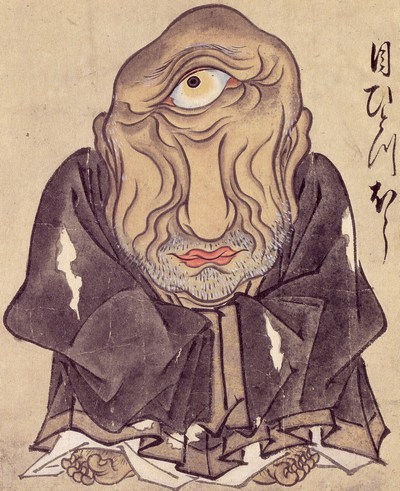
Sawaki Sūshi's Hyakkai zukan (百怪図巻), dated 1737, includes a Mehitotsubō (目一つ坊). The crouching figure has a large, wrinkled head, a single eye above a long nose and a short beard; a dark purple, frayed cloak covers the shoulders, and the small bare feet show their toes. The name is written vertically on the right. The face looks old rather than childlike. There is no notebook and no basket here. The picture alone does not identify this figure with the visitor in the Yamato or Seya tales.
Sources
- Kotobank, "一つ目小僧": Daijisen and Nihon daihyakka zensho (entry by Nomura Jun'ichi).
- Yamato, local heritage exhibition sheet no. 6, "ヨーカゾーの目籠飾り".
- City of Yokohama, Seya Ward, "第十五話:一つ目小僧", updated March 15, 2024.
- Nichibunken, entry C2010164-000, summarising 長野県史 民俗編 東信地方 ことばと伝承, vol. 1 no. 3 (1987), p. 389, by 細川修 and 松本清人.
- Sawaki Sūshi (佐脇嵩之), Hyakkai zukan, 1737: "Mehitotsubō" on Wikimedia Commons, public domain, scanned from a printed book.