The Tenome (手の目) carries its eyes in the palms of its hands. That image turns up in documents of very different kinds: a dictionary entry, a plate by Toriyama Sekien, a sugoroku game and a tale. Taking them one at a time shows what is actually on record about this figure.
Sekien's Tenome
The Daijisen Plus dictionary on Kotobank defines the Tenome as a yōkai from Toriyama Sekien's Gazu hyakki yagyō, shown as a zatō with eyes in its palms, and likens it to the Teme-bōzu. According to the National Museum of Japanese History (Rekihaku), the book was published in 1776 and brings together named figures.
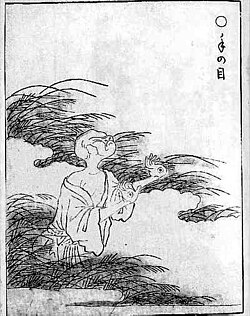
The Tenome plate, reproduced on Wikimedia Commons, is in monochrome. A thin human figure in a loose garment leans slightly forward among tall grasses, both arms raised toward the right, hands open, with eye motifs in the palms. The Japanese name is written vertically in the top right corner. The definition and the plate give an appearance, not a story.

Another medium
The Nichibunken yōkai image database has an entry titled 手のめ, filed under 新版妖怪飛巡雙六, a sugoroku game with no author listed. It describes a bald head, a face without eyes, eyeballs in the palms and a black kimono.
The Shokoku hyakumonogatari (諸国百物語)
The Shokoku hyakumonogatari, published in 1677, places an encounter in Shichijōgawara, Kyoto (volume 3, story 6). A tall old man has eyes in his hands. The pursued man flees to a temple; a monk hides him in a chest. After the monster enters and noises are heard, the man is found without his bones.
The National Institute of Japanese Literature’s summary does not name the monster Tenome. The comparison with Sekien rests here on the eyes-in-hands motif.
A vanished face, displaced eyes
The noppera-bō, a faceless yōkai, helps place the Tenome by contrast. The two are neither one species nor one story: with the noppera-bō, the face disappears; with the Tenome, the eyes move into the palms.
Sources
- Daijisen Plus, “手の目”, Kotobank.
- National Museum of Japanese History (Rekihaku), record F-320-813, Gazu hyakki yagyō.
- Toriyama Sekien, Tenome, public domain, reproduced via Wikimedia Commons.
- Nichibunken, entry “手のめ”.
- 工藤隆彰, National Institute of Japanese Literature, 2021.