The Hyottoko mask represents a comic Japanese figure recognized by a puckered, sideways mouth, as if blowing air onto a fire. It is associated with humor, household fortune and festival dance rather than fear. Hyottoko is often paired with Okame or Otafuku, but the character's regional legends and performance roles are more varied than a single ‘god of fire’ label suggests.
Hyottoko mask meaning: the short answer
Hyottoko is a comic masked character tied to the hearth, laughter and regional dance traditions. The crooked mouth is usually explained as a man blowing through a bamboo tube to keep a fire alive. In festivals, the exaggerated face turns practical breath into comedy, rhythm and a cheerful association with prosperity.
| Feature | Common meaning | Important nuance |
|---|---|---|
| Puckered, sideways mouth | Blowing air onto hearth embers | The gesture is a common explanation, not the only regional story |
| Uneven eyes | Comic exaggeration and movement | Not every historical mask uses the same asymmetry |
| Dotted headscarf | A recognizable folk-performance costume | Colors and patterns vary |
| Laughing or foolish role | Humor, release and festival energy | Hyottoko can be a farmer, clown or stock character depending on the performance |
| Hearth association | Household fortune and continuity | This does not make every Hyottoko mask a sacred ritual object |
Who is Hyottoko?
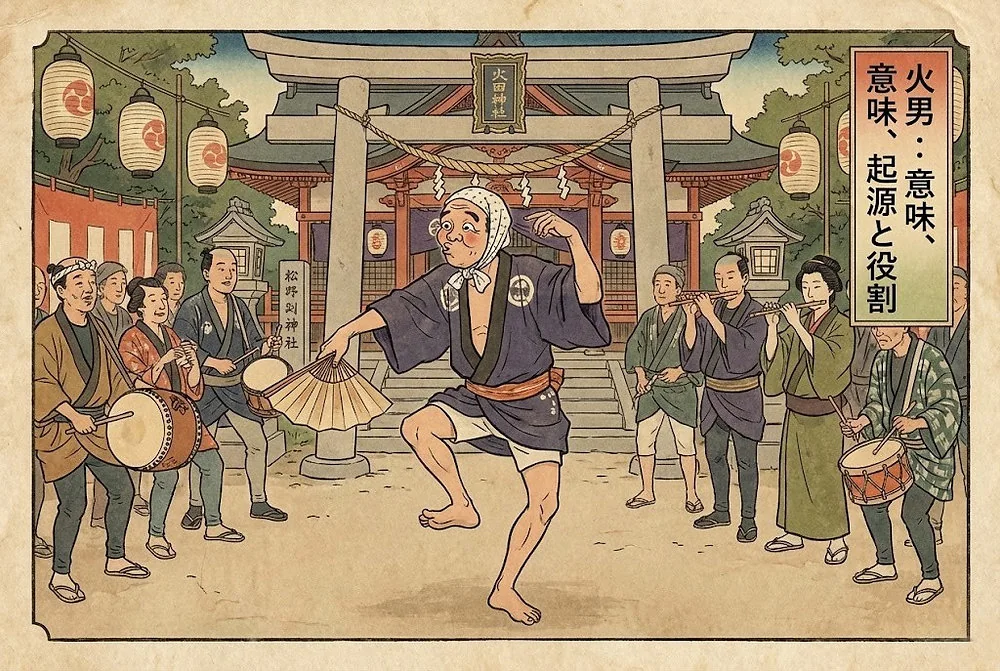
Hyottoko is a stock comic figure in Japanese visual and performance culture. His face is human, but deliberately off balance: one eye may be smaller, the cheeks may puff out and the mouth points to one side. The mask is designed to read instantly, even when a dancer is moving through a crowd.
He is not best understood as an evil spirit. Historical collections describe Hyottoko as a comic character, farmer or dance role, while regional legends connect the face with fire and household fortune. Modern lists sometimes place him beside yokai, but that convenient grouping should not erase his theatrical and human qualities.
Where does the name Hyottoko come from?
The most common explanation links Hyottoko to hi-otoko, ‘fire man’, often represented with the characters 火男. In a traditional home, a person could blow through a bamboo fire tube, or hifukidake, to revive embers in the irori, the sunken hearth. The mask's mouth resembles that focused breath.
This is a widely repeated folk etymology rather than a reason to translate every appearance of Hyottoko as a literal fire deity. The name is normally written ひょっとこ in hiragana, and the character accumulated different roles as stories and dances moved between regions.
The Tohoku hearth legend and household luck
One origin story from northeastern Japan tells of a strangely faced boy who produces gold from his navel and brings prosperity to a household. After he is lost, a mask recalling his face is placed near the hearth so that his fortune will remain with the family. Details vary between retellings.
The value of the story is not that it supplies one official birth certificate for Hyottoko. It shows why the character can connect fire, the center of the home and good fortune. Regional legend, household display and stage comedy overlap without becoming one fixed doctrine.
Hyottoko and Okame or Otafuku
Hyottoko is frequently paired with a rounded, smiling female face called Okame or Otafuku. The names overlap in popular use, although their histories and local contexts are not perfectly identical. As a visual pair, the contrast is immediate: his face is pinched and animated; hers is broad and composed.
| Point | Hyottoko | Okame / Otafuku |
|---|---|---|
| Typical face | Puckered mouth, uneven comic expression | Round cheeks, small mouth, calm smile |
| Usual role | Movement, foolishness, blowing and dance | Warmth, composure and smiling humor |
| Shared context | Festivals, folk performance and decoration | Festivals, folk performance and decoration |
| Relationship | Often presented as the male half of a comic pair | Often presented as the female counterpart |
| Caution | Not simply a demon or fire god | Not one single character with an identical history everywhere |
The Hyuga Hyottoko dance and summer festival
Hyuga in Miyazaki Prefecture hosts the best-known Hyottoko festival. The event began in 1984 to help pass on Nagata's Hyottoko dance, performed in the area since the Meiji period and recognized by Hyuga City as intangible folk cultural property. The main celebration normally takes place on the first Saturday of August.
The parade combines puckered masks, bent postures, fans and deliberately awkward steps with flutes, gongs and taiko. Japan's national tourism organization reports more than 2,000 dancers and about 70,000 visitors, showing that Hyottoko is not merely a decorative face but a living public performance.
Hyottoko in kagura, folk dance and historical objects
A wooden Hyottoko mask in the British Museum is catalogued as an Edo-period kagura dance mask representing a drunken farmer. The Metropolitan Museum of Art also holds a seventeenth-century sword guard decorated with the character and a nineteenth-century wooden netsuke shaped like a one-eyed Hyottoko mask.
These objects matter because they prevent an overly narrow label. Hyottoko can appear in religious festival performance, comic dance and small personal objects. Calling every example a Noh mask, a Kyogen mask or a yokai mask would flatten a more varied history.
Hyottoko and the kyōgen mask Usobuki
Hyottoko should not be confused with Usobuki. The Japanese cultural heritage catalogue describes a kyōgen mask with protruding eyes and a pointed mouth resembling Hyottoko. It serves roles such as a mosquito spirit, a scarecrow or an octopus. A similar expression does not make the two masks interchangeable.
Is Hyottoko a yokai, kami or demon?
The clearest answer is that Hyottoko is primarily a comic masked character from folklore and performance. He is not an Oni and is not normally a threatening demon. Some modern sources call him a yokai or a fire spirit, while others describe a human fool, farmer or lucky figure.
Context should decide the label. A festival dancer, an Edo-period kagura mask and a modern anime character do not all perform the same function. ‘Comic folklore figure associated with fire and luck’ is accurate without claiming one universal religious status.
Hyottoko in modern design and Demon Slayer
Hyottoko remains visible in festival souvenirs, wall masks, tattoos, manga and anime. Demon Slayer gives Hyottoko-inspired masks to the Swordsmith Village, turning the comic face into a shared fictional identity. It is a recognizable design choice, not evidence that historical swordsmiths wore this mask as a uniform.
In tattoo or decorative design, the face may suggest humor, luck, fire, eccentricity or festival energy. Those readings are contemporary combinations rather than a fixed code. The surrounding motifs and the artist's intent still matter.
From folklore to a contemporary handmade mask
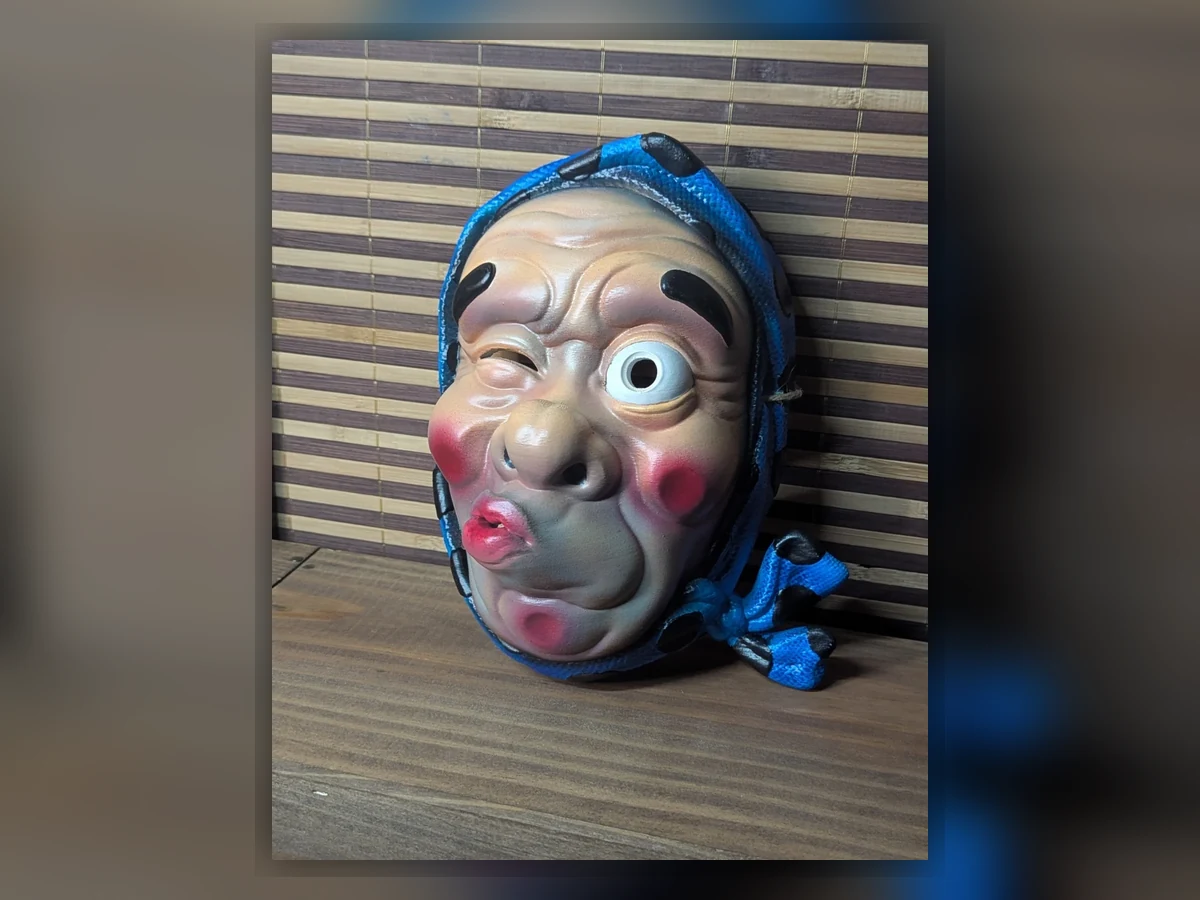
A contemporary Hyottoko mask has to preserve the expression without pretending to be a historical ritual object. The mouth must stay readable from the front and in profile, while the uneven eyes and cheek tension keep the face comic rather than grotesque.
In the Dai Yokai workshop in Brittany, the handmade Hyottoko lucky charm mask is printed in PETG, then sanded, primed, painted, varnished and finished by hand. It is a contemporary piece inspired by the established character. For wider context, explore the guide to Japanese mask types and meanings or the full handmade Japanese mask collection.
Historical and festival sources
The official Hyuga Hyottoko Summer Festival documents the living event and its schedule, while Japan's national tourism organization describes its scale. Historical objects can be checked in the British Museum's kagura mask record and the Metropolitan Museum of Art's seventeenth-century Hyottoko sword guard.
FAQ
What does a Hyottoko mask mean?
A Hyottoko mask represents a comic Japanese figure associated with blowing on a hearth fire, laughter and good fortune. Its puckered mouth, uneven eyes and headscarf make the character instantly recognizable. Meanings vary by region and performance, so it is more accurate to call Hyottoko a comic folklore figure than a universal fire god.
Why is Hyottoko's mouth crooked?
The usual explanation is that Hyottoko is blowing air through a bamboo tube to revive embers in an irori, the traditional sunken hearth. The pursed, off-center mouth freezes that blowing gesture into a comic expression. Some dance styles exaggerate it further for movement and humor.
Is Hyottoko a yokai?
Hyottoko is best described as a comic masked character from Japanese folklore and performance, not a frightening demon such as an Oni. He is sometimes grouped with yokai or supernatural figures in modern lists, but historical objects and dances also treat him as a stock human character, farmer or festival clown.
What is the difference between Hyottoko and Okame?
Hyottoko is usually the male comic face with a puckered, sideways mouth. Okame, also closely associated with the name Otafuku, is the rounded smiling female face. They often appear together in dances, decorations and festival imagery as a contrasting comic pair, although each character also has separate traditions.
Does a Hyottoko mask bring good luck?
Hyottoko is connected with household fortune in regional hearth legends, and modern masks are commonly displayed as cheerful good-luck figures. This is a cultural association rather than a guaranteed ritual function. A contemporary decorative mask should not be presented as an authentic sacred object.
Where is the Hyottoko dance festival held?
The best-known event is the Hyuga Hyottoko Summer Festival in Hyuga, Miyazaki Prefecture. It developed from Nagata's Hyottoko dance, a local tradition recognized by Hyuga City as intangible folk cultural property. The main festival is normally held on the first Saturday of August.
Why do Demon Slayer swordsmiths wear Hyottoko masks?
Demon Slayer uses Hyottoko-inspired masks as a memorable visual identity for the Swordsmith Village. That is a modern fictional choice based on a recognizable Japanese comic mask. It should not be treated as evidence that historical Japanese swordsmiths routinely wore Hyottoko masks.
What does a Hyottoko tattoo mean?
A Hyottoko tattoo can suggest humor, luck, fire, festival energy or the ability to face life without excessive seriousness. Those meanings are modern design interpretations, not one fixed traditional code. The surrounding motifs, expression and placement determine how the character reads in an individual tattoo.
Is Hyottoko the same mask as Usobuki?
No. Usobuki is a kyōgen mask with its own stage roles. Its pointed mouth can resemble Hyottoko, but visual similarity does not make them the same character.