A Kitsune tattoo mainly evokes transformation, intelligence, and the fox's ambiguity in Japanese stories. It may depict a messenger of Inari, a trickster fox, a hidden identity, or the powerful nine-tailed fox. Its meaning depends on the chosen subject, attributes, and composition, rather than a universal dictionary.
Before planning the design
- Kitsune means fox in Japanese, although stories often give it powers of transformation and cunning.
- Inari's fox is a messenger. Inari Ōkami should not be confused with a fox.
- A whole fox and a Kitsune mask do not tell exactly the same story.
- Colors have no fixed code that applies to every tattoo.
- The number of tails should be intentional, especially when depicting a nine-tailed kyūbi.
What does a Kitsune tattoo mean?
The motif can suggest several coherent ideas: the ability to change, intelligence, seduction, cunning, moving between identities, or a connection with the unseen world. These meanings come from very different stories. Some foxes help humans, others deceive them, and others appear as messengers associated with Inari.
Instead of looking for a single Kitsune meaning, ask which fox you want to tell a story about. A white fox before a torii, a spirit taking human form, and a kyūbi surrounded by ghostly lights do not create the same image, even though all three may be called Kitsune.
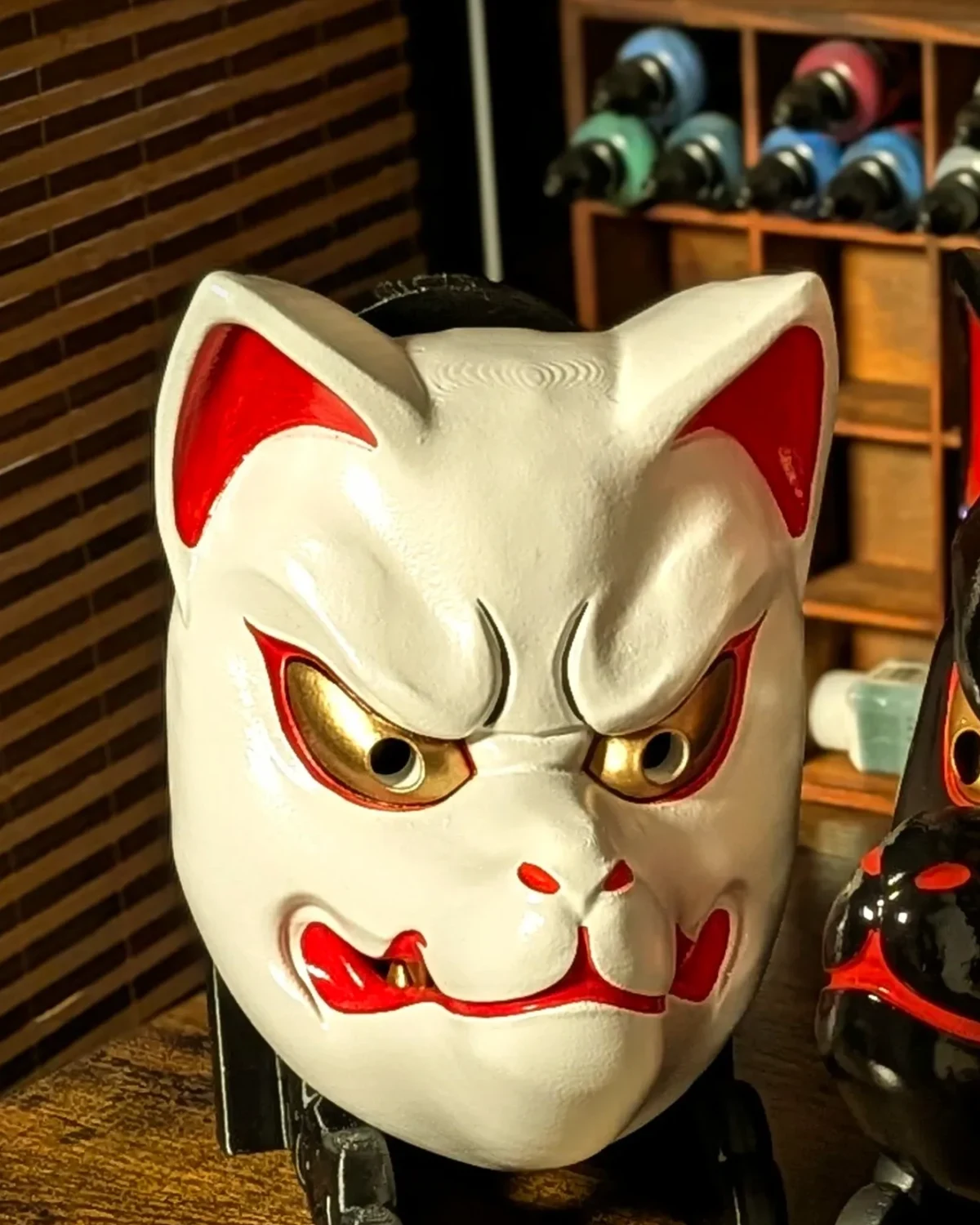
Inari, the magical fox, and kyūbi: three different directions
Inari's messenger
At Inari shrines, foxes are considered the deity's messengers. Fushimi Inari Taisha explains that these invisible messengers are called byakkosan, or white foxes, and that Inari Ōkami is not a fox. This distinction avoids a frequent shortcut in tattoo descriptions.
A composition can reinforce this direction with attributes associated with Inari fox figures: a rice granary key, a jewel, or a torii. Japan's National Diet Library describes the fox statues as embodied messengers of Inari. These details need to stay readable, rather than being piled together simply to look Japanese.
The shapeshifting trickster fox
Stories of supernatural foxes often involve disguise, transformation, and deception. The fox may appear human to seduce, test, or sometimes help someone. A woman in a kimono whose shadow reveals a tail, a human face alongside a mask, or a fox between two forms can express that duality.
A kamishibai catalog record held by Japan's National Diet Library describes the folkloric fox as a magical trickster that often takes a woman's appearance. It illustrates cunning and transformation more clearly than modern lists of Kitsune powers.
The nine-tailed fox
The kyūbi no kitsune is a specific nine-tailed fox figure, part of a wider East Asian tradition that was reworked in Japan. Its nine tails suggest exceptional supernatural power. Avoid treating them as a modern ranking in which each tail automatically corresponds to a set age or power.
If you choose nine tails, allow enough space. They should surround the fox's body, guide the eye, or create movement without becoming an unreadable mass once the tattoo has healed.
A whole fox or a Kitsune mask: which should you choose?
| Version | What it emphasizes | What to consider |
|---|---|---|
| Whole fox | Movement, animal nature, tails, transformation | Allow enough room for the silhouette and tails |
| Kitsune mask | Hidden identity, the expressive face, a more compact design | Do not automatically assign it a ritual function |
| Kyūbi | Supernatural power and a dramatic composition | Avoid nine tails that are too small or merge together |
| Human form and fox | Transformation, dual identity, storytelling | Give a clear visual clue: a shadow, tail, mask, or fire |
A mask works well on the forearm, calf, or shoulder blade because its outline stays readable in a contained format. A whole fox or kyūbi needs more space and generally suits the thigh, back, shoulder, or a sleeve planned around the body.
Colors: design choice or traditional symbol?
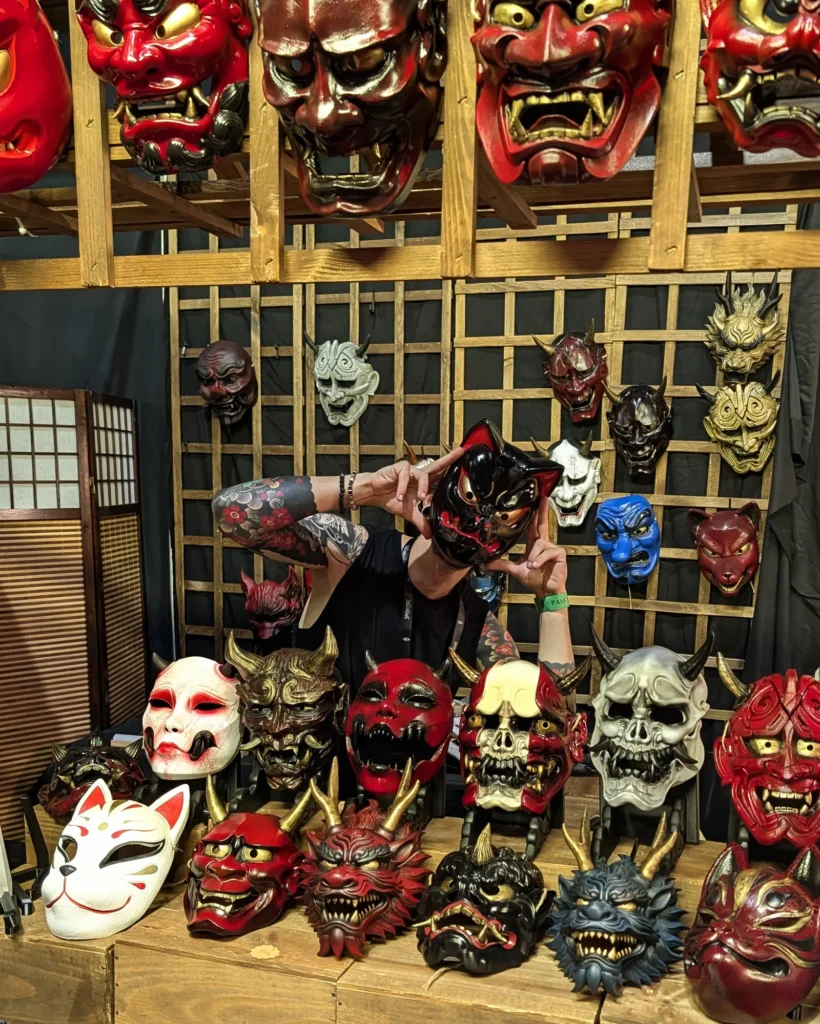
White, black, red, and gold create different visual impressions, but they do not form a universal folkloric code. White may recall Inari's white fox messengers. A black fox can create a nighttime atmosphere or strong contrast. Red may echo vermilion torii. Treat these associations as choices within a composition, rather than mandatory meanings.
| Palette | Possible visual effect | What not to assume |
|---|---|---|
| White, red, black | An appearance associated with fox masks and shrines | That every white Kitsune is protective |
| Black and gray | A nighttime mood, contrast, and cohesion with blackwork | That black identifies a specific type of fox |
| Red and gold | A warm, decorative, intense focal point | That gold must mean wealth or divinity |
| Natural colors | A more animal-like fox, less like a mask | That realistic fur removes every supernatural aspect |
Which motifs can accompany a Kitsune in irezumi?
Good supporting motifs strengthen the story and the way the design flows over the body. Kitsunebi, or fox fires, create a supernatural atmosphere. Japan's National Diet Library describes these lights attributed to foxes and the tradition of their gathering at Ōji Inari at New Year.
- Torii, key, or jewel: for a connection with Inari, used precisely.
- Kitsunebi, clouds, or wind: to guide movement and make the scene supernatural.
- Flowers and foliage: to establish a season and balance the larger shapes.
- A mask or human figure: to tell a story of transformation and hidden identity.
- A skull, leaf, or other accessories: only when the tattoo artist can explain their origins within the chosen composition.
In a large Japanese piece, season, background, and supporting motifs should be planned together. An artist specializing in Japanese tattooing can assess whether flowers, waves, wind, or clouds fit the rest of the project. For the overall structure, read the Japanese tattoo motifs guide and the article on the history of irezumi.
Placement: following the body's movement
Do not choose a placement only because it is popular. It needs to preserve the muzzle, ears, eyes, and tails as the body moves.
- Forearm or calf: a compact mask, fox head, or one clearly readable tail.
- Shoulder and upper arm: a head facing the torso, with tails or background flowing down the sleeve.
- Thigh: enough space for a whole fox, a human figure, or several tails.
- Back: suitable for a kyūbi or a full scene with its surroundings.
- Sleeve: requires an overall plan for future motifs, rather than a collection of small images.
Seven questions to prepare for your tattoo artist
- Do you want a fox, a mask, or a character transforming?
- Should the connection with Inari be visible or absent?
- How many tails do the story and clarity of the design need?
- Do you prefer traditional Japanese, neo-Japanese, graphic, or blackwork composition?
- Which motifs already exist or might be added around it?
- Which season and background movement do you want?
- Which references are documented, and which come only from pop culture?
Bring images to show a direction, but let the artist rebuild the drawing for your anatomy. A copy from Pinterest is neither personal nor automatically suited to your body.
The connection with Dai Yokai masks
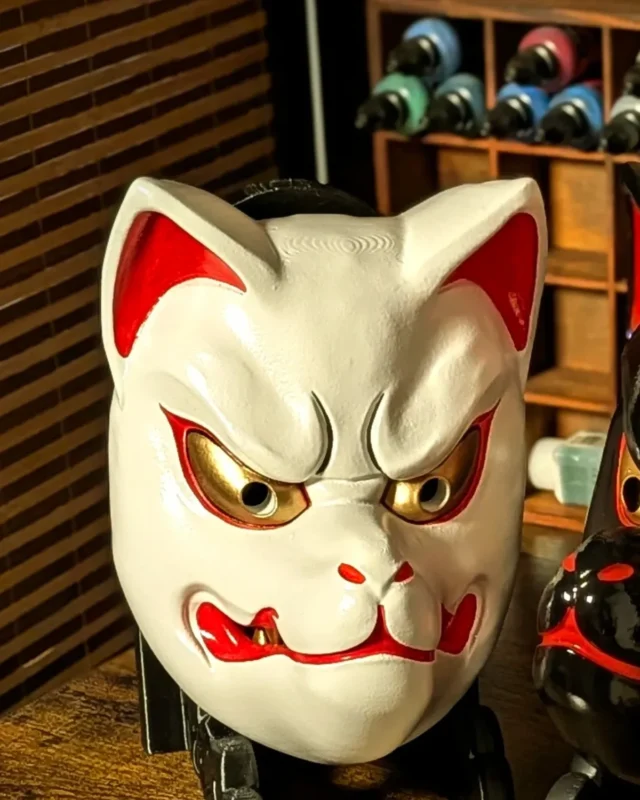
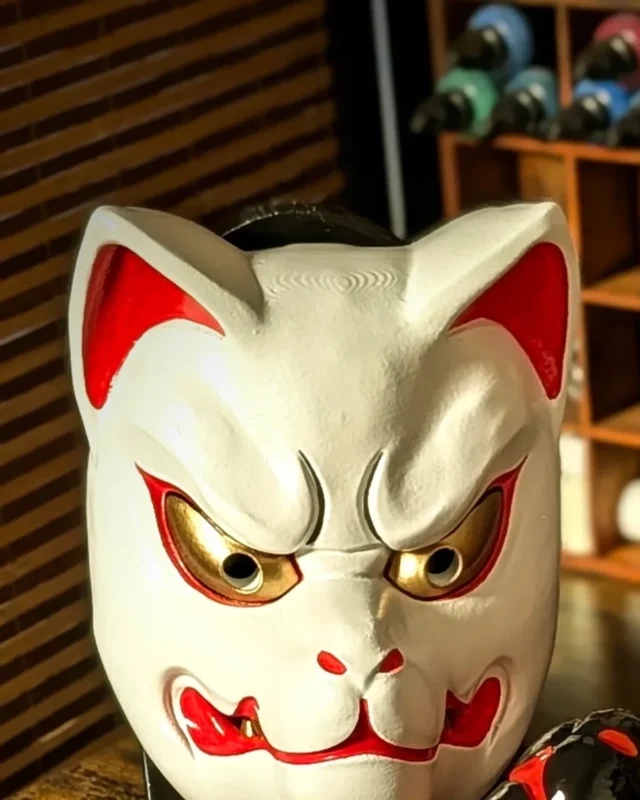
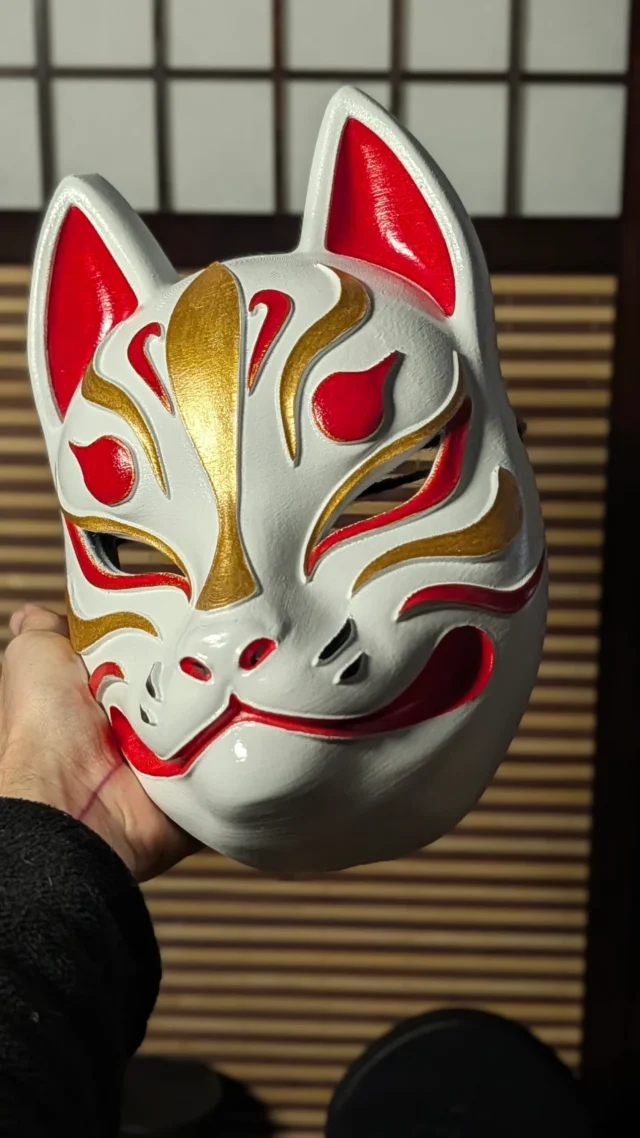
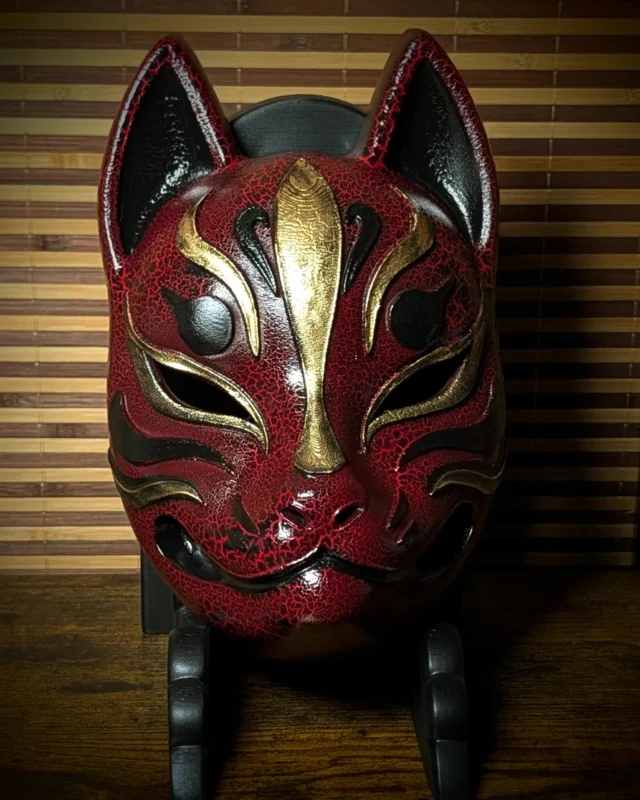
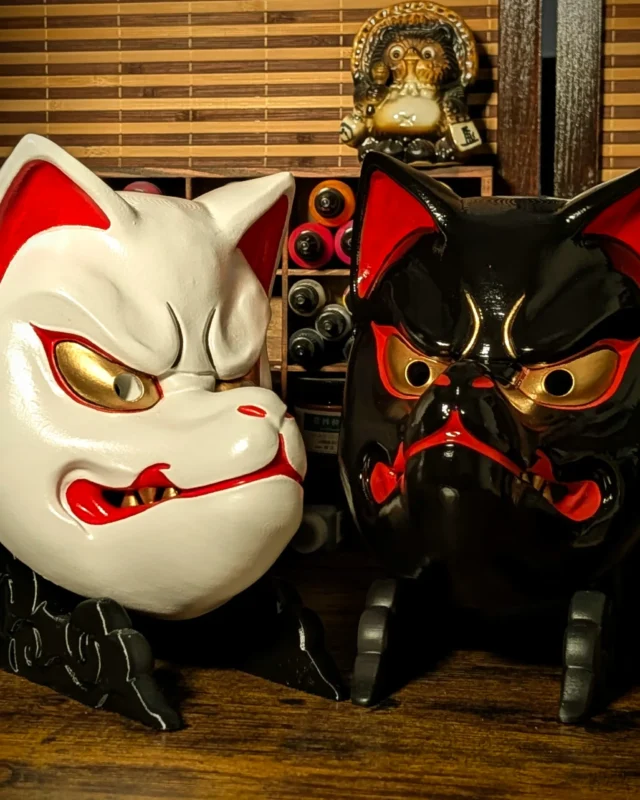
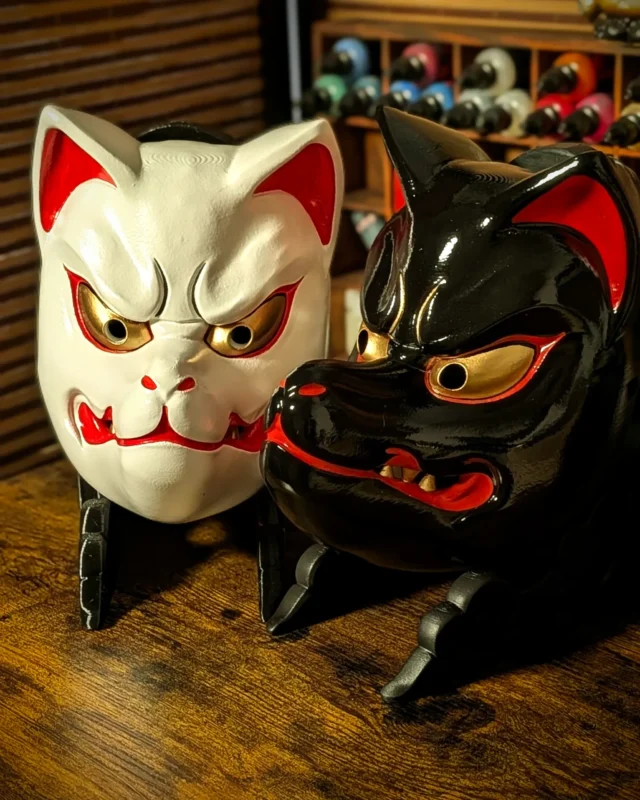
I am not a tattoo artist. I make contemporary masks that can serve as references for volume, line, or palette when discussing a project with your artist. They are printed in PETG, prepared, painted, and finished by hand in Brittany. They are not presented as Japanese ritual objects or historical models to reproduce.
Personally, I prefer the traditional Kitsune, especially in white, although I also really like the black version. Its elegance is an aesthetic preference, not a symbolic code I impose on a tattoo.
At conventions, visitors sometimes call a Kitsune mask “Inari”. I explain that Inari is not a fox: foxes are the deity’s messengers in Inari worship.
Before finalizing your project, explore fox culture in the Kitsune folklore guide and the guide to Inari Ōkami. The workshop's interpretations are available in the handmade Kitsune mask collection.
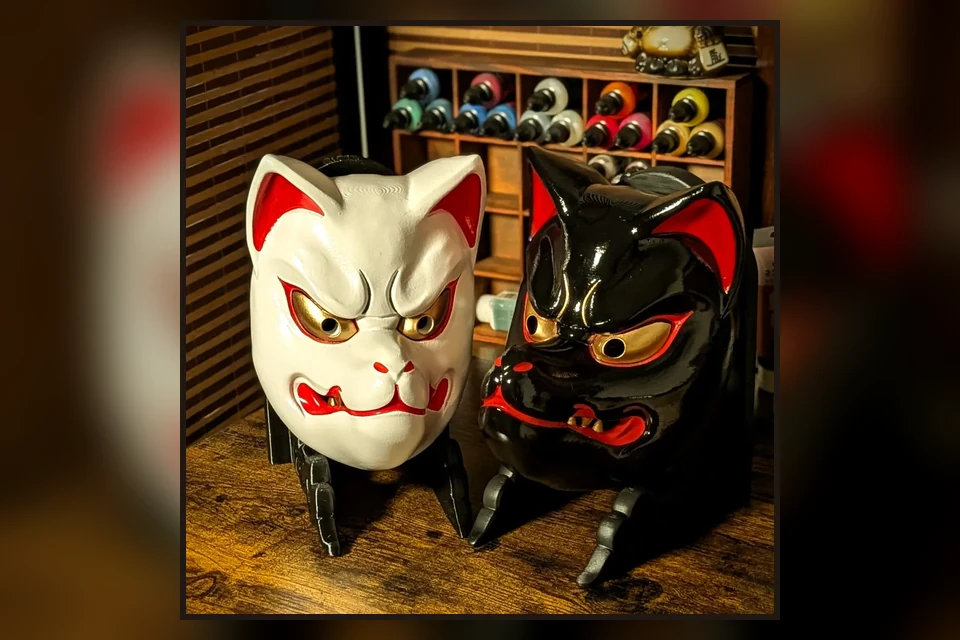
Related Kitsune pieces
These pieces can inspire a palette or study of form, while leaving the original tattoo design to your artist.
Kitsune tattoo FAQ
What does a Kitsune tattoo mean?
It can evoke transformation, intelligence, cunning, a hidden identity, or the unseen world. The exact meaning depends on the fox depicted, its attributes, and the project's personal story.
Is the Kitsune the god Inari?
No. According to Fushimi Inari Taisha, foxes are the messengers of Inari Ōkami. Inari is not a fox. This distinction matters if the tattoo includes torii, a key, or other shrine attributes.
What do a Kitsune's nine tails mean?
Nine tails identify the kyūbi no kitsune, a particularly powerful supernatural fox. They should not be treated as a modern ranking where each tail automatically has a specific power.
Should I choose a fox or a Kitsune mask tattoo?
A whole fox emphasizes movement, tails, and the shapeshifting animal. A mask gives a more compact design focused on the face and hidden identity. The choice mainly depends on the available space and story.
Which color should I choose for a Kitsune tattoo?
Start with a palette that fits the style and your other tattoos. White can recall Inari's fox messengers, black can create a nighttime mood, and red can suggest torii, without forming a compulsory code.
Which motifs work with a Kitsune?
Fox fires, torii, clouds, wind, flowers, and foliage can work. Their season, direction, and relationship to the body should be developed with a specialist artist rather than chosen from a generic list.
Where should a Kitsune tattoo go?
A compact mask suits the forearm, calf, or shoulder blade. A whole fox or kyūbi needs more space, such as the thigh, back, shoulder, or a sleeve planned as a whole.
Does Dai Yokai create Kitsune tattoos?
No. Dai Yokai makes contemporary masks in Brittany. Photos of the pieces can be references for shape or color, but the drawing and tattoo must be created by a professional tattoo artist.