Onigawara (鬼瓦) are decorative ridge-end tiles used in Japanese architecture. Many show a fierce Oni-like face and are traditionally associated with warding off misfortune, but not every onigawara depicts an Oni. They belong to tiled roofs, not to the history of wearable masks.
Onigawara meaning in one table
| Question | Short answer |
|---|---|
| What does the word mean? | Oni means an ogre-like supernatural being; kawara means roof tile. |
| What is the object? | A decorative tile fitted at the end of a roof ridge or a related terminal point. |
| Does it always show an Oni? | No. Some historical examples use lotus, crests, animals or other motifs. |
| What is its symbolic role? | Fierce-faced examples are traditionally said to ward off misfortune. |
| Is it a mask? | No. It is an architectural component and ornament. |
What is an onigawara?
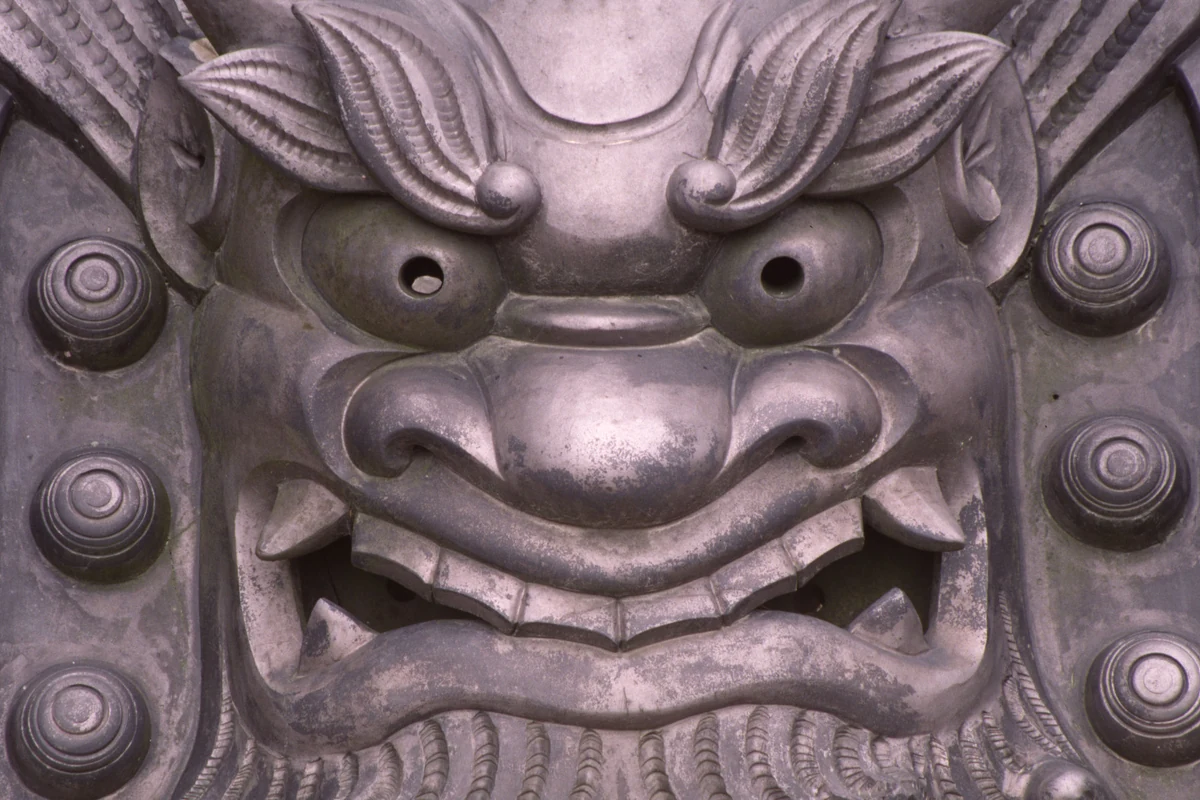
The usual English spelling is onigawara, although oni-gawara makes the two Japanese words easier to see. Oni (鬼) refers to a class of powerful supernatural beings commonly translated as ogres or demons. Kawara (瓦) means a roof tile.
Government and museum sources describe onigawara as decorative tiles attached to the ends of roof ridges. They form part of the larger system of Japanese ceramic roof tiles, alongside round, concave, eave and other specialised pieces.
The familiar design is a fierce face. However, onigawara is also used as a conventional name for ridge-end tiles that do not show an Oni. A Nara National Museum example carries a lotus motif, while other traditions use crests, animals, clouds or plants.
Architectural role and protective symbolism
An onigawara occupies a terminal point in the roof composition. It finishes and emphasises the end of a ridge, where the different tile elements meet. It should not be described as a magical device or as the only part that keeps a roof watertight.
Its second role is symbolic. Official Japanese sources describe the well-known demon-face motif as one believed to ward off misfortune. The accurate wording matters: this is a traditional apotropaic association, not proof that every onigawara was made with one identical religious meaning.
| Role | What can be stated safely | What to avoid |
|---|---|---|
| Architectural | A decorative terminal tile fitted to a roof ridge. | Saying the face alone waterproofs or structurally supports the roof. |
| Visual | It marks the roofline and can carry a face, crest, flower or other motif. | Calling every design a demon face. |
| Symbolic | Fierce examples are traditionally associated with warding off misfortune. | Promising literal supernatural protection. |
| Historical | Japanese forms developed with influences from China and the Korean Peninsula. | Claiming one simple, fully proven origin for the demon face. |
Where can you see onigawara in Japan?
Onigawara are strongly associated with Buddhist temple roofs. They also appear on shrines, castles, traditional houses and other tiled buildings. Their use, scale and motifs vary by region, period, building type and workshop.
Ancient examples show that the category changed over time. The Japan Cultural Expo traces Japanese onigawara through East Asian influence and archaeological finds at Nara. The Kyushu National Museum notes that the exact origin of the demon-faced form remains unresolved and may relate to several continental and Buddhist visual sources.
For the longer chronology, firing methods and the work of onishi craftspeople, continue with Onigawara: meaning, history and Japanese roof tiles. This page stays focused on the short definition and the difference from a mask.
How traditional onigawara are made
Traditional onigawara are ceramic works made within regional kawara industries. A specialist craftsperson, often called an onishi, shapes the clay ornament so it fits the roof design, survives firing and remains readable from the ground. Large brows, eyes and mouths are not only dramatic details; their relief helps the face remain visible at architectural distance.
The tile is dried and fired like other architectural ceramics. Some Japanese roof-tile traditions use reduction firing to produce the characteristic silver-grey surface associated with ibushi kawara. Materials and finishes vary, so not every onigawara should be described as black, glazed, smoke-fired or made by one identical process.
This craft context also explains why an onigawara should not be reduced to a generic monster decoration. It is designed for a particular ridge, roof scale and visual rhythm. Museum examples preserve both the imagery and the technical history of Japanese tiled architecture.
Onigawara, Oni masks and gargoyles compared
| Object | Context | Usual function | Key distinction |
|---|---|---|---|
| Onigawara | Japanese tiled architecture | Ridge-end ornament with architectural and symbolic roles | A roof tile, even when the motif is not an Oni face |
| Oni mask | Folklore-inspired art, performance, decor or modern design | Worn, displayed or used as a visual reference | A mask is not an architectural tile |
| European gargoyle | European architecture | Often a carved waterspout, sometimes decorative | A helpful comparison, not an exact equivalent |
| Grotesque | Architectural sculpture | Decorative or symbolic figure | Unlike a gargoyle, it does not need to drain water |
The word gargoyle is common in English descriptions because the visual comparison is immediate. Use it carefully. An onigawara normally sits within a ceramic roof-tile system rather than projecting rainwater away from a wall.
From roof tile to contemporary Dai Yokai mask
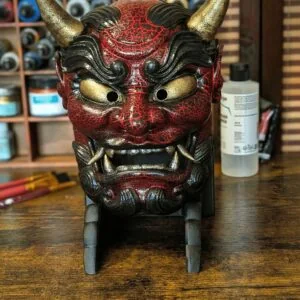
The Dai Yokai Oni-Gawara mask is a contemporary interpretation, not a traditional Japanese roof tile or ritual object. I model it as a mask, print it in PETG, then sand, prime, paint and finish it by hand in my workshop in Brittany, France.
The connection is visual: a frontal stare, heavy brow, teeth and an aged surface inspired by architectural ceramics. The function is different. The finished piece is made for wall display, collection, conventions or light wear, not for installation on a roof.
Compare the broader Oni mask meaning guide, or browse the handmade Oni mask collection.
FAQ
What does onigawara mean?
Onigawara (鬼瓦) literally combines oni, an ogre-like supernatural being, and kawara, a roof tile. The term refers to a decorative ridge-end tile in Japanese architecture. Many examples show a fierce face, although historical tiles can also use floral, animal, crest or other designs.
What is an onigawara used for?
An onigawara finishes or marks the end of a tiled roof ridge and forms part of the roof's architectural ornament. Fierce-faced examples are also traditionally understood as apotropaic images, meaning they are intended to ward off misfortune. That symbolic role should not be confused with a measurable supernatural effect.
Is every onigawara shaped like an Oni?
No. Demon-faced tiles are the best-known type, but Japanese museum sources also classify ridge-end tiles with lotus and other motifs as onigawara. The name became a conventional category for this position and form, even when an ogre face is absent.
Where are onigawara placed?
They are placed at ridge ends and related terminal points on tiled roofs. They are strongly associated with Buddhist temples and also appear on shrines, castles, traditional houses and other Japanese-style buildings. Their exact form and position depend on the roof and period.
Is an onigawara the same as an Oni mask?
No. An onigawara is an architectural roof tile. An Oni mask is a wearable, theatrical, decorative or modern artistic object inspired by Oni imagery. The two may share fierce eyes, teeth or horns, but they belong to different material and cultural contexts.
Is an onigawara a Japanese gargoyle?
Japanese gargoyle is a useful visual shortcut, but it is not an exact translation. Many European gargoyles project water away from masonry. An onigawara is primarily a decorative ridge-end roof tile and does not normally function as a waterspout.
Who makes traditional onigawara?
Specialist roof-tile craftspeople are often called onishi, literally Oni masters. They model and fire decorative tiles as part of regional kawara traditions. Methods, clay bodies, surface finishes and workshop practices vary by production centre.
Is the Dai Yokai Oni-Gawara mask a traditional roof tile?
No. It is a contemporary PETG mask made and hand-finished in Brittany, France. Its design borrows the frontal force and weathered surface associated with demon-faced roof tiles, but it is made for display or light wear, not for architectural installation.