
| Question | Reliable answer |
|---|---|
| Literal meaning | Oni or demon roof tile |
| Object type | Decorative ridge-end roof tile |
| Main locations | Ends of main and descending roof ridges |
| Common motifs | Oni faces, clouds, flowers, crests and animals |
| Main roles | Roof finishing, ornament and symbolic protection |
What is an onigawara?
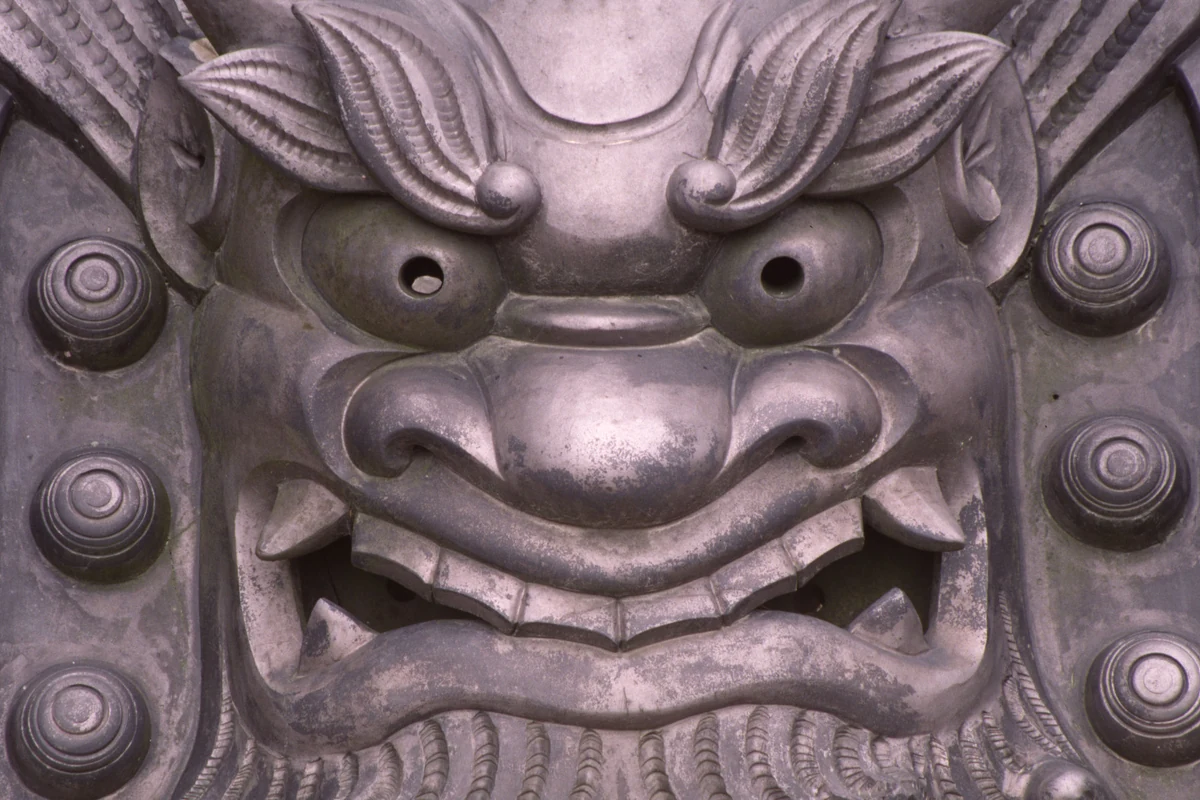
Onigawara is written 鬼瓦. Oni is the ogre or demon figure familiar from Japanese folklore, and kawara means roof tile. “Demon tile” is the direct translation, but “decorative ridge-end tile” is often more accurate when discussing architecture because the motif is not always an oni face.
The Nara National Research Institute for Cultural Properties uses onigawara for a wider family of ridge tiles. Some carry demon faces, while others use lotus flowers, animals, phoenixes or abstract designs. The name describes an architectural category as well as its most famous image.
This article focuses on the historical roof tile. For the modern wall and costume interpretation, use the separate guide to the Oni-gawara mask.
Where does an onigawara sit on the roof?
Onigawara are installed at the outer ends of a main roof ridge or at the ends of descending ridges. These are highly visible points where roof lines meet. The tile closes and finishes the junction, helps protect it from weather and gives the roof a clear visual endpoint.
| Role | What it means in practice |
|---|---|
| Architectural | Finishes and covers an exposed ridge junction |
| Visual | Marks the roofline with a large readable motif |
| Symbolic | Presents a guardian or auspicious image |
| Social | Can display a regional style, family crest or institutional identity |
The downward angle matters. A famous Dazaifu tile in the Kyushu National Museum was designed with eyes looking toward the ground rather than straight ahead, so its fierce gaze remained effective from a high roof position.
How onigawara developed in Japan
Japanese tiled roofs developed with Buddhist temple architecture. The Nihon Shoki records master tilers arriving from the Korean Peninsula in 588, and tiles were used for Asukadera before spreading to later capitals and temples. This was the beginning of Japanese kawara culture, not yet the finished demon-face style seen today.
Research from the Nara institute finds demon-face motifs on a small number of temple eaves tiles from the middle to late seventh century. Demon-faced ridge tiles cannot be securely dated before the eighth century. Their forms show connections with the Korean Peninsula and wider East Asian architectural imagery.
The late seventh- to early eighth-century Dazaifu onigawara is one of the earliest surviving high-relief types. Its heavy brow, bulging eyes, nose, open mouth and fangs turn the clay into a face directed against approaching evil. Researchers still debate whether its deeper visual source was a beast, taotie image, Niō guardian or another model.
| Period | Development |
|---|---|
| Sixth century | Roof tiling arrives with Buddhist architecture |
| Later seventh century | Demon motifs appear on some decorative eaves tiles |
| Eighth century, Nara period | Securely dated demon-faced ridge tiles appear |
| Medieval and early modern periods | Regional kilns, new motifs and building types expand |
| Today | Onigawara remain architectural pieces and independent craft objects |
Why put an Oni face on a roof?
The fierce face works through an apotropaic idea: something frightening is placed on the boundary to repel a greater threat. The Kyushu National Museum describes the Dazaifu tile as directing its enraged gaze against approaching evil. Regional craft guides likewise present onigawara as talismans for buildings and households.
This does not mean every historic owner believed the same story or performed the same ritual. Onigawara combine structure, design, status and protective symbolism. The reliable claim is that guardian meaning became attached to the roof ornament, not that every tile carried one universal magical function.
The same visual reversal appears elsewhere in Oni culture: a threatening face can also guard. Read the broader guide to Oni meaning and symbolism for that wider context.
Not every onigawara has a demon face
The demon face is iconic, but it is not a requirement. Jōjima craft traditions in Fukuoka include clouds and chrysanthemums as well as fierce faces. Other workshops create water, waves, plants, animals, geometric patterns or family crests. These motifs can express protection, prosperity, identity or the character of a particular building.
This variety explains why translating every onigawara as a literal demon can be misleading. When the motif is a cloud or flower, “ridge-end roof tile” describes the object more clearly. The Japanese name remains useful because it holds the whole craft family together.
The oni-shi: specialist makers of onigawara
An artisan who specializes in onigawara is called an oni-shi. The work sits between architectural ceramics and sculpture. The maker must understand the drawing, the clay, the depth needed for a face to read from the ground, the roof position and the shrinkage that occurs before the piece leaves the kiln.
| Stage | Craft task |
|---|---|
| Design | Calculate dimensions and prepare the drawing |
| Cutting and assembly | Build the body from prepared clay sections |
| Modeling | Add the face, clouds, crest or other relief |
| Slow drying | Control moisture so the large piece dries evenly |
| Firing | Harden the tile at high temperature |
| Inspection and fitting | Check the finished dimensions and roof use |
Sanshū onigawara crafts use clay from the Mikawa area and are fired at roughly 1,150°C. Traditional ibushi, or smoked-silver, firing gives many Japanese roof tiles their metallic grey surface. The exact firing sequence varies by kiln and product, so the finish should not be reduced to one universal recipe.
Important regional onigawara traditions
Sanshū onigawara are mainly produced around Hekinan, Anjo and Takahama in Aichi Prefecture. Takahama remains closely associated with oni-shi workshops and Sanshū roof tiles. Modern makers continue producing temple and shrine commissions while also adapting the techniques to smaller decorative objects.
Jōjima in Fukuoka developed a major tile tradition from the early seventeenth century under the Arima clan. Its tiles became known across Kyushu for their luster, shape and durability. The region’s onigawara include demon faces, clouds and chrysanthemums intended for temples, shrines and traditional houses.
Dazaifu represents a much older archaeological chapter. The strong high-relief face found there differs from flatter styles around the ancient capitals. Together these examples show that onigawara are not one frozen national design but a long architectural craft with regional solutions.
How to spot an onigawara from the ground
| What to check | What you may see |
|---|---|
| Position | End of the main ridge or a descending ridge |
| Silhouette | Large upright tile closing the ridge line |
| Motif | Oni face, cloud, crest, flower, animal or abstract design |
| Viewing angle | Relief and eyes designed to read from below |
| Surface | Natural clay, glaze or smoked-silver ibushi finish |
Do not look only for horns. A cloud or crest at the ridge end can belong to the same family. Photograph the whole roof position as well as the face or motif, because the architectural placement is what distinguishes an onigawara from a loose sculpture or mask.
Onigawara, shibi, gargoyle or Oni mask?
| Object | Main use | Key distinction |
|---|---|---|
| Onigawara | Japanese ridge-end roof tile | May use a demon face or another motif |
| Shibi | Paired ornamental tiles at both ends of a major ridge | L-shaped or fishtail-related architectural form |
| Gargoyle | Western architectural sculpture, often a waterspout | Useful comparison, not an exact equivalent |
| Oni mask | Wearable or display object | Belongs to the face, costume or wall, not the roof |
From roof guardian to contemporary mask
A contemporary Oni-gawara mask borrows the frontal stare, heavy brow, fangs and guardian presence of the roof tile. It changes the medium and function. The architectural tile is fired clay made for a roof; the Dai Yokai interpretation is a modern mask made for display, collection, conventions or light costume use.
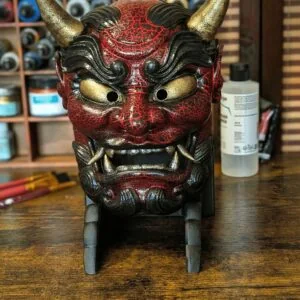
Dai Yokai pieces are made in Brittany from PETG bases that are sanded, primed, painted, varnished and finished by hand. Cracked, stone-like or metallic paint can suggest aged ceramic, but the object remains a contemporary handmade creation inspired by Japanese architecture and Oni imagery.
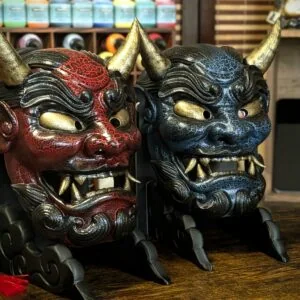
Read the dedicated Oni-gawara mask guide, browse the handmade Oni mask collection, or see the Dai Yokai Oni-gawara mask. Use the product description for the mask’s dimensions, finish and intended use; the historical roof tile has a different function.
Sources and further reading
- Nara National Research Institute for Cultural Properties, demon-faced ridge tiles of the Nara period
- National Institutes for Cultural Heritage e-Museum, Dazaifu demon-face ridge tile
- Japan Cultural Expo, development of onigawara in Nara
- KOGEI JAPAN, Sanshū Onigawara craft and production process
- Visit Fukuoka, Jōjima Onigawara tradition
FAQ
What is an onigawara?
An onigawara is a decorative ridge-end tile used in Japanese architecture. Many examples show a fierce oni or demon-like face, but the category also includes tiles with clouds, flowers, crests and other motifs. It finishes an important point of the roof while giving the building a strong visual and symbolic guardian.
What does onigawara mean?
Onigawara is written 鬼瓦. Oni refers to the ogre or demon figure of Japanese folklore, while kawara means roof tile. “Demon tile” is the usual short translation. Researchers sometimes translate the broader architectural category as “ridge-end tile” because not every onigawara actually carries an oni face.
What is an onigawara used for?
An onigawara is fitted at the end of a main or descending roof ridge. It completes and protects a vulnerable roof junction, serves as architectural ornament and can act as an apotropaic symbol intended to repel misfortune. Its practical construction role and protective cultural meaning should be understood together.
Are all onigawara shaped like demons?
No. Demon faces are the most recognizable form, but onigawara can also use clouds, waves, flowers, family crests, animals or other designs. Official museum research notes that the Japanese term covers ridge tiles whose decoration is not exclusively limited to demons. The motif depends on period, region and building.
How old are onigawara?
Japanese roof tiling arrived with Buddhist architecture in the sixth century. Demon-face designs appear on some eaves tiles from the later seventh century, while securely dated demon-faced ridge tiles belong to the eighth-century Nara period. The Dazaifu examples are among the earliest and most distinctive surviving forms.
Where can you see onigawara in Japan?
Look at the ends of the main ridge and descending ridges on temples, shrines, castles and older tiled buildings. Historic examples survive in museum collections, while craft regions such as Takahama in Aichi and Jōjima in Fukuoka continue to make decorative roof tiles using regional clay and firing traditions.
Who makes onigawara?
Specialist artisans are called oni-shi, meaning onigawara makers. They prepare drawings, cut and assemble clay sections, sculpt the design, dry the piece slowly and fire it. Large architectural tiles require careful planning because clay shrinks during drying and firing, and the final piece must fit a precise roof position.
Is an onigawara the same as a gargoyle?
No. Gargoyle is a useful visual comparison for Western readers, but it is not an exact translation. A traditional gargoyle often channels rainwater away from a wall. An onigawara is a Japanese ridge-end tile with architectural, decorative and symbolic functions. The two belong to different building traditions.