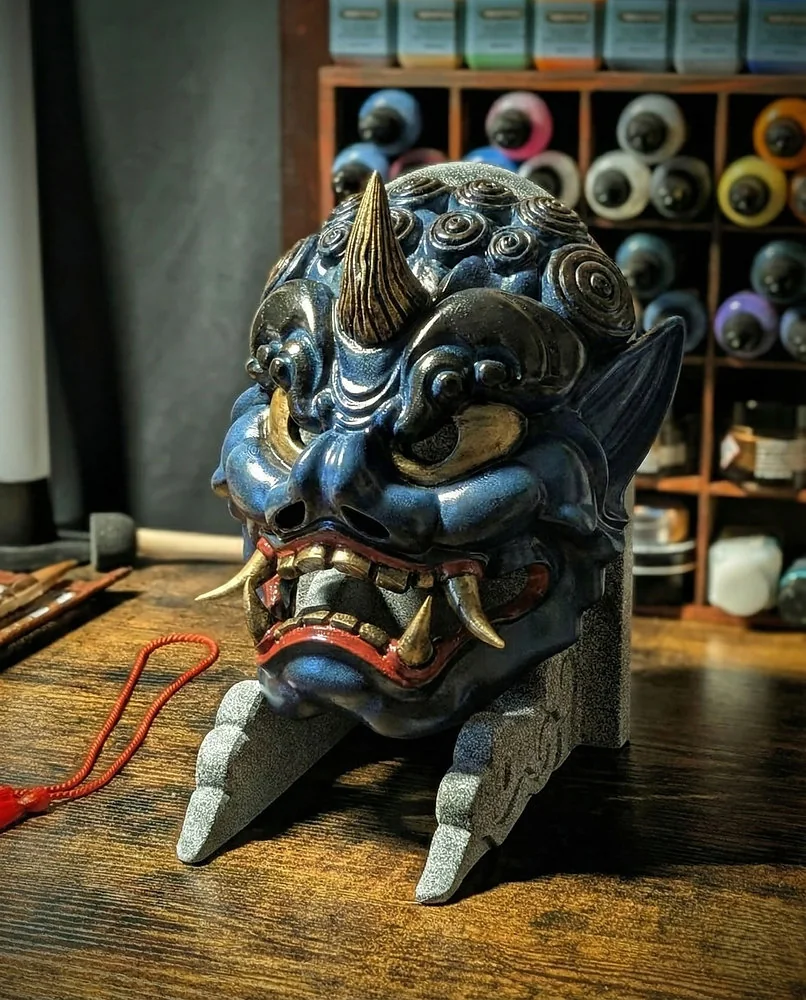
A blue Oni, or Ao-Oni (青鬼), does not have one fixed meaning. In a five-color Setsubun interpretation, blue represents anger or ill will. In the 1933 children’s story Naita Aka Oni, Blue Oni embodies loyalty and self-sacrifice. Japanese ao also covers a wider blue-to-green range than the English word blue.
| Quick question | Short answer |
|---|---|
| What does Ao-Oni mean? | Blue Oni |
| Is it one named yokai? | Usually no, it is a descriptive term used in different contexts |
| Five-hindrance reading | Anger, hostility or ill will |
| Naita Aka Oni reading | Friendship, generosity and sacrifice |
| Can ao look green? | Yes, Japanese ao can cover blue and some green shades |
What is an Ao-Oni?
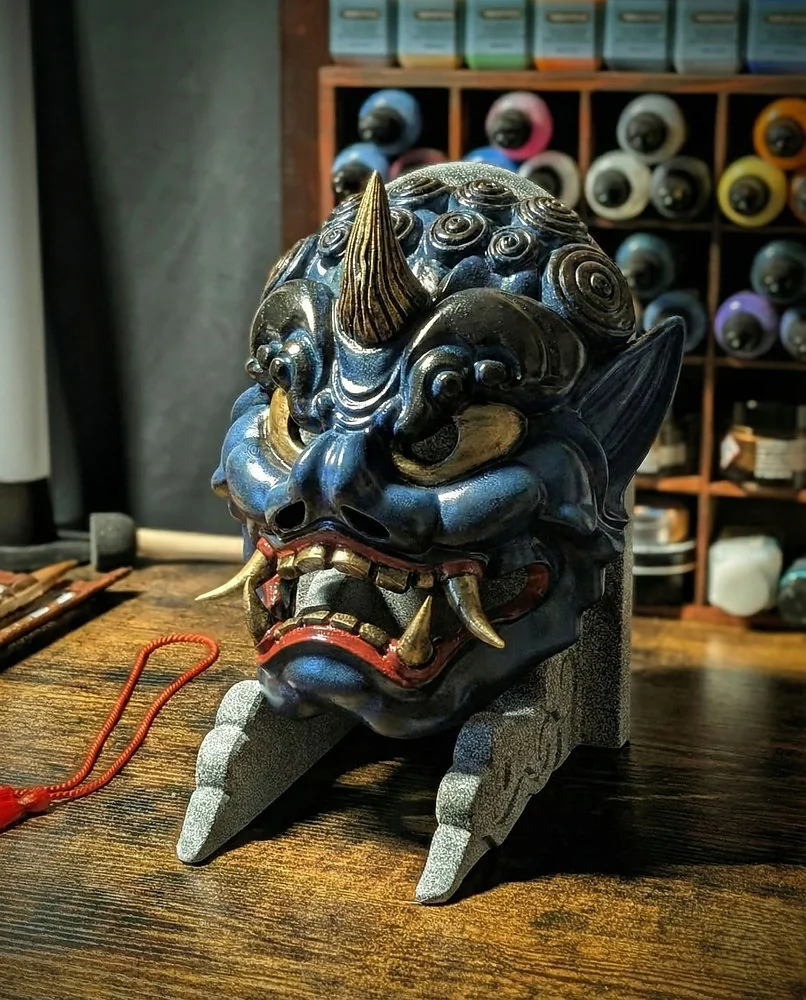
Ao-Oni combines ao (青), blue, with oni (鬼), an Oni or ogre-like supernatural being. It is usually a description rather than the personal name of one creature. A blue Oni can appear in religious imagery, seasonal customs, children’s literature, local festivals, games or contemporary art without carrying the same role in each setting.
The Japanese dictionary entry collected by Kotobank defines an Ao-Oni as a horned, blue-bodied imaginary monster based on Buddhist and Onmyōdō ideas and said to live in hell. An older dictionary citation records the term in the 14th century. This establishes the expression historically, but it does not create one universal personality for every blue Oni.
Why ao can mean blue and green
Ao does mean blue in modern Japanese, so saying that it does not mean blue is inaccurate. The important nuance is that its historical and continuing range is wider than English blue. It can include indigo, blue-green and some colors normally labelled green in English.
Kotobank’s dictionary entry for ao includes colors from indigo blue through greenish shades. Everyday compounds preserve this wider use: a green apple can be ao-ringo and a green traffic light is commonly called ao-shingō. This explains why an Ao-Oni may be painted blue, turquoise or greenish without becoming a different category of creature.
| Japanese expression | Literal form | Usual English reading |
|---|---|---|
| Ao-Oni (青鬼) | Ao Oni | Blue Oni |
| Ao-ringo (青りんご) | Ao apple | Green apple |
| Ao-shingō (青信号) | Ao signal | Green traffic light |
| Aoi ha (青い葉) | Ao leaves | Green or fresh leaves, depending on context |
Blue Oni and the five Buddhist hindrances
One documented interpretation connects five Oni colors with the five Buddhist hindrances, mental obstacles that block clarity. In this teaching, the blue Oni represents shinni, anger, hostility or ill will. Throwing beans at Setsubun can then be read symbolically as driving that obstruction out of oneself.
A study published by the Color Science Association of Japan records this association: red with desire or greed, blue with shinni, yellow or white with restlessness and regret, green with torpor or sleepiness, and black with doubt. The article also explains that color systems in Japanese religion draw on several overlapping Buddhist and five-element traditions.
| Oni color | Five-hindrance association | Careful English wording |
|---|---|---|
| Red | Craving or greed | Desire that obstructs clear judgement |
| Blue | Shinni | Anger, hostility or ill will |
| Yellow or white | Restlessness and regret | An unsettled mind |
| Green | Torpor and sleepiness | Lethargy or inertia |
| Black | Doubt | Uncertainty that blocks action or understanding |
This table is a contextual reading, not a master code for every Oni mask. A festival costume, medieval image, modern tattoo and commercial character can use the same color differently. The source and setting should always be named.
Is the blue Oni cold, calm or controlled?
Blue often feels visually cooler than red, and modern stories frequently contrast a quiet blue character with a loud red character. That makes calmness, restraint or calculated force useful design readings. They are not fixed properties of the historical term Ao-Oni, and they should not replace the documented five-hindrance meaning of anger or ill will.
The contrast works best as an artistic choice: red advances, blue recedes; red reads as heat, blue as distance. A tattooer, illustrator or mask maker can use that contrast without claiming that all Japanese folklore assigns one permanent temperament to each color.
Blue Oni in Naita Aka Oni
The best-known friendly Blue Oni belongs to Naita Aka Oni, The Red Oni Who Cried, a children’s story by Hirosuke Hamada first published in 1933. It is modern literature, not an anonymous ancient legend. Its red and blue pair helped shape the popular contrast between an outgoing red character and a quieter, self-sacrificing blue character.
In the story, Red Oni wants to befriend the villagers. Blue Oni offers to frighten them so Red can appear as their rescuer. The plan works, but Blue leaves to prevent the villagers from discovering the deception. Red later finds the farewell note and cries. The Kagawa Prefecture Tourism Association retells the story in English and describes Blue Oni as a model of kind friendship. The Yamagata Prefectural Library dates the story to 1933.
For the companion character, read the dedicated Aka-Oni red mask meaning guide.
A blue Oni can also be a guardian
Not every blue Oni is an enemy or a symbol of anger. At Ishiyamadera temple, a large blue Oni figure commemorates the learned monk Rōchō (1132-1209), who was remembered as vowing to protect sacred texts in Oni form after death. Here the figure is connected with protection, learning and the expulsion of evil.
The official Ishiyamadera temple page explains that its annual Blue Oni Festival honours the monk Rōchō, whose transformed Oni form guards the temple’s scriptures and vows to repel evil and bring good fortune. This local example shows why “blue Oni equals one emotion” is too simple.
Blue Oni masks, tattoos and contemporary design
In a modern mask or tattoo, blue can suggest distance, night, water, discipline or controlled energy. Those are design interpretations rather than automatic folklore translations. Composition matters: waves and clouds create a different reading from flames, temple architecture, a kanabō club or a paired red Oni.
For the broader creature, use the complete Oni mask meaning guide. For tattoo composition, compare the Oni tattoo guide.
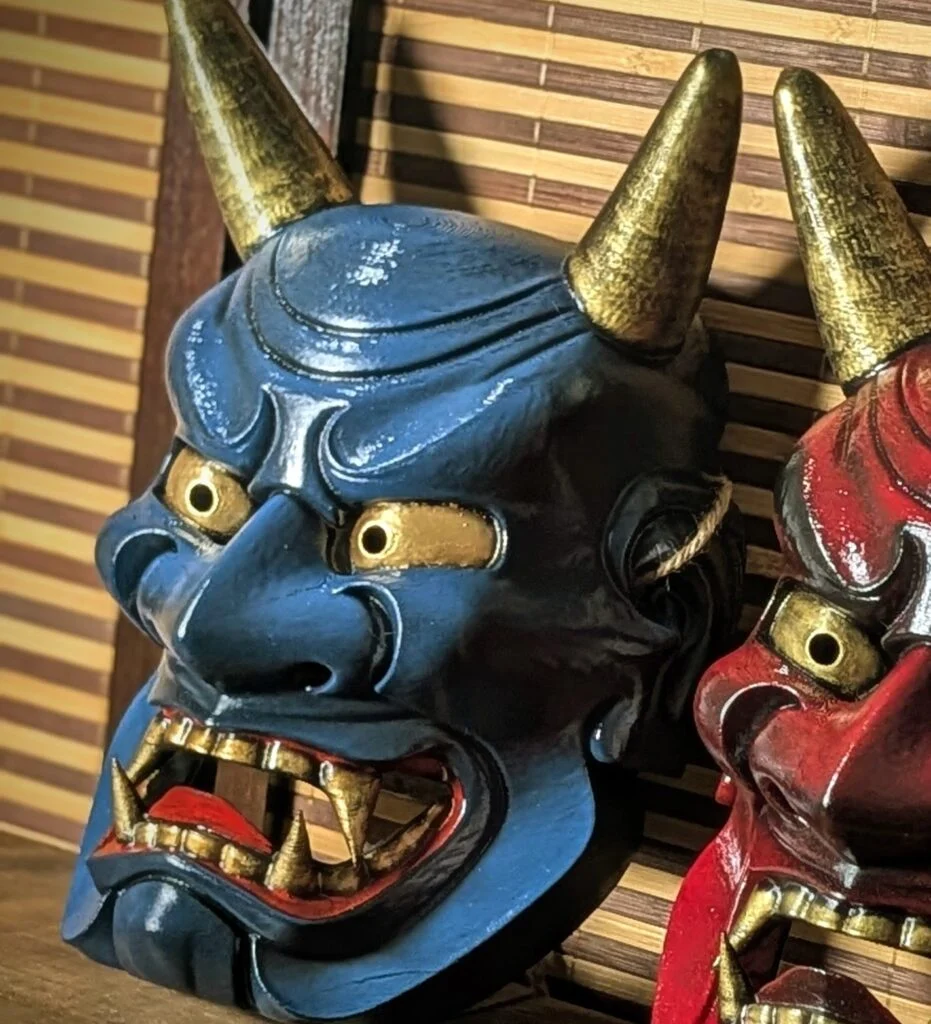
The horror game Ao Oni is a separate modern work. Its blue pursuer does not explain the colour’s meaning in folklore.
From Ao-Oni imagery to a handmade Dai Yokai mask
I like midnight blue. When I make an Oni in red, I often make a blue version too. They are usually my first two colours, and I find they work well together.
I do not have a fixed recipe for blue. I use many shades and experiment, so the result is not always identical from one mask to another. When the technique or finish differs noticeably from the reference photo, I sometimes send the customer a photo before dispatch.
Personally, I prefer red. It stands out more and I find it easier to place in a room. Blue makes me think a little more about where it will be displayed. When the two are side by side, people often choose red first, but some take both because the contrast works well.
Dai Yokai blue Oni masks are contemporary Japanese-inspired creations, not ritual masks or historical artefacts. They are made in Brittany, France. The PETG form is printed, sanded, primed, painted, varnished and finished by hand.
You can compare the blue form with the red and blue Oni Ondeko duo or browse the broader handmade Oni mask collection. These are modern display and convention pieces inspired by Oni imagery, not protective equipment or objects used in Japanese rites.
Sources and further reading
- Kotobank: dictionary definition of Ao-Oni
- Kotobank: dictionary definition and color range of ao
- Color Science Association of Japan: colors associated with Oni in Japanese and Chinese culture
- Kagawa Prefecture Tourism Association: The Tale of Kind Ao Oni-kun
- Yamagata Prefectural Library: Hirosuke Hamada chronology
- Ishiyamadera: Blue Oni Festival
FAQ
What does a blue Oni mean?
A blue Oni does not have one universal meaning. In one Setsubun teaching based on the five Buddhist hindrances, the blue Oni represents anger or ill will. In Hirosuke Hamada’s children’s story Naita Aka Oni, the blue Oni represents generous friendship and sacrifice. Context decides which reading applies.
What does Ao-Oni mean in Japanese?
Ao-Oni (青鬼) literally means blue Oni. Japanese dictionaries describe it as a blue-bodied, horned imaginary monster associated with Buddhist and Onmyōdō traditions and said to inhabit hell. The word ao usually means blue, but it can also cover shades that English speakers would call green.
Why is an Ao-Oni sometimes green?
The Japanese color word ao has historically covered a wider blue-to-green range than modern English blue. Green apples and green traffic lights can still use ao in Japanese. A blue-green or greenish Ao-Oni is therefore linguistically possible, although a specific artwork may use any palette its maker chooses.
Is the blue Oni calmer than the red Oni?
Not as a universal rule. The calm-blue and impulsive-red contrast is common in modern character writing and design, but it should not be presented as a fixed law of Japanese folklore. The best-known red and blue contrast comes from the 1933 children’s story Naita Aka Oni.
What happens to the blue Oni in Naita Aka Oni?
Blue Oni offers to frighten a village so Red Oni can appear to rescue the people and earn their trust. After the plan succeeds, Blue Oni leaves because his continued friendship could expose the trick. Red Oni finds his farewell note and cries for the friend who sacrificed their life together.
Does a blue Oni represent anger?
It can in a specific five-color Setsubun interpretation. In that scheme, blue is linked with shinni, anger, hostility or ill will, one of the five hindrances. This is a useful documented reading, but it is not the only meaning of every blue Oni in art, festivals, stories or contemporary masks.
Is Ao-Oni an ancient individual yokai?
Ao-Oni is primarily a descriptive term meaning blue Oni, not the proper name of one single creature with one official biography. Different temples, festivals, stories, games and artworks use blue Oni figures in different ways. The object or narrative must be identified before assigning a meaning.
Are Dai Yokai blue Oni masks traditional ritual masks?
No. Dai Yokai blue Oni masks are contemporary Japanese-inspired creations made in Brittany, France. Their PETG forms are sanded, primed, painted, varnished and finished by hand. They borrow the horns, fangs and strong facial volumes of Oni imagery without being presented as historical, ritual or protective objects.
Context comes before color symbolism
A blue Oni can represent anger in a five-hindrance Setsubun teaching, friendship in Naita Aka Oni, guardianship at Ishiyamadera or a cool visual mood in contemporary art. Identify the source first. The color becomes meaningful only when the story, festival, artwork or mask is clear.