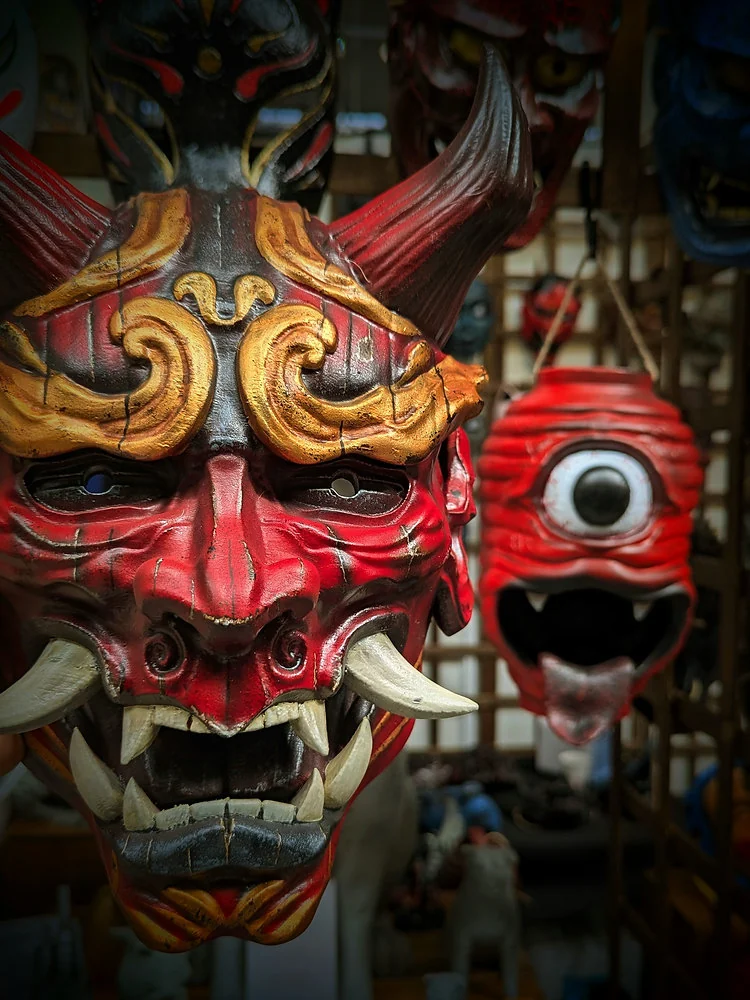
What is a Chōchin-obake?
A Chōchin-obake is a Japanese yokai shaped like a traditional paper lantern. Its paper shell splits into a mouth, a tongue hangs from the opening, and one or two eyes turn a familiar household object into a face. This instantly readable design explains why the lantern ghost remains popular in yokai books, prints, games, tattoos and modern decorations.
The short definition is simple; its history needs more care. Chōchin-obake is frequently called a tsukumogami, yet reference sources also stress that it has very few concrete oral legends and is known mainly as a yokai of pictures. Its visual identity is firmer than any one story about how it behaves.
How is Chōchin-obake written and pronounced?
The name is commonly written 提灯お化け. Chōchin means a collapsible paper lantern, and obake refers to something transformed or changed. “Lantern ghost” is a convenient English translation, although “transformed lantern” better preserves the wordplay behind obake.
A practical pronunciation is “choh-cheen oh-bah-keh.” The line over the ō marks a long vowel. Search results also use Chochin obake, Chōchin’obake, chouchin obake and lantern yokai. These spellings normally refer to the same figure.
What does the lantern yokai look like?
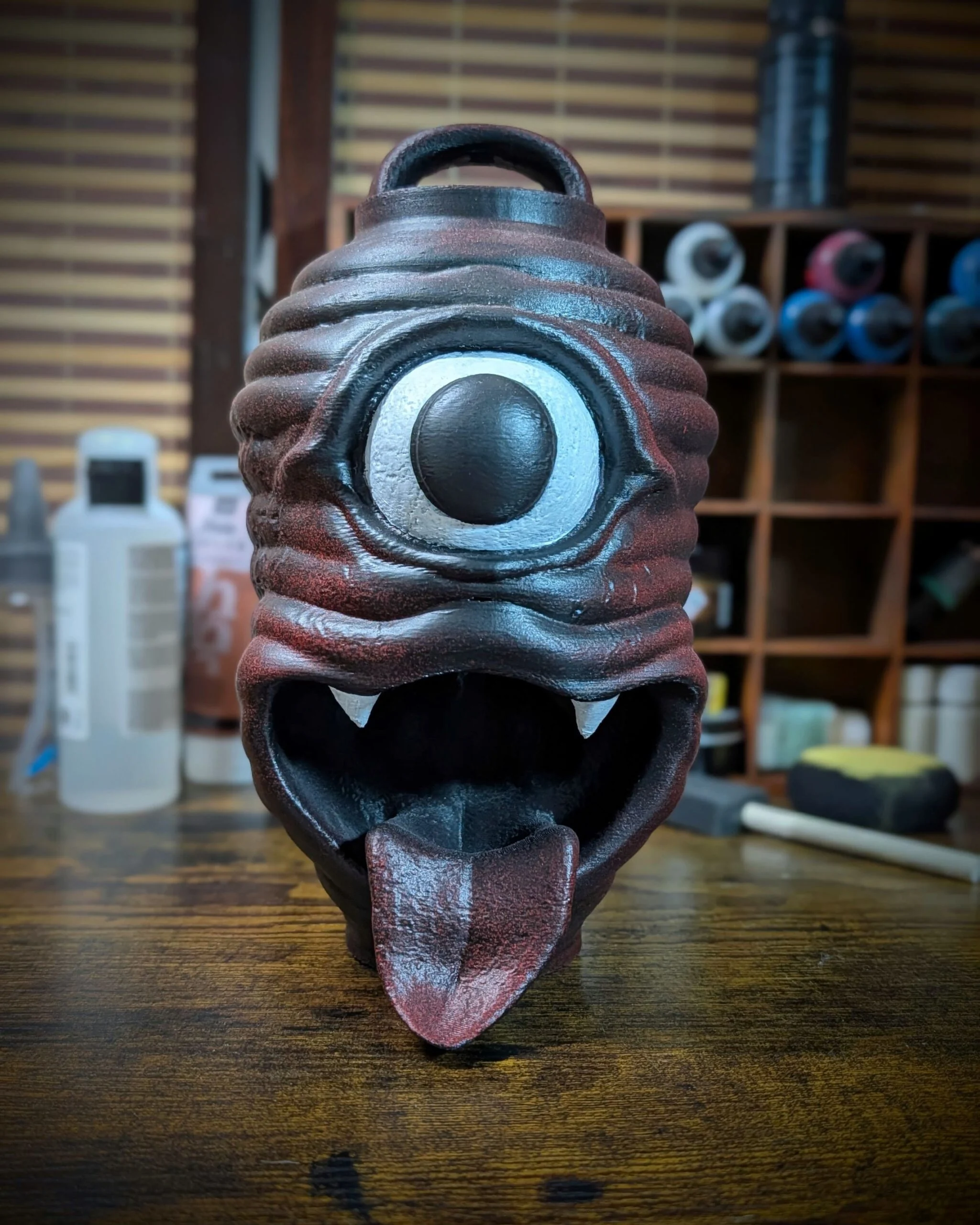
The design begins with the structure of a real chōchin. Paper is stretched over a spiral frame so that the lantern can collapse. In the yokai version, a tear in that paper becomes an enormous mouth. The upper shell becomes a forehead, the internal frame suggests ribs, and the hanging tongue gives the object a mocking expression.
One eye is common, but not compulsory. Japanese summaries describe versions with either one or two eyes. Shape, color and handle also vary. The constant feature is not a precise anatomy; it is the visual trick of reading damage in an ordinary lantern as a living face.
Is Chōchin-obake a tsukumogami?
Often, but the answer is not absolute. Tsukumogami are manmade objects that acquire spirit or agency after long use. Modern yokai guides naturally place an animated lantern in that family. The connection is convincing as a category, yet it does not prove that every historical Chōchin-obake picture was created from one hundred-year-old-object folklore.
Kyoto University’s explanation of the medieval Tsukumogami story describes tools more than one hundred years old gaining souls and discarded old tools becoming resentful. That source documents the wider literary motif. It does not name the Chōchin-obake as the compulsory example from which all lantern-ghost images descend.
What does the hundred-year rule mean?
The hundred-year rule is a recurring explanation of tsukumogami: an object used for a century can receive a spirit. It gives storytellers a threshold between familiar tool and uncanny being. In the medieval tale summarized by Kyoto University, old utensils are thrown away before reaching that age, become angry and transform into supernatural beings.
It is tempting to turn this into a universal Japanese law or an environmental slogan. The sources support a literary and folkloric motif, not the claim that all Japanese people believed every object literally awakened on its hundredth birthday. Respect for old things is a reasonable modern reading, but it should not replace the historical context.
A visual yokai with few oral legends
Unlike yokai attached to a named mountain, river or repeated encounter story, Chōchin-obake has almost no stable legend of its own. Japanese reference summaries call it a yokai that exists mainly in drawings. There is therefore no reliable universal script in which it always flies, attacks, protects, tricks travellers or appears at one exact hour.
The Japanese Wiki Corpus overview notes both the one-or-two-eye design and the scarcity of concrete legends. This is the most important correction to simplified modern summaries: Chōchin-obake is historically strong as an image and comparatively weak as a fixed narrative character.
Chōchin-obake in Edo-period print culture
During the Edo period, artists and publishers circulated large numbers of supernatural characters through illustrated books, inexpensive prints, card games and toy pictures. The lantern face worked perfectly in that environment because the transformation could be understood at a glance. The round paper body remained identifiable even after it received eyes, teeth and a tongue.
An Ohio State University Libraries exhibition note places paper-lantern ghosts within the wider visual history of yokai and describes illustrated parades filled with discarded manmade objects. It provides useful institutional context for seeing Chōchin-obake as part of a long image-making tradition.
Oiwa’s lantern is a different ghost story
A human face emerging from a lantern is sometimes labelled Chōchin-obake online, but one famous version represents Oiwa. She is the murdered and disfigured onryō, or vengeful ghost, from the nineteenth-century story and kabuki play Yotsuya Kaidan. Her identity, grievance and theatrical history are specific; she is not simply an old lantern that gained a spirit.
The Museum of Fine Arts, Boston identifies Hokusai’s circa 1831-32 print The Ghost of Oiwa, in which her face appears through a lantern. The resemblance helped the lantern-face image travel, but generic Chōchin-obake and Oiwa’s lantern should remain distinct when explaining their origins.
| Figure | Core identity | Best-supported distinction |
|---|---|---|
| Chōchin-obake | A paper lantern transformed into a yokai | Best documented as a recurring visual character with few fixed oral legends |
| Tsukumogami | A broad class or motif of old manmade objects gaining spirit | The hundred-year rule belongs to this wider tradition |
| Oiwa’s lantern | The ghost of Oiwa represented through a lantern | A specific vengeful human ghost from Yotsuya Kaidan |
| Kasa-obake | An animated umbrella yokai, often one-eyed and long-tongued | A separate object yokai with a similar comic visual vocabulary |
Is Chōchin-obake dangerous?
Most contemporary versions are comic or lightly eerie. The protruding tongue and exaggerated face feel closer to a visual prank than to the violence associated with a named onryō. Still, “completely harmless prankster” is too definite because the older image has no single behavior established by a body of legends.
The careful answer is that Chōchin-obake is usually portrayed as startling rather than murderous, and its threat level depends on the modern story, game or artwork using it. Appearance is traditional; a detailed personality is often a later creative choice.
Chōchin-obake, Kasa-obake and tsukumogami compared
| Feature | Chōchin-obake | Kasa-obake | General tsukumogami motif |
|---|---|---|---|
| Object | Paper lantern | Traditional umbrella | Any old manmade tool or utensil |
| Familiar face | Torn mouth, tongue, one or two eyes | Often one eye, tongue and one leg | Varies according to the object |
| Narrative evidence | Few stable oral legends | Also strongly visual in modern culture | Documented in medieval illustrated tales |
| Hundred-year link | Common modern interpretation | Common modern interpretation | Central recurring motif |
| Safe description | Lantern yokai known mainly through images | Umbrella yokai with a comic silhouette | Broad tradition of animated old objects |
Why the torn lantern becomes a face
Chōchin-obake works through visual economy. A damaged vertical opening already resembles a mouth. One circle becomes an eye, the exposed frame suggests teeth or ribs, and a strip of paper becomes a tongue. The artist changes very little, yet the viewer can no longer see the lantern as entirely inanimate.
That economy also explains its longevity. A lantern ghost can be frightening, funny or cute without losing its identity. Modern illustrators and makers can simplify the shape for a game icon or add texture and damage for a darker object, while keeping the same basic transformation.
What can a Chōchin-obake tattoo mean?
There is no single traditional tattoo dictionary meaning for Chōchin-obake. In a contemporary tattoo, it can represent transformation, the hidden life of ordinary objects, night-time streets, humour or an affection for yokai imagery. A one-eyed design may also be chosen simply because it produces a stronger silhouette.
For historically grounded work, decide whether the reference is a generic lantern yokai, the broader tsukumogami theme or Oiwa from Yotsuya Kaidan. Those choices lead to different supporting motifs and should not be treated as interchangeable symbols.
A handcrafted Dai Yokai interpretation
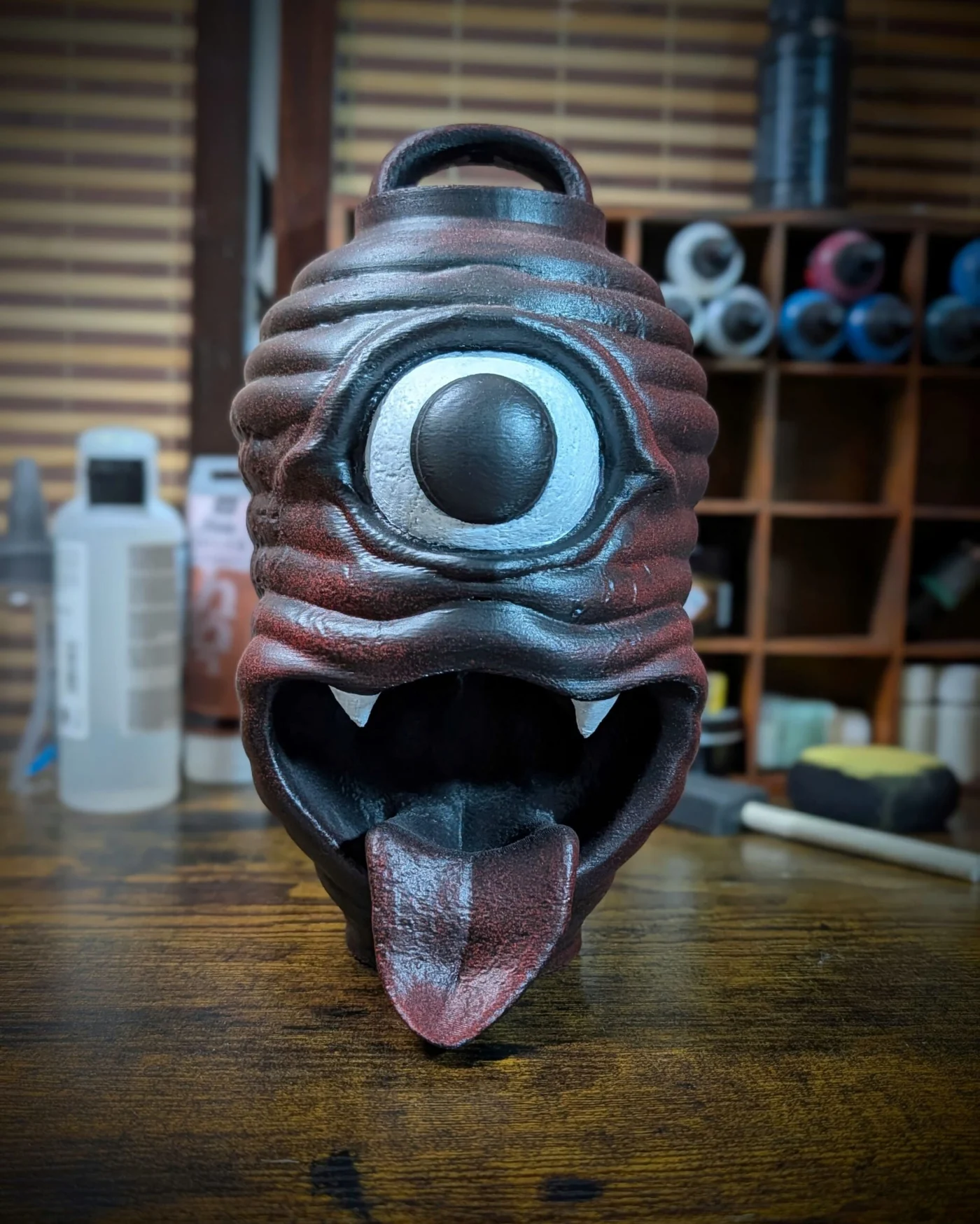
The Dai Yokai Chōchin-obake figure is a contemporary object inspired by the lantern ghost’s established visual features. It is made from a PETG base, then prepared, painted, varnished and finished by hand in Brittany, France. It is not presented as a Japanese antique, ritual lantern or historical replica.
The small format suits a shelf, tattoo-studio counter or convention display. Side lighting brings out the torn-mouth relief and painted surface. As with any hand-finished decorative object, exact colors and small paint details can vary slightly from one piece to another.
How to display and care for the figure
- Use soft side lighting so the eye, mouth and tongue cast readable shadows.
- Keep the figure on a stable shelf away from edges, strong heat and prolonged direct sunlight.
- Remove dust with a clean, dry microfiber cloth; do not soak the painted surface.
- Avoid solvents, abrasive cleaners and rough fabrics that could mark the varnish.
- Check the current product page for exact dimensions, availability and finish before ordering.
Sources and further reading
- Kyoto University Rare Materials Digital Archive: The Tsukumogami Story, for the hundred-year-old tools motif
- Japanese Wiki Corpus: Chochin Obake, for the visual description, scarce legends and distinction from Oiwa
- Ohio State University Libraries: Japanese Monsters, Ghosts and Spirits, for print and illustrated-yokai context
- Museum of Fine Arts, Boston: Hokusai, Inspiration and Influence, for Hokusai’s Ghost of Oiwa lantern image
- Ashmolean Museum: Japanese Ghosts and Demons, for the meaning of obake and ukiyo-e context
Conclusion
Chōchin-obake is best understood first as a powerful visual idea: a torn paper lantern suddenly read as a face. The tsukumogami tradition helps explain why an old object might come alive, but it should not erase the yokai’s strong print-culture history or the scarcity of fixed legends. Oiwa’s lantern is related by imagery, not identical in origin.
FAQ
What is a Chōchin-obake?
A Chōchin-obake is a Japanese yokai depicted as a paper lantern with a torn mouth, a long tongue and one or two eyes. It is especially familiar from illustrated and printed culture. Sources record very few concrete oral legends about it, so its appearance is better established than one fixed story or behavior.
What does Chōchin-obake mean?
Chōchin means a traditional Japanese paper lantern, while obake means a transformed or shape-changing being. Chōchin-obake is therefore commonly translated as lantern ghost or haunted lantern. It names the visual transformation of an ordinary lantern into a yokai rather than one single historical character with a fixed biography.
How do you pronounce Chōchin-obake?
A practical English approximation is “choh-cheen oh-bah-keh.” The macron in chō marks a long vowel. You will also see the name written Chochin-obake, Chōchin obake or Chōchin’obake. These variants generally point to the same lantern yokai.
Is a Chōchin-obake always a tsukumogami?
It is often explained today as a tsukumogami, an old manmade object that has gained a spirit. That is a useful connection, but historical summaries also describe Chōchin-obake as a stock yokai of pictures with almost no independent oral legends. The tsukumogami reading should therefore be presented as an interpretation, not its only proven origin.
Does Chōchin-obake have one eye or two?
Both forms exist. The familiar design turns a split in the lantern paper into a mouth, adds a hanging tongue, then places one or two eyes above it. A single eye is common in modern designs, but it is not a universal rule for every print, toy, illustration or handcrafted interpretation.
Is Chōchin-obake dangerous?
There is no single documented legend that fixes its level of danger. Modern depictions usually treat it as comic, strange or startling rather than violently threatening. Because the yokai is known mainly through images, claims about it attacking travellers, playing specific tricks or always being harmless should be treated as later storytelling rather than established folklore.
Is Oiwa’s lantern a Chōchin-obake?
Not exactly. Oiwa is the vengeful ghost from Yotsuya Kaidan. Artists, including Hokusai, represented her disfigured face emerging from a lantern. That image resembles a lantern yokai, but it refers to a specific human ghost and theatrical story. Generic Chōchin-obake and Oiwa’s lantern should not be merged into one origin.
What does a Chōchin-obake tattoo or design mean?
There is no universal traditional tattoo meaning. In a contemporary design, Chōchin-obake can suggest transformation, animated objects, humour, eerie nightlife or an interest in Japanese yokai imagery. The exact meaning belongs to the wearer or artist, so it is better to explain the historical visual references than to invent a fixed symbolic code.