| Question | Reliable answer |
|---|---|
| What is Shuten-dōji? | A famous oni leader from Japanese legend |
| What does the name mean? | Commonly understood as sake-drinking youth or drunken demon |
| Where is his stronghold? | Usually Mount Ōe, with Mount Ibuki in another major version |
| Who defeats him? | Minamoto no Raikō and his companions |
| How is he defeated? | Disguise, divine sake and a night attack |
Who is Shuten-dōji?
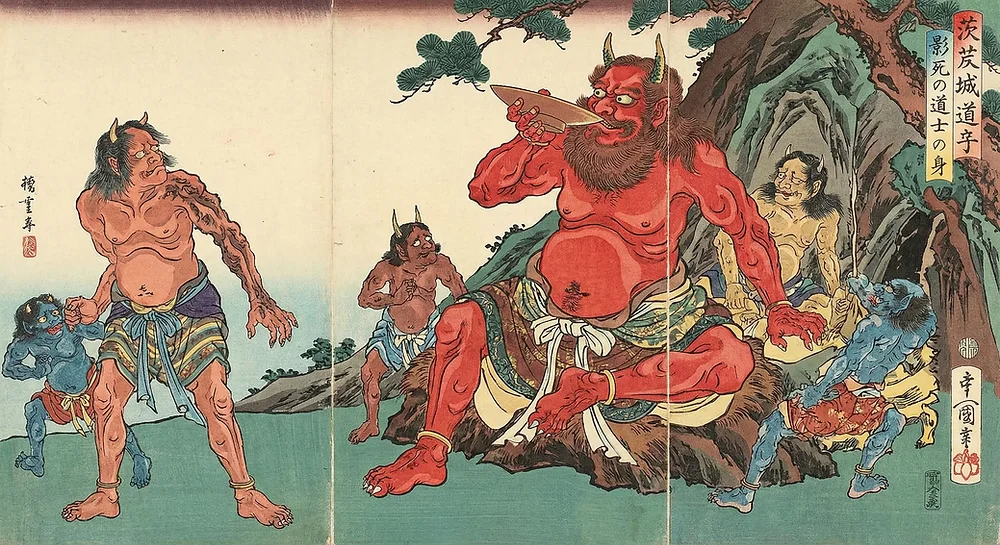
Shuten-dōji is one of the best-known oni in Japanese literature. He is usually presented as the leader of a group that raids the capital and holds captives in a mountain fortress. Modern summaries often call him the king of the oni, but the surviving stories are not a single biography with one fixed origin, appearance or location.
The legend is set around the Heian court and names the historical warrior Minamoto no Yorimitsu, better known in the tale as Raikō. That does not make the supernatural episode a historical record. It is a medieval literary story that combines court authority, warrior heroism, Buddhist and Shinto divine aid, horror and entertainment.
For the wider category, read what Oni mean in Japanese folklore and mask culture. Shuten-dōji is a specific named figure within that much broader tradition.
What does Shuten-dōji mean?
The name is commonly written 酒呑童子. Shuten refers to drinking sake. Dōji can describe a child, youth or young attendant depending on the religious and literary context. “Sake-drinking youth” is therefore a useful literal guide, while scholarly English also uses “drunken demon.”
The name points to the banquet at the center of the story, but it should not be reduced to a modern drinking nickname. Sake functions as hospitality, temptation, divine aid and the weapon that makes the oni vulnerable.
One legend, several textual traditions
The earliest surviving text is the fourteenth-century Ōeyama ekotoba, a picture scroll associated with the Mount Ōe version. Shuten-dōji later became part of the otogi-zōshi tradition, short prose tales copied and printed between the fourteenth and seventeenth centuries for entertainment and moral or religious instruction.
Folklore scholar Noriko T. Reider distinguishes two major textual families. The older and better-known version places the oni fortress at Mount Ōe. Another places it at Mount Ibuki and adds different religious explanations. Later books, prints, plays and local traditions continue to reshape the story.
This variation matters. Claims about Shuten-dōji being born human, wearing a mask that fused to his face, possessing a fixed number of horns or carrying one mandatory weapon belong to particular retellings or modern designs. They should not be presented as universal facts about the medieval legend.
The Mount Ōe story, step by step
| Stage | What happens |
|---|---|
| Disappearances in the capital | The court orders Raikō and his companions to confront the oni |
| Journey to Mount Ōe | The warriors disguise themselves as yamabushi, or mountain ascetics |
| Divine assistance | Three mysterious old men provide directions, protection and special sake |
| Banquet | Shuten-dōji receives the travelers while remaining suspicious |
| Attack | The sake incapacitates the oni and the warriors enter his chamber |
| Beheading | Raikō and his companions kill Shuten-dōji and fight the remaining oni |
The mission and the disguise
In the Hyogo Prefectural Museum of History’s account, the emperor delegates the mission to Minamoto no Yorimitsu, his four celebrated retainers and Fujiwara no Yasumasa. The six men visit sacred sites, then dress as mountain ascetics because an ordinary frontal attack against oni would fail.
On the mountain, they meet three old men who guide them and give them jinben kidoku-shu. The drink is medicine for humans but poison or a supernatural restraint for oni. The old men are later revealed as divine manifestations.
The banquet and the divine sake
Shuten-dōji receives the disguised warriors but suspects they may be soldiers. Museum accounts describe the visitors dancing and joining the banquet to lower the oni’s guard. Raikō then serves the special sake. Shuten-dōji drinks, returns to his fearsome oni form and becomes unable to resist the attack.
The beheading and the attacking head
The warriors enter the chamber and behead Shuten-dōji. In one of the most famous episodes, his severed head still leaps at Raikō and bites his helmet. The protection holds. This impossible final attack makes the oni’s defeat feel dangerous even after decapitation and became a powerful subject for picture scrolls and prints.
Raikō, the Four Heavenly Kings and Fujiwara no Yasumasa
| Figure | Role in the expedition |
|---|---|
| Minamoto no Raikō / Yorimitsu | Leader of the warriors and central hero |
| Watanabe no Tsuna | One of Raikō’s Four Heavenly Kings, also linked to Ibaraki-dōji |
| Sakata no Kintoki | One of the four retainers |
| Usui Sadamitsu | One of the four retainers |
| Urabe no Suetake | One of the four retainers |
| Fujiwara no Yasumasa | The sixth warrior in major Mount Ōe accounts |
Continue with the related stories of Watanabe no Tsuna and Ibaraki-dōji. These figures share the same narrative world, but each article should keep its own search intent.
Shuten-dōji and Ibaraki-dōji: what is the difference?
| Feature | Shuten-dōji | Ibaraki-dōji |
|---|---|---|
| Main role | Leader of the Mount Ōe oni | Prominent companion or subordinate |
| Best-known conflict | Defeated by Raikō’s expedition | Fights Watanabe no Tsuna in another famous legend |
| Defining episode | Divine sake and beheading | The severed-arm story |
| Reliable distinction | The central ruler in the Mount Ōe tale | A separate named oni with related traditions |
How is Shuten-dōji represented?
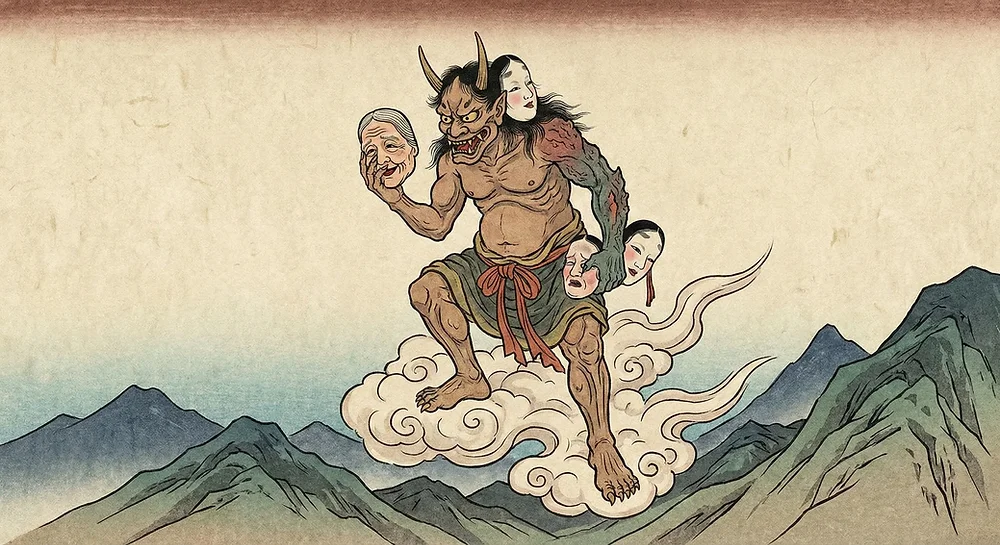
There is no single official Shuten-dōji design. The Ota Memorial Museum of Art shows works in which he first appears in human form at the banquet, then shifts back toward an oni form during the attack. Picture scrolls, ukiyo-e, theater, manga and games change his size, hair, skin, horns, clothing and weapons.
A sake vessel, an imposing body and an oni transformation help identify him, but five horns, white hair, a kanabō or one exact color scheme are not universal rules. Context matters more than a checklist of accessories: Mount Ōe, the banquet, Raikō, the special sake and the severed head make the figure recognizable.
Villain, outsider and political symbol
At the surface level, the story celebrates warriors who rescue captives and defeat a cannibalistic enemy with divine support. It clearly frames Shuten-dōji as a threat. Yet the method of victory also creates tension: the heroes enter as guests, deceive their host, drug him and attack when he cannot move.
Scholars have therefore read oni stories as more than simple monster tales. Reider summarizes interpretations in which oni can represent people pushed outside court society or political order. She also shows how later performances could strengthen the image of Raikō as a protector of the state. These are academic readings, not one secret meaning shared by every version.
Picture scrolls, prints and museum collections
The Hyogo Prefectural Museum of History presents the full Mount Ōe sequence as a medieval picture tale. Its illustrated account is especially useful for following the expedition, disguise, banquet, divine sake and final battle without blending in modern game lore.
The Ota Memorial Museum of Art explains the same legend through ukiyo-e and painted scrolls, including Shuten-dōji’s changing human and oni forms and the attack of the severed head. Together with the Hyogo museum sequence, these works show how artists selected different moments rather than enforcing one fixed design.
What Shuten-dōji can symbolize today
In contemporary art and tattoo culture, Shuten-dōji can evoke dangerous charisma, excess, defiance, betrayal or power outside established authority. None of these meanings is mandatory. A reliable design should first identify the legend, then let the wearer, artist or collector decide which modern interpretation matters.
A contemporary Oni mask can borrow the heavy brow, fangs, horns and commanding presence associated with this world. Dai Yokai pieces are made in Brittany from PETG bases that are sanded, primed, painted, varnished and finished by hand. They are modern creations inspired by Japanese imagery, not ritual masks or historical replicas.
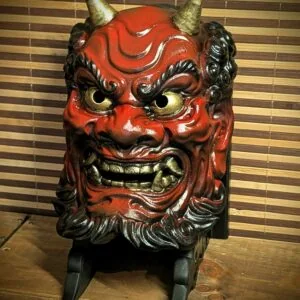
Browse the handmade Oni mask collection or read the wider guide to yokai in Japanese folklore. The article remains informational, while the collection carries the commercial intent.
Sources and further reading
- Hyogo Prefectural Museum of History, illustrated Mount Ōe story
- Ota Memorial Museum of Art, Shuten-dōji in scrolls and ukiyo-e
- Noriko T. Reider, Asian Folklore Studies, annotated study and translation
- Ride with Kyoto, Mount Ōe legend and Japanese Oni Exchange Museum material
FAQ
Who is Shuten-dōji?
Shuten-dōji is a famous oni leader from Japanese medieval legend. In the best-known Mount Ōe story, he abducts people around Kyoto and rules a mountain stronghold. Minamoto no Raikō and his companions enter in disguise, weaken the oni with divine sake and behead him while he is unable to fight.
What does Shuten-dōji mean?
The name is commonly written 酒呑童子. Shuten refers to drinking sake, while dōji can mean a youth, child or young attendant depending on context. English sources therefore use translations such as “sake-drinking youth” or “drunken demon,” although the Japanese name is usually kept unchanged.
Is Shuten-dōji an oni or a yokai?
Shuten-dōji is primarily described as an oni, often as an oni chieftain or king. Oni can also be discussed within the wider modern category of yokai, but the more precise label for this figure is oni. The legend presents him as the leader of a demonic group rather than a generic wandering spirit.
Where did Shuten-dōji live?
The most famous version places Shuten-dōji at Mount Ōe in Tanba, northwest of Kyoto. Other textual traditions place his fortress at Mount Ibuki, and some later retellings use different mountains. The surviving medieval literature does not give him one completely fixed location across every version.
Who defeated Shuten-dōji?
Minamoto no Raikō, also called Minamoto no Yorimitsu, leads the expedition. He travels with his Four Heavenly Kings and, in major versions, Fujiwara no Yasumasa. Disguised as mountain ascetics, the group gains entry to the stronghold, serves the oni divine sake and attacks after Shuten-dōji is incapacitated.
Why was sake used against Shuten-dōji?
In the legend, mysterious old men who are later revealed as divine protectors give Raikō a special sake called jinben kidoku-shu. It acts as medicine for humans but weakens or poisons oni. The drink lets the warriors defeat a supernatural enemy through disguise, divine aid and strategy rather than strength alone.
Did Shuten-dōji’s severed head attack Raikō?
Yes, in a famous version of the story the severed head leaps at Raikō and bites his helmet. The attack fails because the warrior is protected. This scene became one of the legend’s most memorable images, although individual picture scrolls and retellings do not all include exactly the same details.
What powers does Shuten-dōji have?
The medieval story treats Shuten-dōji as an exceptionally dangerous oni with great strength and a terrifying true form. Exact lists of powers, weapons, horn counts or transformations vary in later art and popular culture. It is safer to describe him as a powerful oni leader than to give him a fixed modern-style ability list.