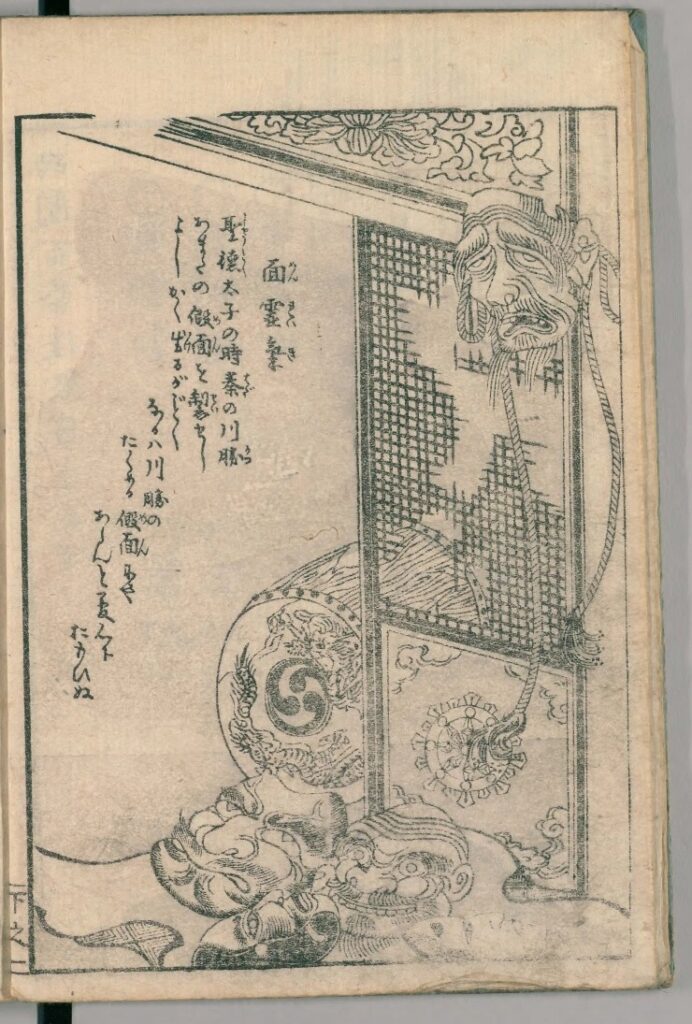
In Toriyama Sekien’s print of Menreiki (面霊気), a group of masks seems to come alive. The short caption to this yōkai illustration imagines, in a dream, a link to masks made by Hata no Kawakatsu.
How to read the print
On the National Diet Library’s digitized spread, Menreiki takes the right-hand page, where the title is printed with its reading in small characters. The illustration here shows just that page. The page on the left is a separate entry, Heiroku (幣六).
A mask with long cords hangs beside a lattice. Below it, other faces cluster at the foot of the screen. The eye moves between faces with closed eyes and open mouths.
The catalog record describes this third volume of the Gazu Hyakki Tsurezure Bukuro (画圖百器徒然袋) as an 1805 copy reprinting an edition from the fourth year of the Tenmei era (1784).
What the caption does
The commentary opens with hearsay: in Prince Shōtoku’s time, it is said, Hata no Kawakatsu made a great many masks. The narrator then wonders, in a dream, whether these lifelike masks could be Kawakatsu’s.
The caption starts with a story people told and ends with a question posed in a dream. Looking back at the print, it is the expressions on the faces that make the masks seem to stir.
Stage masks and paper apparitions
The Tokyo National Museum lists 31 gigaku masks from the Hōryū-ji treasures, dated in its catalog to the 7th and 8th centuries. Its catalogue describes them as masks worn for gigaku, an early form of musical theatre.
Sources
- National Diet Library (NDL), catalog record for the Gazu Hyakki Tsurezure Bukuro, vol. 3, call number わ-38.
- NDL, digitized spread and IIIF scan of the full spread.
- Tokyo National Museum, gigaku masks from the Hōryū-ji treasures.
