Jizō, also called Jizō Bosatsu, is a figure of Japanese Buddhism associated with compassion. Commonly shown as a monk with a shaved head, he is invoked particularly for children and travelers. His statues appear at temples, beside paths and in places of remembrance.
A small smiling figure and an old temple sculpture can both depict Jizō while serving different purposes. His religious identity, the practices of a particular place and contemporary decorative interpretations should be understood separately.
Who is Jizō Bosatsu?
Jizō is the Japanese name for Kshitigarbha, a bodhisattva associated with compassion and helping beings who suffer. The Metropolitan Museum of Art describes his worship as reaching Japan in the eighth century and flourishing during the Kamakura period. His roles also include aiding beings in the different realms of Buddhist existence.
Bosatsu means bodhisattva. It does not mean a yokai or a ghost. Jizō belongs to a particular Buddhist context, even though his appearance has become familiar far beyond large religious sculptures.
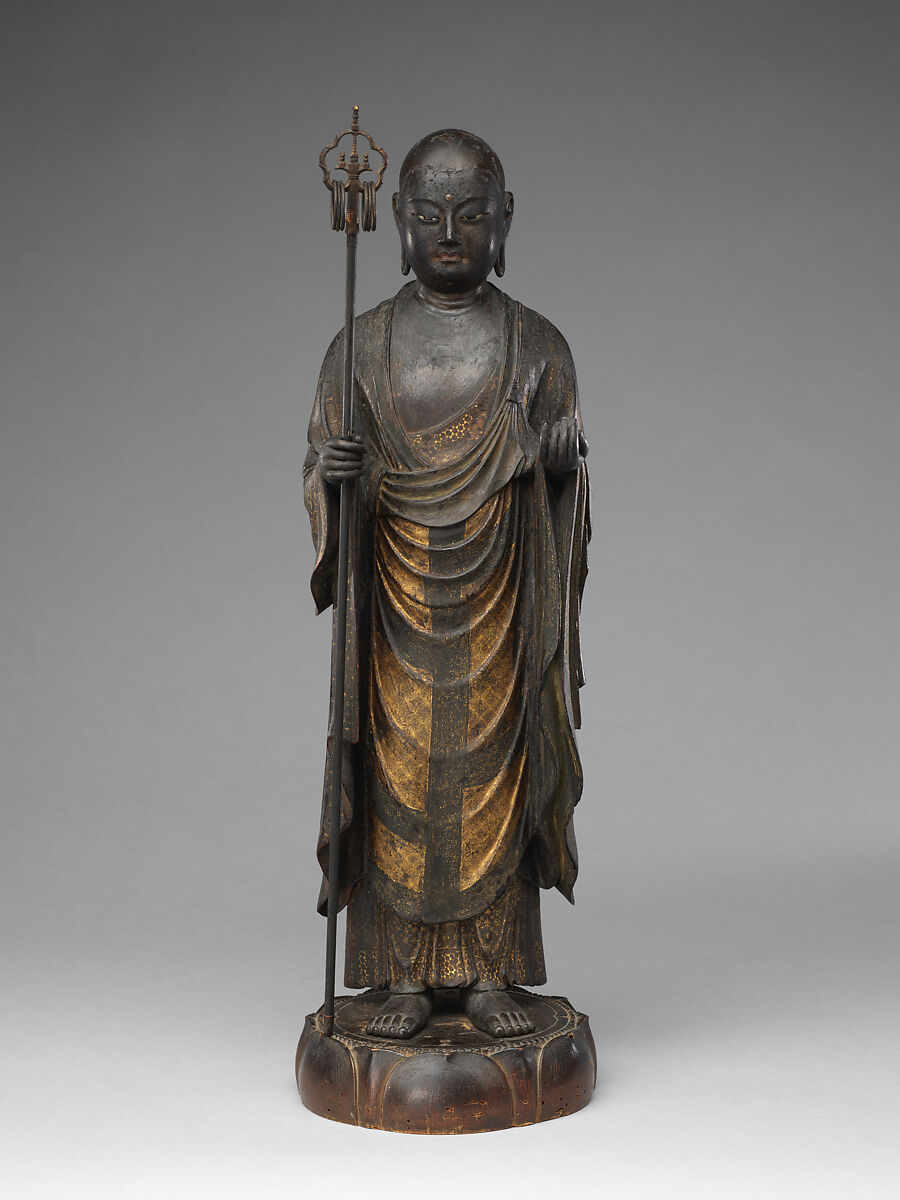
How can you recognize a Jizō statue?
Historical works often show a shaved head, a monk’s robe and an attentive expression. Some figures hold a ringed staff and a jewel. These attributes appear in the Met’s sculpture by Intan, dated 1291, as part of the bodhisattva’s religious imagery.
- The robe and shaved head give Jizō the appearance of a monk.
- The ringed staff is a familiar attribute, although not every representation includes it.
- The jewel belongs to religious symbolism, rather than a promise attached to any small statue.
These features help with reading an image. They cannot establish an object’s age, origin or intended use when it is offered for sale today.
Why are Jizō statues found beside paths?
Jizō’s association with travelers helps explain his presence at places of passage. The Japan National Tourism Organization describes Jizō figures along the Nakasendo, the old route connecting Kyoto and Edo. The walking route gives a concrete setting to his role as a guardian beside the road.
A statue seen on a walk might also belong to a temple, a local story or a neighborhood practice. Its location offers a clue, but a sign or an explanation from the place is more reliable than interpreting the photograph alone.
Children, red clothing and remembrance
Some statues wear red hats or bibs. At Sainokawara Park, the JNTO connects small Jizō figures with protecting the spirits of children who died before their parents. This context helps explain why a gentle-looking figure can stand in a place carrying a strong sense of remembrance.
Reducing every Jizō to a cute mascot misses that meaning. When visiting, respect clothing, objects left nearby and photography rules. A statue and its accessories should not be moved to arrange a photograph.
From historical sculpture to smiling figures
Hasedera Temple in Kamakura presents several forms of Jizō imagery: rows of statues around its Jizo-do hall, a smiling Nagomi Jizo and small groups called Ryo-en Jizo. The variety shows how the same figure can take different forms and scales.
When looking at a statuette, begin with its expression, posture and attributes, then find out how it was made. A contemporary interpretation should be described accordingly. A Jizō silhouette alone does not make an object consecrated, antique or connected with a particular temple.
The guide to Japanese good luck symbols and objects provides a comparison between other figures and their roles, without treating Jizō as a generic lucky charm.
Japanese figurines coming to Dai Yokai
New Japanese figurines are coming soon to Dai Yokai. Models and availability will be announced when they are introduced.
Find the pieces currently offered in the Japanese statues and figurines collection.
Sources
- The Metropolitan Museum of Art, Jizō, Bodhisattva of the Earth Store, identity and historical context.
- The Metropolitan Museum of Art, Jizō by Intan, 1291, imagery and attributes.
- JNTO, Nakasendo, Jizō and travelers.
- JNTO, Sainokawara Park, children and clothed statues.
- Hasedera Temple, introduction, Jizo-do, Nagomi Jizo and Ryo-en Jizo.