Say "oni" and most people picture a menacing horned demon, the kind chased away with beans at Setsubun. The yabu of Kure flips that image. Behind its oni mask, it isn't the festival's enemy , it's its guardian. That single shift is what makes the Oni Yabu mask so distinctive.
An oni unlike the others
At Setsubun, an oni is driven away with beans. In Kure, the masked yabu belongs to the sacred procession: Kameyama Shrine describes this figure as a messenger and guard of the kami. That local role should not be applied to every oni in Japan. For a different regional practice, Sado’s Ondeko brings Oni, dance and taiko together in its own local setting.
Origins: The Autumn Festivals of Kure
The yabu is inseparable from Kure, a port city in Hiroshima Prefecture. It appears most notably at the autumn festival of Kameyama Shrine, held every year for well over a century to give thanks for the harvest and pray for the community's safety. The yabu is described as a local custom, specific to the Kure area , you won't find it in standard Shinto textbooks. It's a living, locally transmitted tradition rather than a fixed religious symbol.
Faces and customs vary between districts. The history published by Kameyama Shrine suggests that the present form may have developed after the shrine moved in 1890, through a meeting of customs brought by different communities. This is a hypothesis, not a certain founding date.
Role: Guardian of the Mikoshi, the Rice, and the Deity
The festival description at Kameyama Shrine distinguishes two moments. The yabu guard the rice offering carried on a tawara-mikoshi, locally called tonbo, and ritually challenge its passage. They then guide and guard the mikoshi carrying the kami through the town. Their bamboo poles and severe faces serve a protective role.
A tradition centered on children
Kameyama Shrine records a local belief that a child held by a yabu will grow up healthy. Families therefore present young children to these imposing figures. This custom belongs to Kure; it should not be described as a practice of all Japanese shrines.
| Figure | Context | Documented role |
|---|---|---|
| Yabu of Kure | Local autumn festivals | Messenger and guard of the kami and procession |
| Setsubun oni | Bean throwing | Figure driven out with harmful influences |
| Onigawara | Roof architecture | Fierce protective figure on a building |
The Oni Yabu Mask, Reimagined by Dai Yokai
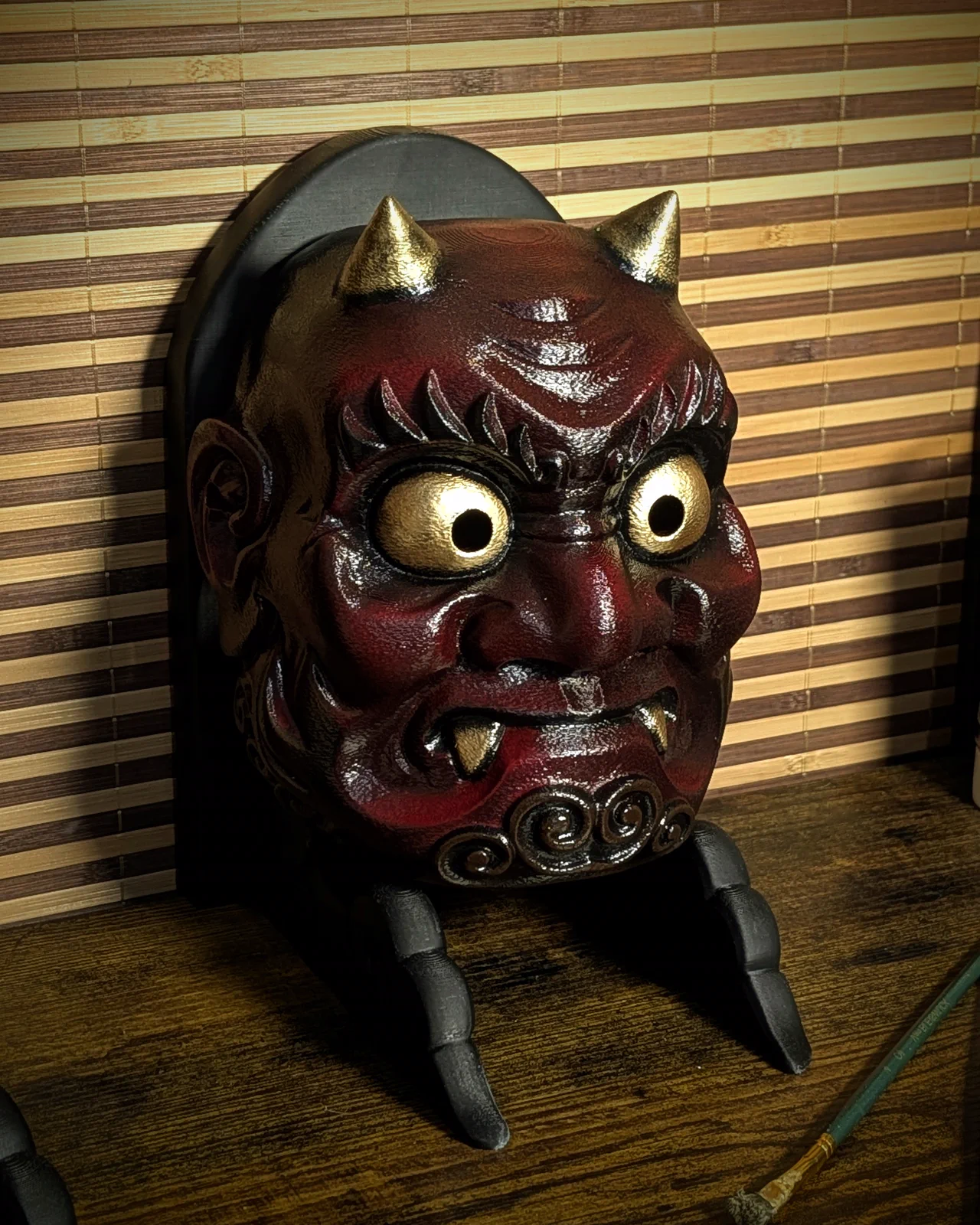
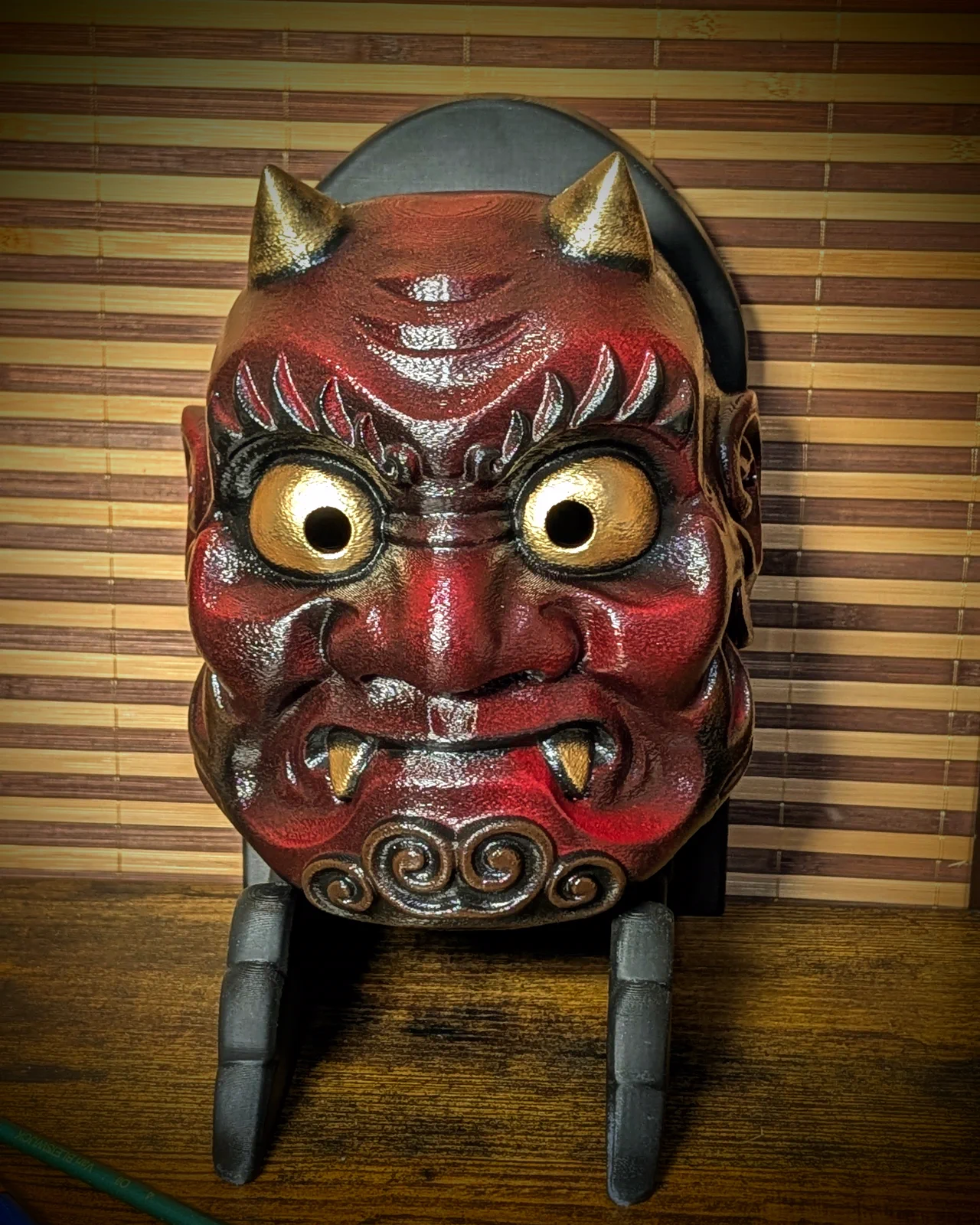
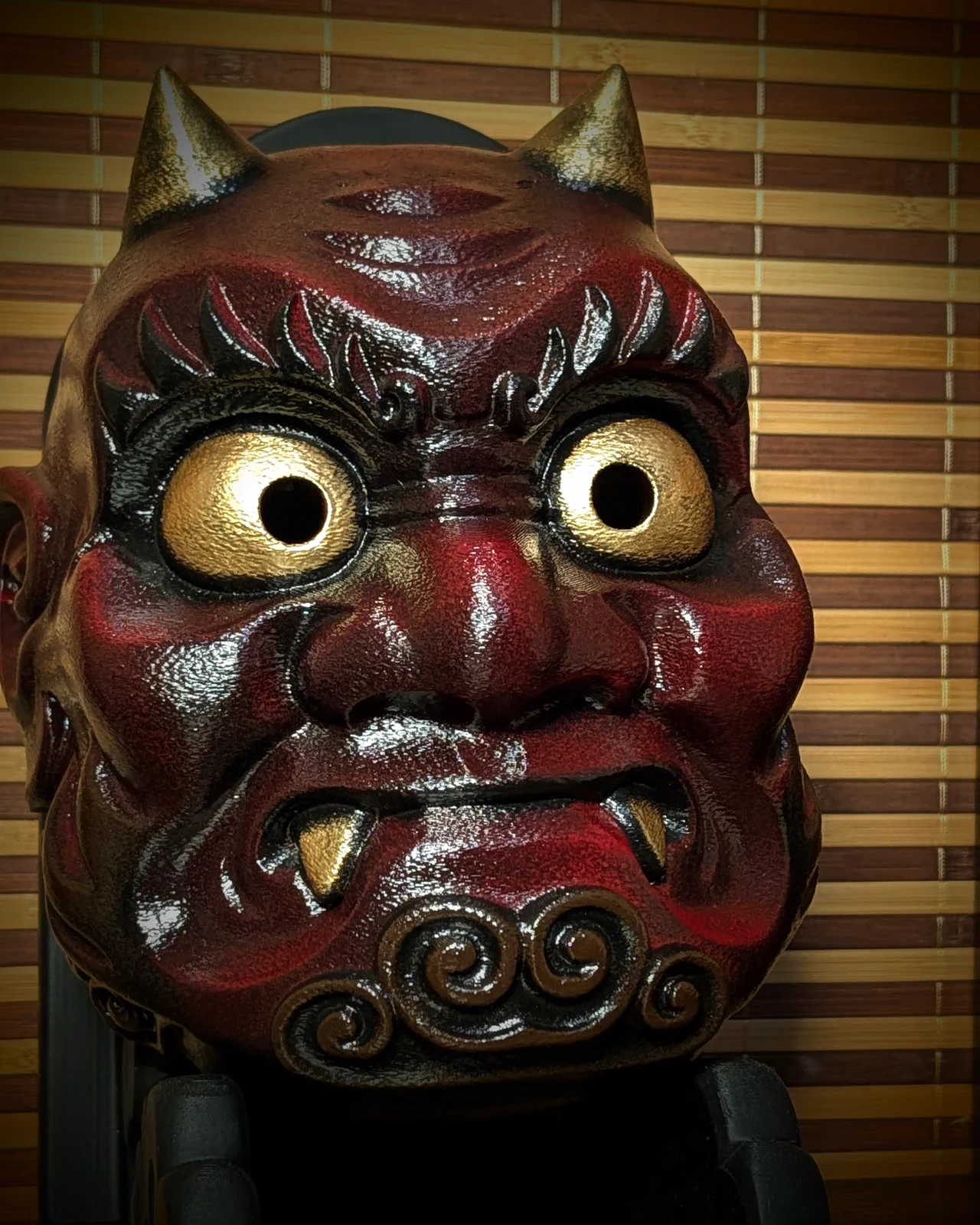
The Dai Yokai Oni Yabu is a contemporary interpretation. Its burgundy, black and gold palette, horns and relief are choices of this model, not a standard for every festival mask in Kure. The PETG base is 3D printed, then sanded, painted and finished by hand in Brittany, France. Occasional wear is possible after checking fit, comfort and field of vision; wall display is another option. See the Oni Yabu mask and its current details.
See the collection of handmade Oni masks too.
For the link with irezumi, read the Oni tattoo guide.
Frequently asked questions
Is the Oni Yabu mask a traditional Japanese object?
No. It's a contemporary handcrafted piece inspired by the yabu of Kure's festivals. It is neither an antique nor a mask made in Japan.
What material is the mask made of?
It's 3D-modeled and printed in PETG, a strong plastic, then sanded, prepped, and painted entirely by hand.
Can it be worn, or only displayed?
It can be displayed or worn occasionally. Check the product measurements, fit, comfort and field of vision before wearing it. This does not guarantee comfort for prolonged use.
What is a yabu in Kure?
A masked participant in the local autumn festivals. The yabu wears an oni-like face, a sacred rope on the back and carries a bamboo pole. Its role is to guard and guide the procession.
Why do families present children to the yabu?
A local belief recorded by Kameyama Shrine says that a child held by a yabu will grow up healthy. It is a festival custom, not a guarantee or a nationwide rule.