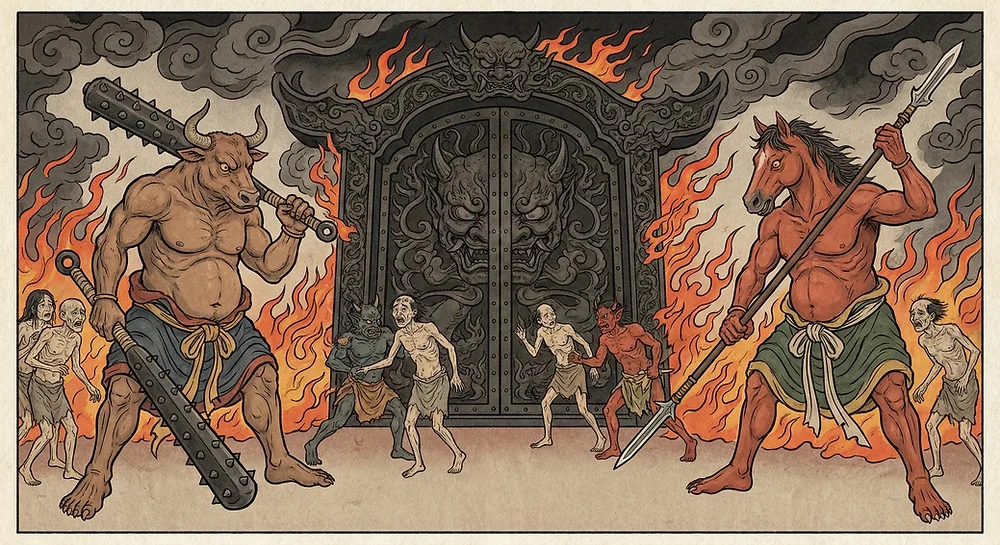
Gozu (牛頭, Ox-Head) and Mezu (馬頭, Horse-Head) are animal-headed warders in Japanese Buddhist hell imagery. They are often shown escorting the dead, guarding the underworld or carrying out punishments associated with Enma's court. Their exact weapons, colors and individual duties are not fixed by one universal tradition.
Gozu and Mezu at a glance
| Name | Literal meaning | Reliable identification | Related East Asian name |
|---|---|---|---|
| Gozu (牛頭) | Ox-Head | A human-like warder with an ox or bull head | Niútóu in Chinese |
| Mezu (馬頭) | Horse-Head | A human-like warder with a horse head | Mǎmiàn in Chinese |
| Gozu Mezu (牛頭馬頭) | Ox-Head and Horse-Head | A collective expression for the animal-headed hell warders | Ox-Head and Horse-Face |
What are Gozu and Mezu?
Gozu and Mezu belong to the visual and narrative world of Buddhist hells. Japanese sources use terms such as gokusotsu for hell warders or jailers, and some texts connect animal-headed demons with rasetsu, the Japanese form of rakshasa. It is safer to describe their function than to force every example into one supernatural species.
They are not kami worshipped for luck, and they are not simply a pair of free-roaming yōkai. Their place is normally the underworld, where they appear among officials, judges and demonic warders who confront the dead with the consequences of their actions.
From the Chinese underworld to Japanese Buddhist imagery
Ox-Head and Horse-Face are well known in Chinese underworld traditions as Niútóu and Mǎmiàn. Japanese Gozu and Mezu share their names, animal-headed appearance and connection to the courts of the dead. The transmission was not a single moment or a simple copy. Buddhist cosmology, Chinese underworld bureaucracy and Japanese preaching imagery developed together across centuries.
In Japan, ideas about judgment after death were shaped by Buddhist scriptures, sermons, illustrated hell scrolls and works such as Genshin's Ōjōyōshū. These sources helped make the hell realms, their judges and their warders vivid to audiences. Gozu and Mezu should therefore be understood inside an East Asian religious network, not as exclusively Japanese inventions.
What role do they play in hell?
Across different accounts, ox-headed and horse-headed warders may escort the newly dead, guard entrances, herd beings toward judgment or participate in punishments. They are often associated with Enma, the judge of the dead, but Japanese Buddhist hell is not always organized around Enma alone. The Ten Kings tradition includes several judges and courts.
The current article previously assigned crushing force to Gozu and pursuit to Mezu, along with fixed weapons, colors and personalities. Those distinctions are useful for a game design, not as historical rules. Religious art varies too widely to support that chart.
| Claim | Evidence-based reading |
|---|---|
| Gozu always uses a club | Some images give animal-headed warders clubs or tools, but no single weapon is universal. |
| Mezu always hunts escaping souls | Warders may escort, guard or punish the dead; a fixed pursuit role is not universal. |
| Each has an official color | Colors depend on the artwork, period and modern adaptation. |
| They are exactly two individuals | They can be treated as a pair, names, types or members of a larger group of hell warders. |
| They rule the Eight Great Hells | They serve within hell imagery; Buddhist texts describe many hells, judges and warders. |
Gozu, Mezu and Enma's court
Enma is the Japanese form of a judge whose history passes through the Indian Yama and the Chinese Yanluo. In popular images, his court resembles a bureaucracy: records are kept, testimony is examined and warders carry out decisions. This administrative language helped make karmic judgment understandable, but individual paintings and stories do not all use the same staff or procedure.
Tokyo National Museum explains that Japanese Buddhist belief placed beings within six realms of rebirth and connected judgment to a future destination. Gozu and Mezu belong to the frightening imagery around that moral system, not to a simple adventure map of one permanent hell.
How hell scrolls and temple displays use animal-headed warders
Japanese hell scrolls turn abstract consequences into visible scenes. The Nara National Museum's Tales of the Buddhist Hells shows punishments described in Buddhist texts, including material linked to the Horse-Headed Demon Sutra. Other mandalas and temple displays place ox-headed or horse-headed warders among cauldrons, courts and paths through the afterlife.
These images were not character sheets. They supported ritual, teaching and picture-explaining practices. A modern reader should therefore separate what a particular artwork shows from claims about an official personality or power shared by every version of Gozu and Mezu.
Do not confuse these figures
| Figure | Context | Why it is different |
|---|---|---|
| Gozu and Mezu | Animal-headed warders of Buddhist hell | Their defining traits are the ox and horse heads and their underworld function. |
| Gozu Tennō | A separate deity historically linked with Gion belief and protection from epidemic disease | Sharing the word Gozu does not make him the ox-headed hell warder. |
| Batō Kannon | Horse-headed form of Kannon or Avalokiteśvara | A compassionate bodhisattva form, not Mezu the hell warder. |
| Ushi-oni | A diverse group of ox-related yōkai traditions | A folklore category with different bodies, stories and regional contexts. |
| Oni | A broad class of Japanese supernatural beings | Some hell warders may look oni-like, but Gozu and Mezu are more specific roles. |
For terminology, compare the difference between yōkai and kami. For a separate group of fierce Japanese supernatural beings, read the Oni meaning guide.
Gozu and Mezu in modern popular culture
Games, manga and animation often turn the warders into named fighters with separate powers. Nioh 2, for example, adapts them as the bosses Gozuki and Mezuki. Such versions can preserve the ox-head and horse-head identification while inventing weapons, attacks, colors and personalities for gameplay.
Modern adaptations are useful for showing that the figures remain recognizable, but they should not be used as historical evidence. When a power or rivalry appears only in a recent game, treat it as that work's creative interpretation rather than a rule of Buddhist folklore.
A note from the Dai Yokai workshop
I do not currently make a Gozu or Mezu mask. Their animal-headed forms sit outside the main Dai Yokai catalogue of contemporary Oni, Kitsune, Hannya, Tengu and Mempo-inspired pieces. This guide remains educational rather than forcing a product connection that is not there.
FAQ
Who are Gozu and Mezu?
Gozu and Mezu are the Japanese names for ox-headed and horse-headed warders associated with Buddhist hell imagery. They may escort the dead, guard the underworld or carry out punishments. Their exact number, appearance and duties vary across texts, paintings, temple displays and later popular culture.
What do the names Gozu and Mezu mean?
Gozu (牛頭) means Ox-Head, while Mezu (馬頭) means Horse-Head. The same character pair appears in the collective expression gozu mezu (牛頭馬頭). Chinese traditions commonly call the corresponding figures Niútóu and Mǎmiàn, Ox-Head and Horse-Face.
Are Gozu and Mezu Japanese yōkai?
They are better described as Buddhist hell warders in Japanese religious and popular imagery. Modern yōkai references may include them, but that label can hide their wider East Asian Buddhist and Chinese underworld context. They are not simply local Japanese monsters.
Do Gozu and Mezu serve Enma?
They are often shown as warders or attendants in an underworld governed by Enma, the Japanese form of Yama or the Chinese Yanluo. However, Buddhist hell traditions contain several judges and many types of warders, so not every source presents one identical chain of command.
Do Gozu and Mezu have different weapons or powers?
There is no universal rule assigning one fixed weapon, color, temperament or power to each figure. Artists may give them clubs, spears, tools or other attributes, but those choices vary. The reliable distinction is their animal heads: ox for Gozu and horse for Mezu.
Are Gozu and Mezu the same as Gozu Tennō or Batō Kannon?
No. Gozu Tennō is a separate deity associated historically with Gion belief, while Batō Kannon is the horse-headed form of the bodhisattva Kannon. Similar words or animal imagery do not make these figures equivalent to the hell warders Gozu and Mezu.
Are Gozu and Mezu mentioned in Japanese art and literature?
Ox-headed and horse-headed hell warders appear in Japanese Buddhist narratives and visual culture. Hell scrolls, temple displays and mandalas depict animal-headed demons among the beings who escort or punish the dead. The precise figures and scenes depend on the source.
Does Dai Yokai make Gozu or Mezu masks?
No. Dai Yokai does not currently make a Gozu or Mezu mask. The workshop focuses mainly on contemporary handmade masks inspired by Oni, Kitsune, Hannya, Tengu and related Japanese imagery. This article is a cultural guide, not a product claim.
Sources and further reading
- Nara National Museum, Tales of the Buddhist Hells
- Tokyo National Museum, Buddhist judgment and the six realms
- Noriko T. Reider, Japanese Demon Lore
- Japanese Journal of Religious Studies, demonic warders of hell
- Yokai.jp, Tateyama Jigoku mandala tradition