The Hannya is one of the most recognizable faces in Noh theater: horns, metallic eyes, sharp teeth and an expression that can feel furious or wounded. Its history is theatrical, not a generic story about every Japanese demon mask.
Short answer: A Hannya mask is a Noh theater mask used for a woman transformed by jealousy, resentment or obsessive attachment. Its horns, metallic eyes and fangs make it demonic, yet the face also conveys grief. It appears in plays such as Aoi no Ue and Dōjōji. A Hannya is not simply an Oni mask.
What is a Hannya mask?
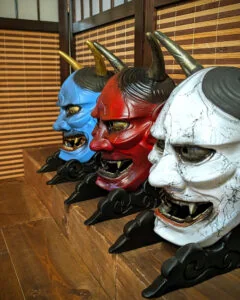
A Hannya is a Noh mask for a female demon or a woman transfigured by resentment. The Nohgaku Performers’ Association uses that definition, while the British Museum describes a once-beautiful woman transformed by jealous rage and records the mask in Aoi no Ue and Dōjōji. Its horns and teeth show the demonic change, while the brow and eyes preserve suffering.
The mask belongs to the ghost and spirit category of Noh masks, not to one fixed species of yōkai. For a contemporary interpretation of the silhouette, see the handmade Hannya masks made in the Dai Yokai workshop.
Is a Hannya the same as an Oni?
No. Hannya names a specific Noh mask and dramatic role. Oni is a broader term for ogre-like supernatural beings in Japanese stories. Both can have horns, fangs and an intimidating face, but a Hannya keeps a clear link to a woman’s emotional and demonic transformation. The Oni mask meaning guide explains the other side of that comparison.
| Feature | Hannya | Oni |
|---|---|---|
| Main context | A specific mask and role in Noh theater | A broad group of supernatural beings across folklore, religion and festivals |
| Typical identity | A woman transformed into a demon or vengeful spirit | Varies by story and context; not one character or gender |
| Recognizable form | Two horns, metallic eyes, sharp teeth and a fixed Noh mask structure | Highly varied forms, often with horns, fangs, wild hair or an iron club |
| Core reading | Resentment, jealousy, suffering and emotional transformation | Danger, punishment, force or the expulsion of misfortune, depending on context |
Which Noh plays use a Hannya mask?
Aoi no Ue: Lady Rokujō’s vengeful spirit
In Aoi no Ue, the spirit of Lady Rokujō appears first through a Deigan mask and later as a female ogre wearing Hannya. The play is based on an episode from The Tale of Genji. Her loss of Genji’s attention and humiliation at the Kamo Festival feed the resentment expressed on stage.
Dōjōji: the woman and the temple bell
In Dōjōji, a female dancer enters a ceremony for a renewed temple bell, hides beneath it and later reappears as a female ogre or poisonous snake. The performance may use a Hannya or Shinja mask. This is the stage tradition behind the story of a woman pursuing a priest to Dōjōji Temple.
Kurozuka: rage that still carries sadness
Kurozuka, called Adachigahara in the Kanze school, also uses Hannya for its female ogre. The Noh Plays Database stresses that the mask is frightening but still expresses human sadness. That tension is central to the Hannya’s visual power.
Why can a Hannya look angry and sad?
A Noh performer changes how the audience reads a fixed mask through posture, viewing angle and light. The Nohgaku Performers’ Association calls the upward and downward effects teru, “to brighten,” and kumoru, “to cloud.” Seen face-on or slightly raised, Hannya can look harder and more threatening. Tilted down, its brow and eye sockets can appear wounded or tearful.
What do Hannya mask colors mean?
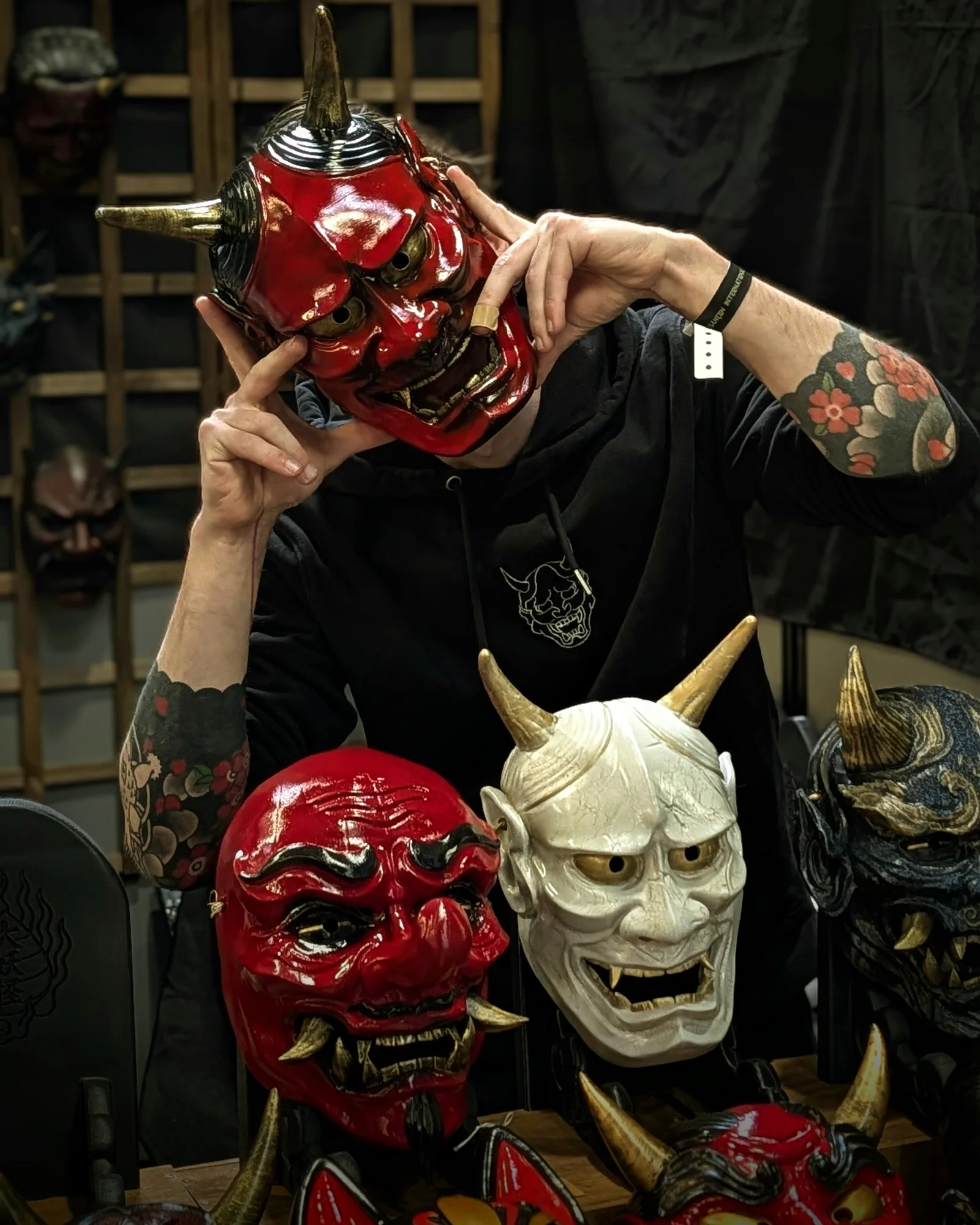
Color distinguishes mask types and stage roles, but it is not one universal chart of “early, middle and complete” transformation. An English guide published by Toyonaka City links Shiro-Hannya with the court lady in Aoi no Ue, Aka-Hannya with Dōjōji, and black Hannya with the demoness in Kurozuka. The play, school and precise mask type still matter.
| Mask or color context | Documented stage context | Careful interpretation |
|---|---|---|
| Shiro-Hannya, white Hannya | Used for the court lady in Aoi no Ue | Retains beauty and elegance while expressing jealousy, sorrow and anger |
| Aka-Hannya, red Hannya | Used in the later act of plays such as Dōjōji | A less refined, forceful female demon mask; not a universal middle stage |
| Black Hannya | Used for the demoness in Kurozuka among other roles | A dark treatment tied to particular roles, not a rule for every Hannya image |
| Jya or Shin-jya | Serpent masks used in Dōjōji variants | More strongly serpentine than Hannya and should not be reduced to a color level |
| Blue, gold or other modern colors | No fixed Noh role | Usually a tattoo, décor or workshop choice defined by the complete composition |
Dai Yokai uses red, white, black, gold and other finishes as workshop design choices. They can echo familiar Japanese mask imagery, but they are not presented as one religious or theatrical color code.
What does the word Hannya mean?
Hannya is the Japanese reading of the Buddhist term prajñā, usually translated as wisdom. The exact reason the demon mask received this name is not certain. One tradition connects it with a mask maker called Hannya-bō; another links it with Buddhist language used in Noh. These are explanations or hypotheses, not proof of one deliberate paradox.
What does a Hannya tattoo mean?
In contemporary Japanese-inspired tattooing, Hannya can represent jealousy, emotional pain, destructive passion or transformation. Some wearers read it as protection or mastery over difficult emotions, but the mask does not carry one automatic tattoo meaning. Color, surrounding motifs and the artist’s composition change the reading. See the dedicated Hannya tattoo meaning guide for that subject.
Contemporary Hannya masks at Dai Yokai
Dai Yokai is a workshop in Brittany, France. Each contemporary Hannya mask starts with a PETG base, then is sanded, primed, painted, varnished and finished by hand. The work takes inspiration from the Hannya silhouette and Japanese mask aesthetics without claiming to reproduce an authentic Noh stage mask.
Depending on the model, a finished piece can be displayed on a wall, taken to a convention or worn for a photo shoot or light cosplay. Check the product’s size and fixing system before planning long wear, and keep the finished mask away from strong heat, prolonged direct sunlight and damp rooms.
Can a Hannya have a skeletal face?
A traditional Hannya keeps a human face distorted by rage and grief. The Gashadokuro Hannya Mask deliberately moves away from that anatomy: the face becomes a skull, while the horns and overall tension keep it visually connected to the Hannya family.
It is not a Noh theater mask or an ancient folklore figure. It is a contemporary interpretation based on Golden Kaeru’s Bone Hannya model, physically produced and hand-painted in my workshop.
The Hannya remains powerful because it does not reduce emotion to a monster face. It keeps rage and grief in the same expression. That tension is the most useful starting point for understanding the mask in Noh, tattooing or contemporary craft.
Sources and context
- Nohgaku Performers’ Association, Noh mask categories and expression
- Toyonaka City, English guide to Hannya, Aka-Hannya and serpent masks
- Aoi no Ue, roles and masks
- Dōjōji, roles and masks
- Kurozuka, synopsis and Hannya context
- British Museum, Edo-period Hannya theater mask
- The Metropolitan Museum of Art, Edo-period Hannya mask
FAQ
What does a Hannya mask mean?
A Hannya mask represents a female demon in Noh theater, often shaped by jealousy, resentment or obsessive attachment. The face is frightening but also sorrowful, so its meaning is more complex than anger alone. It can express emotional transformation, suffering and the danger of passions that have become destructive.
Is a Hannya mask the same as an Oni mask?
No. A Hannya is a specific Noh mask for a female demonic or vengeful spirit, while Oni is a broader term for ogre-like supernatural beings. Both may have horns and fangs, but their theatrical roles and stories are different. Modern designs sometimes mix their features, which causes the confusion.
Is a Hannya mask evil or satanic?
No. The Hannya belongs to Japanese Noh theater and is not connected to Satan or Christian demonology. It represents a character overwhelmed by destructive emotions, but Noh also preserves her suffering and humanity. Calling it satanic removes the mask from its Japanese theatrical and Buddhist context.
Why can a Hannya mask look angry and sad?
The carved expression reacts strongly to viewing angle and light. Seen face-on or tilted upward, the horns, teeth and metallic eyes can feel more threatening. Tilted down, the shadows around the eyes and brow can reveal grief. This change of perception is part of the expressive technique used with many Noh masks.
Which Noh plays use a Hannya mask?
Well-known examples include Aoi no Ue, Dōjōji and Kurozuka, also called Adachigahara in the Kanze school. The exact mask can vary by play and performance tradition. In these works, the Hannya appears for a female spirit or ogre whose rage remains tied to suffering or obsession.
What do Hannya mask colors mean?
Color helps distinguish mask types and stage roles, but there is no universal three-step chart. Shiro-Hannya is associated with the court lady in Aoi no Ue, Aka-Hannya with Dōjōji, and black Hannya with the demoness in Kurozuka. Modern blue, gold or other colors are usually artistic choices.
What does a Hannya tattoo mean?
A Hannya tattoo may suggest jealousy, pain, transformation, destructive passion or emotional struggle. Some wearers also give it a protective or self-mastery meaning, but that reading is personal rather than automatic. The surrounding motifs, colors and the tattoo artist’s composition determine the final message.
Can a Hannya mask be worn or displayed?
A contemporary Hannya mask can be worn for conventions, photo shoots or light cosplay when its size and fixing system are suitable. It can also be displayed as Japanese-inspired wall art. A Dai Yokai mask is a modern handcrafted creation, not an authentic Noh performance mask or ritual object.