
Amazon, AliExpress and independent workshops can all list Japanese-style masks, but the platform name does not tell you who made the object. Compare the exact seller, dispatch location, materials, dimensions, photographs, intended use, return terms and total delivered cost. Choose a marketplace for convenience or a direct maker when process and communication matter.
The short answer: compare the listing, not the logo
Amazon is both a retailer and a marketplace, and it also operates Amazon Handmade for approved makers. AliExpress is a marketplace made up of individual sellers. An independent workshop can sell through its own site and through one or more platforms. That means Amazon does not automatically mean factory-made, AliExpress does not identify one material, and a maker website is not automatically proof of quality.
| Buying route | Possible advantage | Main verification |
|---|---|---|
| Amazon retail or marketplace | Fast comparison, familiar checkout and fulfilment options | Sold by, Dispatches from, maker information and exact product details |
| Amazon Handmade | Approved maker profiles and handmade classifications | Which handmade category applies and what the maker actually performs |
| AliExpress seller | Large choice, frequent stock and wide price range | Seller history, buyer photos, dimensions, dispatch and return eligibility |
| Independent workshop | Direct process information and communication | Identity, portfolio, production estimate, policies and finished quality |
| Specialist or antique shop | Culturally specific work, artists or documented older pieces | Maker, origin, condition, provenance and intended context |
Amazon: retailer, marketplace and Handmade are different
On an Amazon product page, check both Sold by and Dispatches from. The seller may fulfil the order, or Amazon may handle fulfilment for a third party. Those fields help explain who is responsible for the listing and shipment, but they still do not prove how the mask was manufactured.
Amazon Handmade is a separate programme for approved makers and collaborative groups. Its current classifications include hand-altered, hand-designed, handcrafted, repurposed and upcycled products. A Handmade label is therefore useful context, but it should be read with the maker profile and the product-specific process.
AliExpress: judge each seller and eligible service
AliExpress listings come from registered sellers, so material, finish, dispatch and support are listing-specific. Use buyer photographs to check scale and surface finish, but also verify whether reviewers ordered the same variation. Read dimensions rather than assuming that an adult model in a photograph proves adult fit.
Return conditions also vary. AliExpress describes a Free Return service for participating products, sellers and buyers, identified by the relevant label and subject to conditions. Do not assume that every listing includes prepaid return shipping. Save the listing and check the current return information before payment.
Twelve checks before buying any marketplace mask
| Check | Why it matters | Evidence to look for |
|---|---|---|
| 1. Seller identity | The platform and seller are not always the same party | Trading name, location, profile and contact route |
| 2. Dispatch location | Affects delivery, customs and returns | Dispatches from field and realistic delivery estimate |
| 3. Maker claim | Handmade can describe several kinds of contribution | Maker profile and stages performed by the seller |
| 4. Original photographs | Catalogue images may hide scale or finish | Multiple angles, interior view and consistent workshop images |
| 5. Dimensions | One-size and life-size are imprecise | Height, width, depth and eye spacing |
| 6. Weight | Important for wearing, hanging and transport | Approximate finished weight for the chosen variation |
| 7. Material | Plastic, resin, PETG and wood behave differently | Specific material and construction, not only premium quality |
| 8. Intended use | A wall piece may not be safe or comfortable to wear | Display, costume, stage or collection stated clearly |
| 9. Included parts | Straps, foam or wall mounts may be separate | Exact contents of the package |
| 10. Reviews | Averages can hide variation-specific problems | Recent detailed reviews with photographs and negative feedback |
| 11. Returns | Return cost can exceed the item value | Window, address, exclusions and free-return eligibility |
| 12. Total cost | The checkout price may include more than the item | Shipping, tax, customs, accessories and currency conversion |
How to investigate a handmade claim
Start with the seller’s own evidence. A useful maker profile identifies the person or workshop, explains the process and shows work in progress. The listing should state which parts are designed, formed, printed, carved, cast, sanded, painted or assembled by the seller. Handmade is a process description, not a guarantee that every piece is unique or made with only hand tools.
A reverse-image search can reveal identical photographs on several sites. Treat that as a prompt to compare dates, seller names, dispatch countries and product details. It does not prove who created the design: images may be copied, licensed, syndicated or reused by the same seller across channels. Ask a precise question if the origin remains unclear.
| Signal | What it may indicate | What it does not prove |
|---|---|---|
| Workshop and process photographs | The seller documents production stages | That every listed object follows the same process |
| Small variations between finished pieces | Hand finishing or changing batches | That the base was made entirely by hand |
| Identical images on several sites | Wholesale, copied images or multi-channel selling | Which listing is the original |
| Very large catalogue | Resale, a team, production partners or broad stock | Fraud or poor quality by itself |
| Maker answers technical questions | Direct knowledge of the object | That the finished piece will meet every expectation |
Materials are not tied to one marketplace
The old shortcut of Amazon equals injection plastic, AliExpress equals resin and artisan equals PETG is inaccurate. Any channel can contain several materials. Compare the construction of the exact mask. A thin flexible costume shell, a detailed resin casting, a finished PETG piece and a carved wooden mask serve different purposes.
| Material or construction | Can suit | Check before buying |
|---|---|---|
| Light molded plastic | Short costume use and low-cost styling | Edges, thickness, paint, fit and included strap |
| Cast resin | Detailed display pieces and some costume designs | Weight, brittleness, wall mounting and reinforcement |
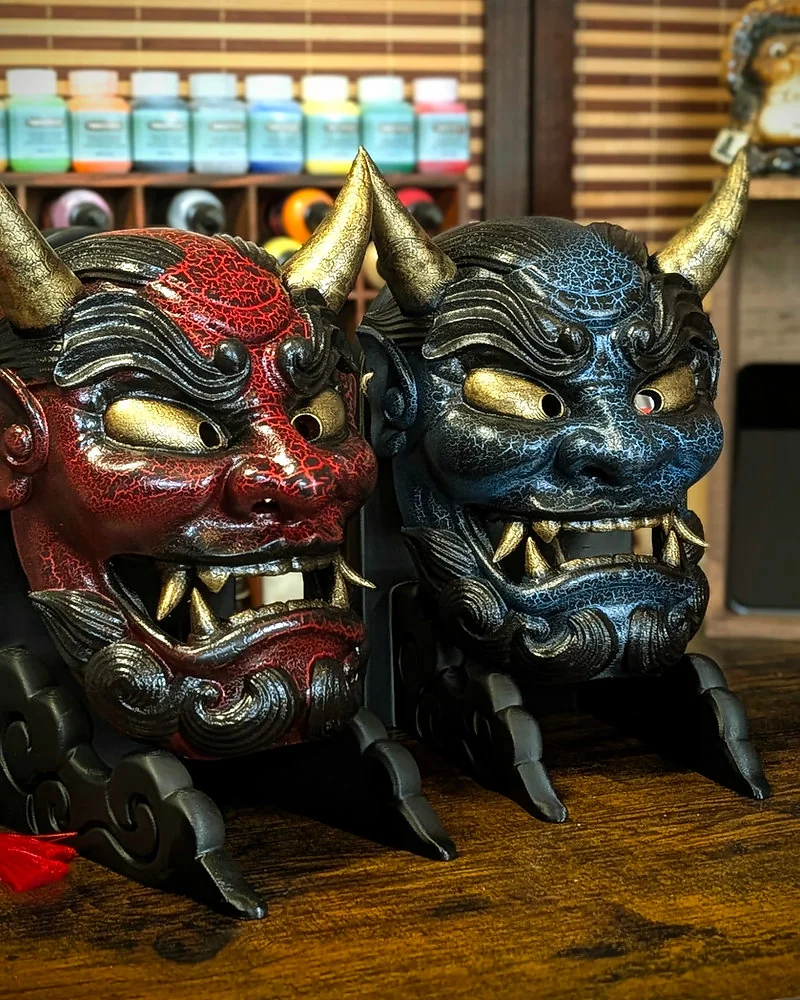
| PETG shell with hand finishing | Contemporary display and light costume use | Wall thickness, preparation, finish, edges and attachments |
| Carved and finished wood | Specialist craft, theatre-informed work and collection | Maker, wood, finish, context, care and provenance |
| Mixed materials | Articulated, decorated or experimental designs | Joins, moving parts, adhesives and care instructions |
For a deeper material comparison, read PETG, PLA or resin mask: which to choose?
Compare the total delivered cost
The item price is only one part of the purchase. Add shipping, taxes, possible customs charges, currency conversion, straps or display hardware and the cost of a difficult return. A faster listing may be useful for a fixed event, while made-to-order work requires more planning. Compare the final checkout and the service you actually need.
For EU buyers, online marketplaces should identify whether a seller is a trader or a private individual. That status matters because EU consumer protections do not apply in the same way to a purchase from a private seller. Buying from outside the EU may also make those rights harder to enforce in practice.
Choose by use: display, costume, gift or collection
For wall display, prioritize silhouette, depth, finish, mounting and how the color behaves in your room. For light costume use, prioritize eye openings, ventilation, edges, weight and attachment points. For a gift, confirm production and delivery dates. For an antique or culturally specific piece, prioritize maker, context, condition and provenance.
Use the complete handmade Japanese mask buyer’s guide for categories and buying routes, and the mask wearing and care FAQ for practical fit questions.
How Dai Yokai fits into the comparison
Dai Yokai is a solo workshop in Brittany, France. The masks are contemporary pieces inspired by Japanese folklore and mask aesthetics, not traditional Japanese stage or ritual objects. The base is printed in PETG, then prepared, painted, varnished and finished by hand in the workshop.
Most pieces are made to order. Check the current product page for intended use, included parts and production estimate. Contact the workshop before ordering if you need a particular color or a fixed event date. The same buyer checks in this article still apply: inspect the photographs, measurements, policies and final checkout rather than relying on the word handmade alone.
Browse the handmade Japanese masks, review shipping and return information, or contact the workshop.
FAQ
Are all Japanese masks on Amazon mass-produced?
No. Amazon combines its own retail offers, third-party marketplace sellers and an Amazon Handmade programme for approved makers. Check the Sold by and Dispatches from information, then read the individual listing. The platform name alone does not identify who made the mask, where it was produced or whether any finishing was done by hand.
Are all Japanese masks on AliExpress poor quality?
No. AliExpress hosts many independent sellers and listings, so construction and service vary. Judge the exact product information, seller history, buyer photographs, dimensions, dispatch location and return eligibility. A low price can reflect scale or a simple finish, but it does not prove a specific material or quality level without evidence.
How can you tell whether a Japanese mask is really handmade?
Look for an identifiable maker, workshop or maker profile, specific process photographs, exact materials, real dimensions and consistent work across the shop. Ask which stages are performed by the seller. Handmade may include a digitally designed or printed base followed by hand preparation, painting and assembly; it does not always mean carved entirely with hand tools.
Does finding the same mask on several websites prove dropshipping?
Not by itself. Duplicate photographs can indicate wholesale resale, copied images, licensed distribution or one seller using several channels. Compare publication dates, seller identity, dispatch country, product details and workshop evidence. A reverse-image search is a useful lead, but it is not enough on its own to identify the original maker or prove misconduct.
Which material is best for a Japanese mask?
There is no universal best material. Lightweight plastic may suit a short costume use, resin can capture fine detail, PETG can work for contemporary display and light wear, and carved wood belongs to specialist craft traditions. Thickness, finish, reinforcement, edges, attachments and intended use matter as much as the material name.
What seller information should you check on a marketplace?
Check the legal or trading name when available, seller location, dispatch location, fulfilment party, shop history, recent detailed reviews and contact route. On Amazon, Sold by and Dispatches from can be different. For EU buyers, whether the seller is a trader or a private individual affects which consumer protections apply.
Should you check returns before buying a costume mask?
Yes. Check the return window, who pays return shipping, the return address, excluded products and whether the listing carries a specific free-return label. Custom or personalized work can follow different conditions. Save the listing, seller messages and order confirmation, especially when fit, color or a delivery deadline matters.
When is buying directly from a mask maker worth it?
Direct buying is useful when you want clear process information, communication about fit or display, a confirmed production schedule, possible color adjustments and an identifiable after-sales contact. It does not automatically guarantee better work, so the same checks still apply, but the maker should be able to answer detailed questions about the object.