The karasu tengu, or "crow tengu", is the form of tengu shown with a bird’s head, a beak and wings. Its name combines karasu (烏, crow) and tengu (天狗). This is the oldest look the figure has in Japanese imagery, long before the red long-nosed face came to dominate tengu masks.
In the stories it lives in the mountains, often serves a great tengu and can be threatening, instructive or plainly ridiculous. Reading a beaked mask therefore means separating three things: the folklore figure, its role in a specific story and the contemporary design inspired by it.
Karasu tengu or long-nosed tengu: what is the difference?
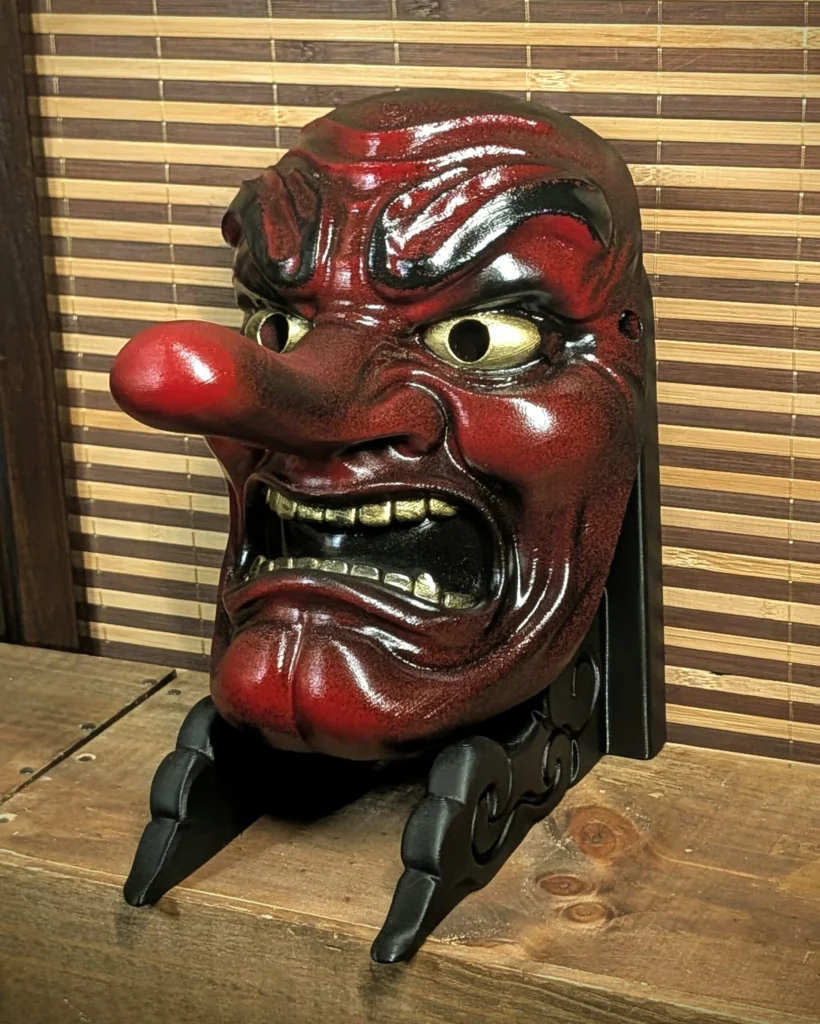
Columbia University’s JAANUS glossary describes two main physical types. The karasu tengu is identified by its bird head and beak. The other type has a human body, wings and a long nose, and often holds a feather fan. That second face is the one associated with great tengu such as Sōjōbō of Mount Kurama.
| Feature | Karasu tengu | Long-nosed tengu |
|---|---|---|
| Face | Bird head and beak | Red human face, long nose |
| Common role in Edo-period stories | Servant, messenger, apprentice | Leader, great tengu |
| Attributes | Wings, claws, yamabushi clothing | Feather fan, yamabushi clothing |
| Visible example | Small tengu at Mount Takao | Sōjōbō of Mount Kurama |
These markers help you read an image; they are not an official classification. One source calls the bird tengu kotengu, "little tengu"; another uses konoha tengu for a different figure. The right term depends on the text and the period. The long-nosed Tengu mask guide covers the other form.
Where does the karasu tengu’s beak come from?
The word tengu comes from the Chinese tiangou, "heavenly dog". In Japan, though, the figure took on the look of a bird of prey early on. The illustrated Tengu zōshi scrolls are dated to the tenth month of Einin 4, which is 1296. They show arrogant monks turned into tengu, with bird beaks. JAANUS lists them among the earliest known depictions.
The red long-nosed face spread later. How the beak became a nose is still debated, and no single explanation has been proven. The karasu tengu simply keeps the animal form that early images already gave the tengu.
Why does it wear yamabushi clothing?
Tengu are tied to sacred mountains and to yamabushi, the practitioners of Shugendō. In many images the karasu tengu wears the small tokin cap and the robes of these ascetics. The costume does not make it a monk: it places the figure in a world of mountains and training.
On Mount Takao, west of Tokyo, two statues stand in front of the Izuna Gongen hall at Yakuō-in temple. According to the temple’s official site, the large tengu suggests an experienced yamabushi who has gained spiritual power, while the small tengu is considered to be still in training. The temple links these tengu to the worship of Izuna Daigongen and to the fan said to sweep misfortune away.
The karasu tengu, Mount Kurama and Ushiwakamaru
The best-known story takes place on Mount Kurama, north of Kyoto. The great tengu Sōjōbō is said to have taught the art of war to the young Ushiwakamaru, the future Minamoto no Yoshitsune. The Japan Search gallery, produced by the National Diet Library and Ritsumeikan University, explains that in the Edo period the legend settled into a version where karasu tengu, the Kurama tengu’s subordinates, act as the boy’s sparring partners.
The same source notes that these crow tengu often became comic characters beaten by Yoshitsune. A print from the Kokkei Miyako-meisho series shows a karasu tengu flying too low, weighed down by a large bottle of sake. Depending on the image, the crow tengu can be a devoted servant, a training opponent or an amusing figure.
Theatre also fixed the story. Wesleyan University’s collection notes that the Noh play Kurama Tengu features a tengu passing secret tactics to the hero. The bird tengu stays connected with the idea of a mountain master and his attendants.
What does a karasu tengu mask represent?
A beaked mask does not reproduce one ritual object. Tengu took several forms in theatre, on armour and at festivals. The Samurai Museum Berlin, for example, holds a tengu armour half-mask (menpō) with a beak, signed by Fukushima Denbei Kunitaka, who worked in the seventeenth century.
Today, people choose a karasu tengu mask mainly for its silhouette. The bird profile reads from a distance and feels more animal than the red Tengu. It works well seen from the side, on a deep shelf or a wall, as long as the beak has room.
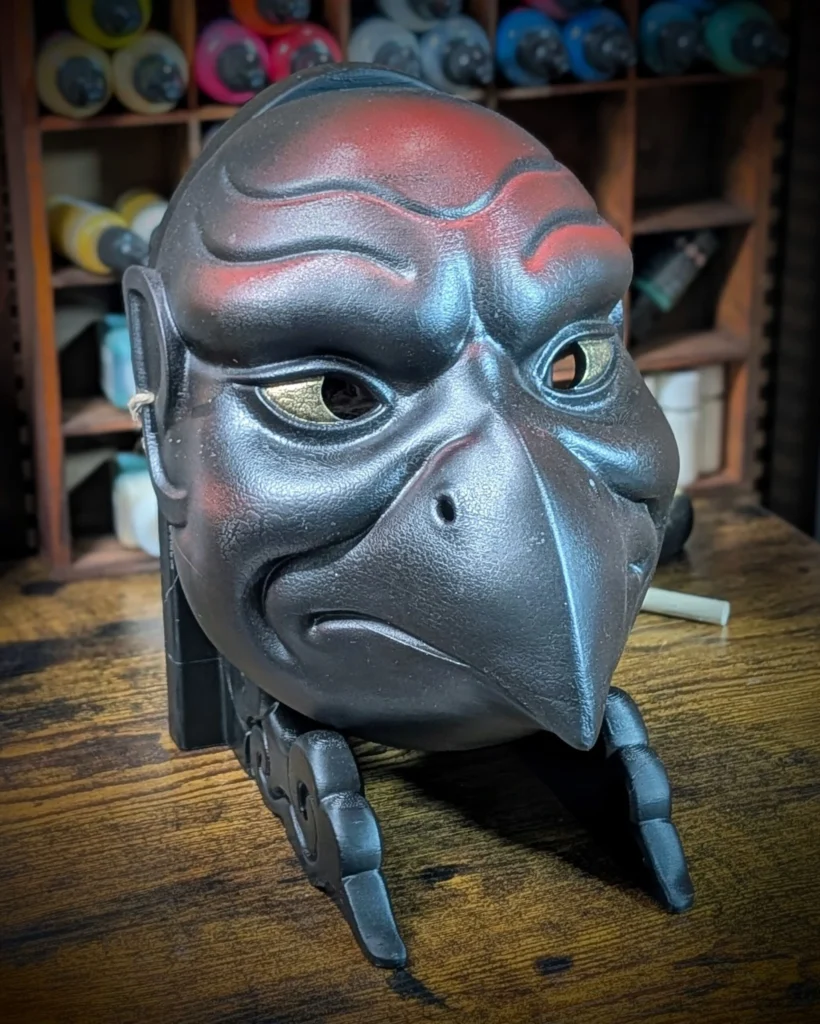
The crow Karasu Tengu mask follows that direction: a strong beak, a black finish and red relief. Its base is 3D printed in PETG, then I sand it, paint it in acrylic and varnish it by hand in my workshop in Brittany. It is 25 cm high and 16.4 cm deep including the beak, and weighs about 191 g. It is a contemporary piece, not an antique mask or a cult object.
To compare profiles, browse the Tengu mask collection. If you are considering the motif for a tattoo, the Tengu tattoo guide covers composition.
FAQ
What is a karasu tengu?
It is the form of tengu shown with a bird’s head, a beak and wings. The name joins karasu, crow, and tengu. In the stories it lives in the mountains and often serves a great tengu.
What is the difference between a karasu tengu and a daitengu?
The karasu tengu has a bird’s beak. The daitengu, or great tengu, has a red human face and a long nose. In Edo-period stories, the first is often shown as the servant or apprentice of the second.
Is a karasu tengu a demon?
Not in the Western sense. Depending on the story, it can trick, fight, serve or make people laugh. At Mount Takao, Yakuō-in temple describes the small beaked tengu as one still undergoing training.
Why does the karasu tengu have a crow’s beak?
The oldest tengu images, such as the Tengu zōshi scrolls dated 1296, already show beaked creatures. The karasu tengu keeps that bird form, while the red long-nosed face became established later for other tengu.
Where can you see karasu tengu statues in Japan?
Yakuō-in temple on Mount Takao, west of Tokyo, has a large long-nosed tengu and a small beaked tengu in front of its Izuna Gongen hall. Mount Kurama, north of Kyoto, is tied to the legend of Sōjōbō.
Did karasu tengu train Minamoto no Yoshitsune?
It is a legend, not a historical fact. According to the Japan Search gallery, the version that spread in the Edo period makes karasu tengu the sparring partners of the young Ushiwakamaru, serving the great tengu of Kurama.
Are karasu tengu, kotengu and konoha tengu the same?
Not always. Kotengu, little tengu, often refers to the bird tengu serving a great tengu. Konoha tengu is used differently from one source to another: some apply it to the crow tengu, others to a long-nosed tengu.
Can a karasu tengu mask be worn?
It depends on the model. The Dai Yokai crow Karasu Tengu mask is mainly designed for display and photography. It comes with a cord; check visibility, comfort and fastening before wearing it for long.
Sources
- JAANUS, Columbia University, "tengu" entry.
- Japan Search, National Diet Library and Ritsumeikan University, Tengu gallery.
- Yakuō-in temple, Mount Takao, the tengu of Mount Takao.
- Tobunken, record on the dating of the Tengu sōshi scrolls (1296).
- Wesleyan University, CEAS collection, karasu tengu mask.
- Samurai Museum Berlin, the menpō and its expression types.