The fox masks seen in anime and video games do not come from nowhere. They build on an image that runs deep in Japan: the fox associated with the kami Inari, stories of shape-shifting foxes and fox faces worn at certain festivals. Each work then chooses what to keep from that heritage.
Knowing these sources helps you choose a mask with your eyes open: an inspired design, a licensed replica and an object tied to a real tradition do not tell the same story.
Why is the fox so present in Japanese culture?
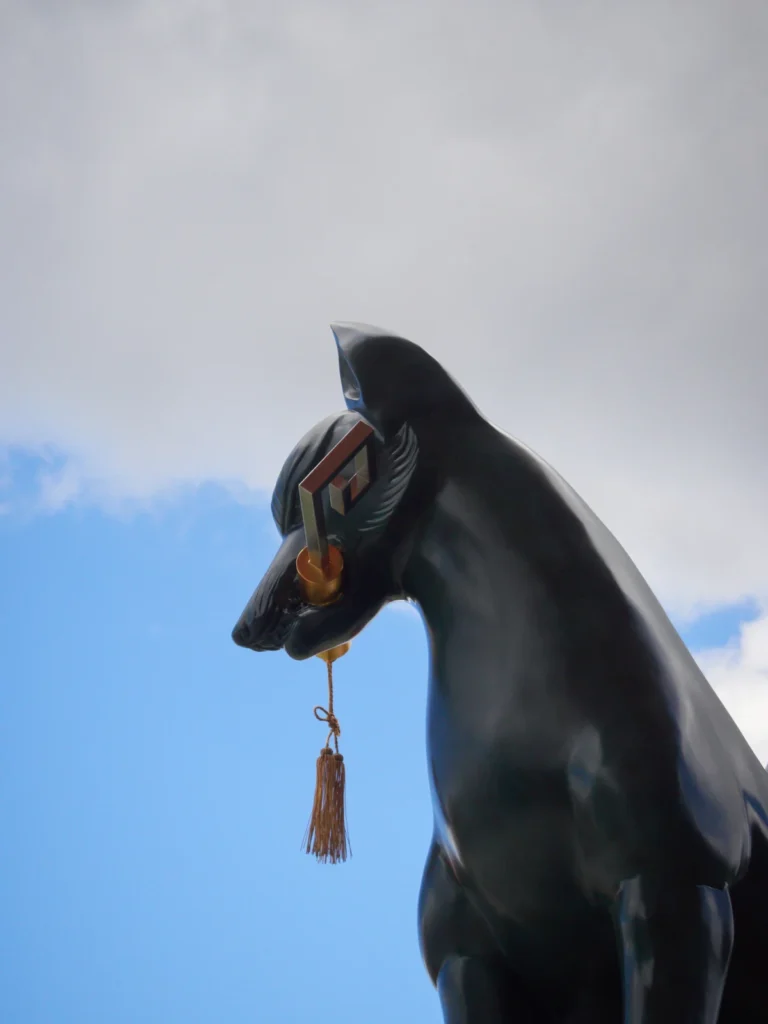
Fushimi Inari Taisha, the head shrine of Japan’s roughly 30,000 Inari shrines, explains that foxes are the messengers of Inari Ōkami. It adds that these messengers are invisible, called byakko-san, "white foxes", and that Inari is not itself a fox. Fox statues guard the entrance to many shrines.
The fox is also a story character. Depending on the tale, the kitsune can trick, transform or protect. The Kitsune mask meaning guide covers these legends, and the guide to Inari Ōkami explains the worship.

The Ōji Fox Parade, from a woodblock print to a modern festival
A Tokyo legend says that on New Year’s Eve the foxes of the whole Kantō region gathered under a large hackberry tree at Ōji before visiting Ōji Inari Shrine. Utagawa Hiroshige illustrated it in 1857 in New Year’s Eve Foxfires at the Changing Tree, Ōji, one of his One Hundred Famous Views of Edo, now held by the Brooklyn Museum and the Metropolitan Museum of Art among others.
Since 1993, the Ōji Fox Parade has recreated the scene. According to Tokyo’s official guide, around 300 participants in traditional clothing and fox masks walk on the night of 31 December from Shōzoku Inari Shrine to Ōji Inari Shrine, carrying yellow lanterns that stand for foxfire. Nearby shops sell fox masks. It is a modern festival built on a legend, and a good example of a fox mask worn in a specific setting.
Demon Slayer: the protective masks carved by Urokodaki
In Koyoharu Gotouge’s manga Demon Slayer, later adapted into an anime, Tanjiro’s master Sakonji Urokodaki wears a red tengu mask. He carves a wooden fox mask for each of his students, meant to protect them during the Final Selection. Sabito’s mask carries a scar, Makomo’s has flowers and Tanjiro’s a sun motif.
These masks are an invention of the story. They borrow the idea of a protective mask and the familiar fox image without matching any specific Japanese rite. The tengu and kitsune pairing works mainly as a character choice. If you want Tanjiro’s mask exactly, an officially licensed product is the only faithful replica.
Naruto: the nine-tailed fox
In Naruto, the hero carries Kurama, the nine-tailed fox, inside him. The series draws on an old figure: the nine-tailed fox appears in Chinese and then Japanese tales, such as that of Tamamo-no-Mae, the fox woman who beguiles the imperial court. The manga turns it into a creature of raw power, far from Inari’s messenger fox.
The series’ special units, the ANBU, also wear animal masks. This is not a single kitsune mask but a costume convention linking animal masks with anonymity and secrecy.
Ghost of Tsushima and Ghost of Yōtei: follow the fox
In Ghost of Tsushima, released in 2020, foxes wait for Jin Sakai near their dens and lead him to hidden Inari shrines. Here the game builds on a real association between foxes and Inari shrines while inventing its own mechanic.
The sequel, Ghost of Yōtei, brought masks back to the fore with its heroine Atsu. The Ghost of Yōtei cosplay mask guide covers her official look and what to check for a costume.
What I see at conventions
At my stand, people often confuse Inari and the kitsune and take the fox for the god itself. At manga conventions the kawaii versions catch the eye most, while online the more aggressive expressions get more attention. These are observations noted in September 2026, not market research.
Choosing an inspired fox mask without copying a character
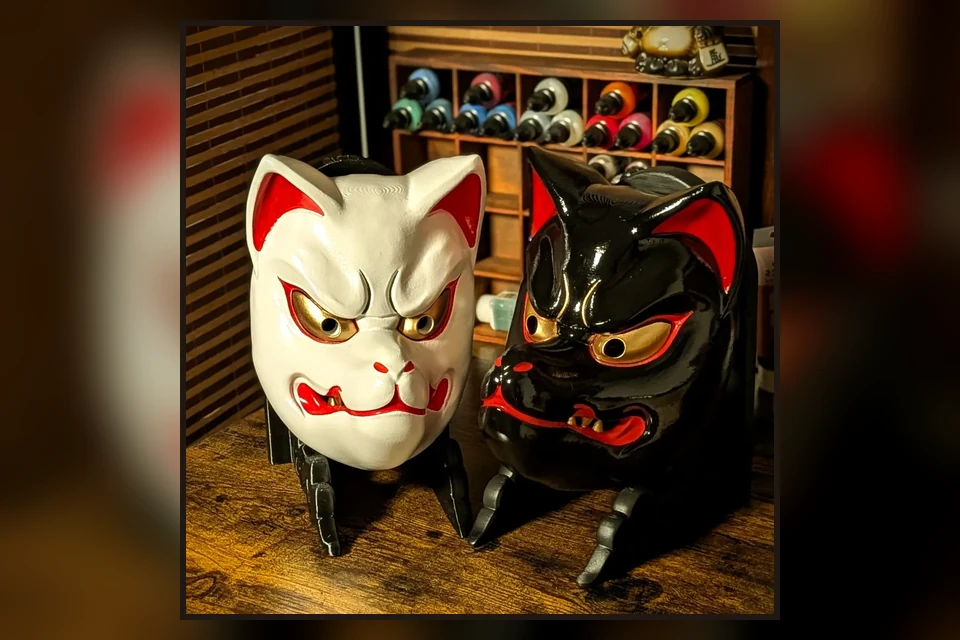
A fox mask can evoke an anime without being a copy. Dai Yokai Kitsune masks are original designs: a traditional face, a more graphic modern version or a rounder kawaii model. None reproduces a copyrighted character.
The Kitsune fox mask is the most classic example. Its base is 3D printed in PETG, then sanded, painted and finished by hand in Brittany. To compare styles, the guide which Kitsune mask to choose helps you decide, and the guide to wearing a cosplay mask covers the safety checks.
FAQ
Why do so many anime characters wear fox masks?
The fox is already everywhere in Japan: Inari’s messenger, the hero of shape-shifting tales, a face worn at festivals such as the Ōji Fox Parade. Creators borrow an image Japanese audiences recognise instantly.
What does Tanjiro’s mask mean in Demon Slayer?
In Koyoharu Gotouge’s manga, it is a protective wooden mask carved by his master Sakonji Urokodaki before the Final Selection. Each student receives a fox mask; Tanjiro’s carries a sun motif. It is a fictional object, not a real rite.
Is the fox in Naruto a kitsune?
Kurama, the nine-tailed fox sealed inside Naruto, draws on the nine-tailed fox of East Asian tales. The character belongs to fiction; it borrows an old image without reproducing a specific legend.
Why do you follow foxes in Ghost of Tsushima?
In Sucker Punch’s game, foxes lead Jin Sakai to Inari shrines. The game builds on a real link: Fushimi Inari Taisha describes foxes as the invisible messengers of Inari.
Is a kitsune mask sacred?
Not automatically. Foxes are linked to Inari worship, but a mask bought for decoration, a festival or cosplay is not a religious object. Its status depends on who made it, why and how it is used.
What is the Ōji Fox Parade?
It is a procession held in Tokyo on the night of 31 December since 1993. Around 300 participants in fox masks walk from Shōzoku Inari Shrine to Ōji Inari Shrine. It recreates a legend illustrated by Hiroshige in 1857.
Does Dai Yokai sell replicas of anime masks?
No. Dai Yokai Kitsune masks are original designs: traditional, modern or kawaii. To reproduce a character’s mask exactly, look for an officially licensed product.
Can you wear a kitsune mask at a convention?
Yes, if the model is designed for occasional wear. Check visibility, ventilation, fastening and weight, and test it at home before the event. The organiser’s rules come first.