Dragon or Tengu mask: which should you choose? The answer is not a simple comparison between two “Japanese guardians”. Ryū and Tengu belong to different kinds of figures. The first is a dragon whose imagery can evoke water, clouds and natural forces. The second is a supernatural mountain being, sometimes unsettling and sometimes protective, depending on the story. Treating them as interchangeable symbols loses what makes them different.
When choosing a Dai Yokai piece, step away from mythology for a moment and look at the actual object. The Dragon Ryū mask is designed for decoration and cannot be worn. The large Tengu mask is also mainly intended for a wall, collection or photography. Its long nose defines the displayed piece’s silhouette. The current product page does not confirm suitability for wear.
Direct answer: choose the Dragon for an animal-like fantasy face, broad forms and a strong frontal view. Choose the Tengu for a recognisably Japanese silhouette, a pronounced profile and a connection to mountain folklore. Then check the available space, viewing angle and intended use. That combination gives a more useful answer than any supposedly universal meaning.
Dragon or Tengu mask: a quick comparison
| Criterion | Dragon Ryū | Tengu |
|---|---|---|
| Nature of the figure | Dragon from Japanese and East Asian imagery | Supernatural being associated with mountains |
| Silhouette | Animal face, horns and dragon-like forms and lines | Long human nose or bird beak, depending on the form |
| Strongest viewing angle | Front and three-quarter views | Front for the traditional model, profile for the large model |
| Atmosphere | Fantastical, natural, energetic | Mountainous, strange, proud or martial |
| Main Dai Yokai use | Wall decoration, collecting, photography | Decoration, collecting and photography, depending on the model |
| What to check | Width, relief and mounting system | Nose or beak depth and surrounding clearance |
This table offers guidance, not an absolute cultural rule. A dragon can have different roles from one work to another. A Tengu can be hostile, mocking, a teacher or a protector, depending on the period and story. To explore each figure separately, see the guide to the Japanese dragon Ryū and the article on Tengu history.

What the Dragon Ryū represents
The Japanese word ryū means dragon. In Japanese art, its form is usually serpentine, with legs, claws, horns and scales. The National Diet Library of Japan shows how widely the motif appears across stories, architecture, objects and textiles. It does not represent a single character or an emblem with one fixed meaning.
The connection to water and clouds is well established, but should not turn into an automatic formula such as “dragon equals peaceful wisdom”. A work held by the Metropolitan Museum of Art, for example, presents dragon, water, clouds and storm as a group of dynamic forces. Depending on the context, the dragon can express power, movement in the sky, authority or natural energy that is difficult to contain.

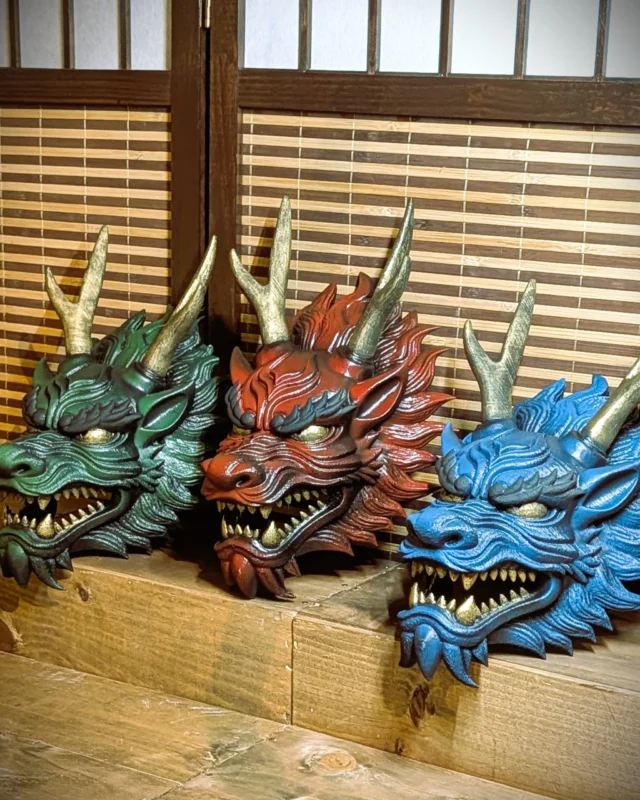
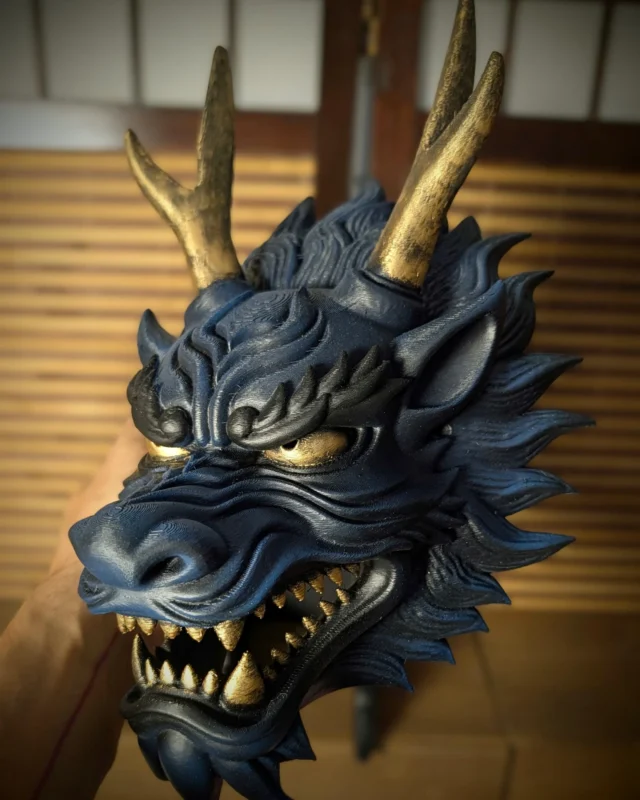
The Dai Yokai mask draws on this visual presence without claiming to reproduce a specific historical object. Its dragon face, horns, relief and paint form a contemporary interpretation primarily intended to be looked at. Choose it for its composition and the place it will occupy in your room, rather than because an online list promises luck or protection.
What the Tengu represents
The Tengu is a supernatural being closely associated with mountains. Its history is not a straight line. Some older depictions emphasise bird features; others show a red human face with a greatly elongated nose. Stories give it varying behaviours: it may lead people astray, punish pride, challenge humans, pass on martial knowledge or act as a local protective presence.
This ambiguity matters. As a Nippon.com feature on Tengu explains, the figure developed from an unsettling creature into a presence sometimes connected with the divine. Calling it only a “mountain guardian” removes the dangerous, proud and unpredictable aspects of its identity. The Tengu mask held by the Met depicts a beaked Karasu Tengu in the context of Japanese armour. It documents a historical use of the figure without making contemporary masks traditional copies.
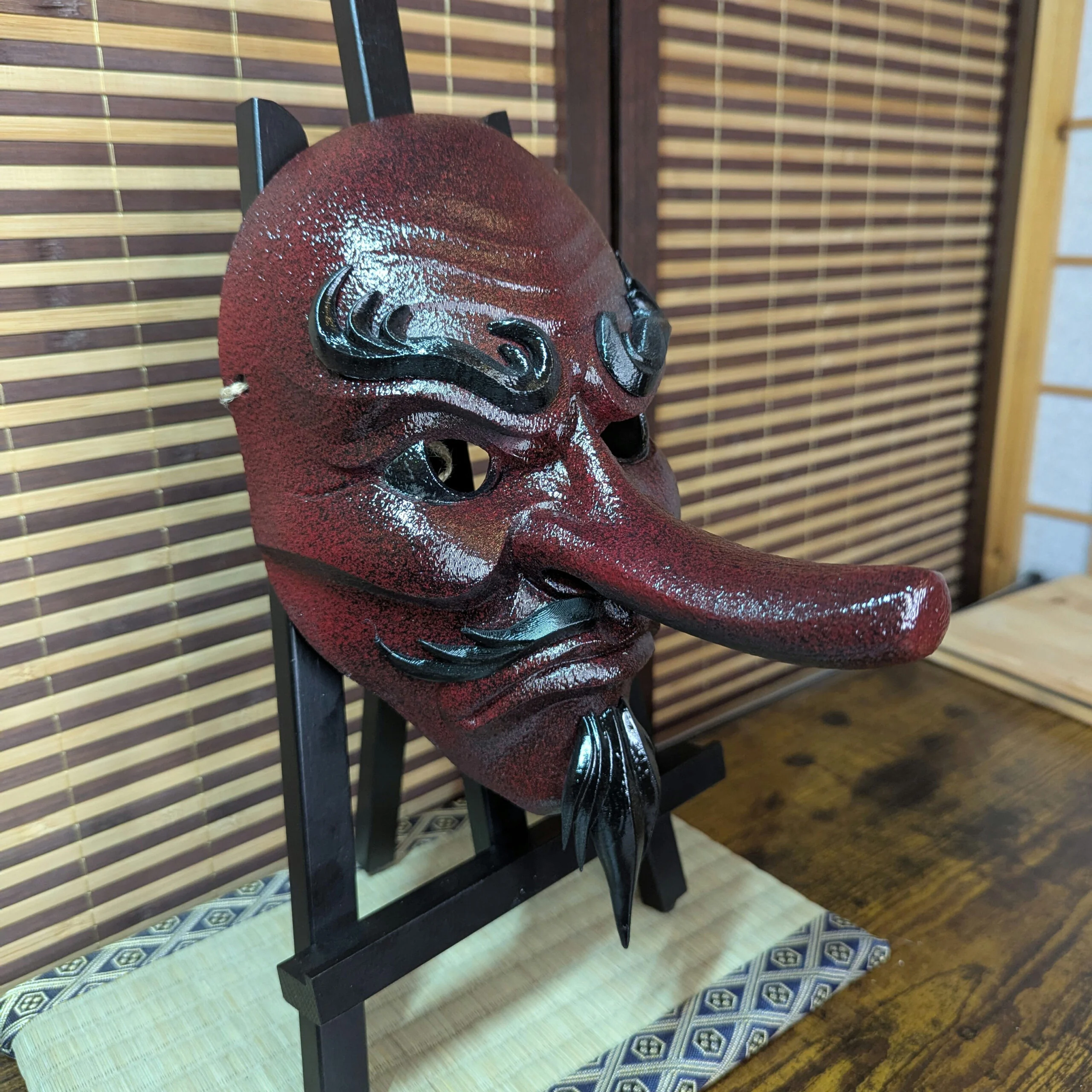
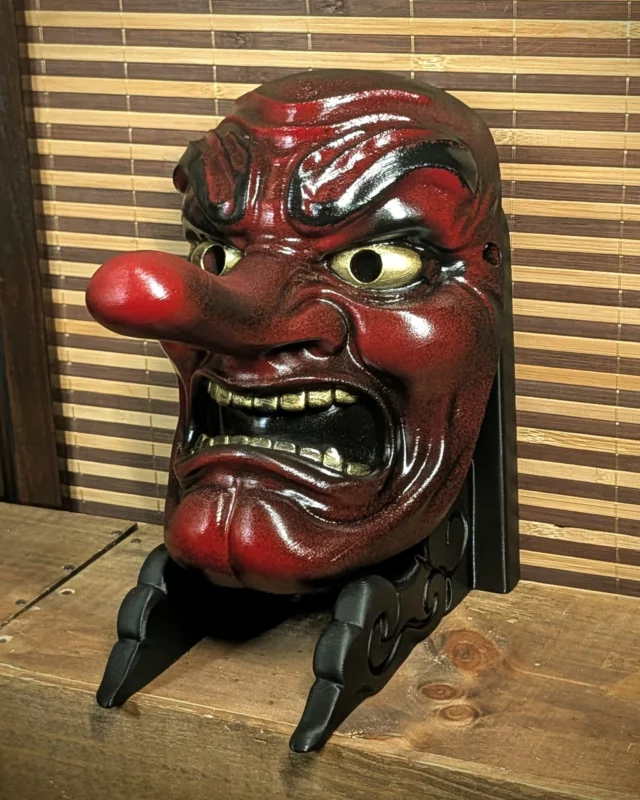
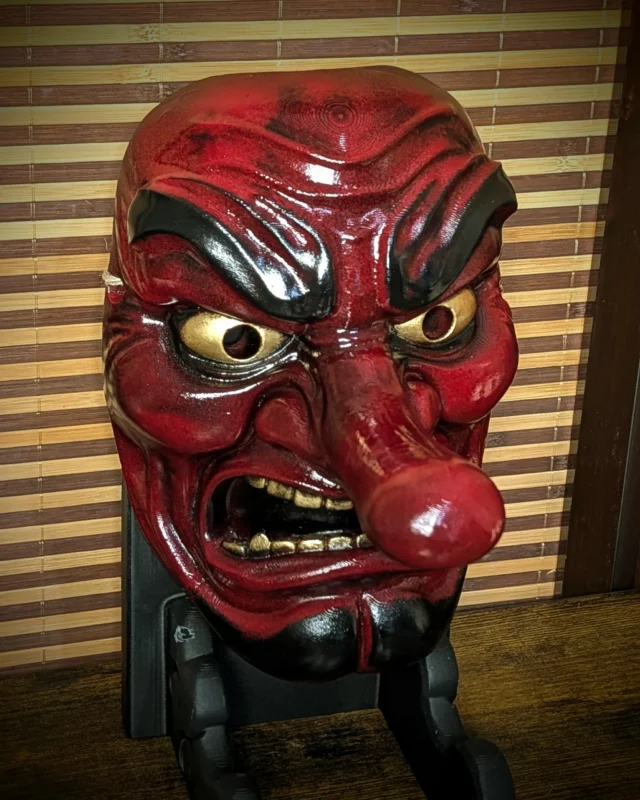
In a display, Tengu has a more human presence than the Dragon, but also a stranger one. Its expression, eyebrows and especially its nose create a clear direction. In profile, it visually occupies the space in front of it. This is an important practical difference in a narrow passage, above a shelf or on an already crowded wall.
Dragon and Tengu are not equivalent guardians
Both figures may be associated with protection in some contexts, but that is not enough to place them in the same category. The Dragon is first a dragon figure appearing in many stories and decorative arts. Tengu belongs to mountain folklore, with behaviour that varies between stories. Their common ground here is that both have inspired Dai Yokai wall pieces. That connection concerns the objects offered, not a shared mythological category.
This distinction also helps avoid a poor choice. If you want a piece clearly evoking a mountain yōkai, Tengu fits. If you want a Japanese dragon image, choose Ryū without automatically giving it the same traits as Tengu. If your main criterion is “something that protects the home”, no mask can guarantee a spiritual function. These are contemporary decorative objects, not consecrated amulets.
Traditional mask or contemporary creation?
“Japanese mask” covers very different things: a historical theatre piece, a festival object, a folklore mask or a modern creation inspired by Japan. The Dai Yokai Dragon Ryū is not presented as a fixed traditional theatre-mask type. It is a contemporary facial sculpture translating a dragon motif into a wall object.
Tengu has more directly recognisable historical precedents in mask form. That does not mean the model sold here is old or ritual. The large Tengu, traditional red Tengu and Karasu Tengu are Dai Yokai interpretations. Each piece is made to order in Brittany, with a PETG base that is prepared, sanded, hand-painted and varnished.
This description lets you appreciate the cultural reference without inventing a provenance. If you collect antiques or Japanese theatre accessories, ask for specialist documentation. If you want handmade decoration inspired by these figures, compare the models, photographs and production information.
Compare the shape, viewing angle and available space
A mask can look striking in a photograph yet work poorly on your wall. The Dragon reads mainly as a broad sculptural face. Its horns, jaw and relief need width and lighting that brings out the forms. Light from directly in front can flatten the paintwork; slightly angled light reveals shadows and edges more clearly.
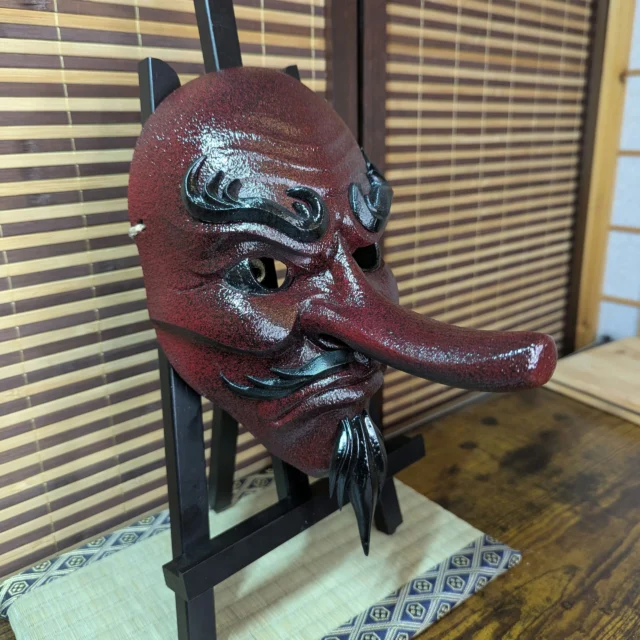
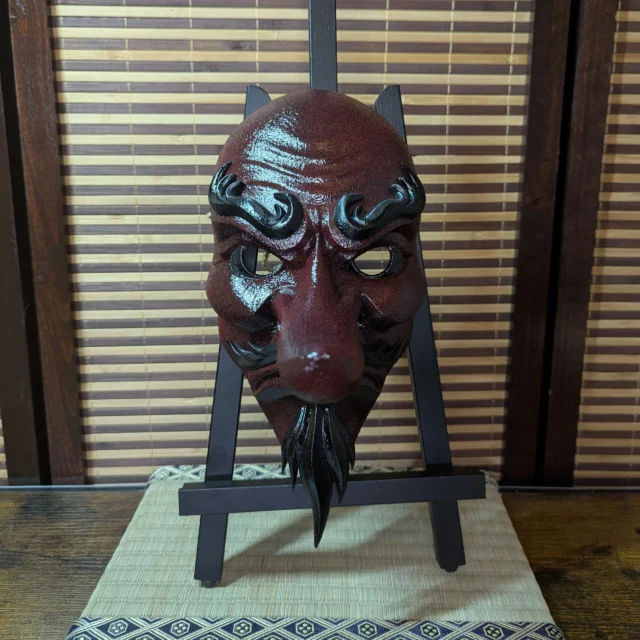
The large Tengu creates a different constraint: depth. Its nose needs clearance from glass, plants and furniture. Think about people passing too. In a narrow hallway, a more compact Tengu or a higher position will often make more sense. The traditional red Tengu retains a strong identity in a more frontal composition. With its beak and warrior-like appearance, Karasu Tengu creates a darker, more bird-like silhouette.
| Your preference | Likely choice | Practical check |
|---|---|---|
| A fantasy face viewed from the front | Dragon Ryū | Measure the free width and plan side lighting |
| An immediately recognisable profile | Large Tengu | Measure clearance in front of the wall |
| A more frontal, classic composition | Traditional red Tengu | Compare the mask's size with nearby furniture or frames |
| A bird-like, martial appearance | Warrior Karasu Tengu | Check that the beak and details remain readable from a distance |
| The mask will be in a passageway | A shallower model or a higher mounting position | Test movement around a cardboard template |
A cardboard template is a simple method: roughly cut out the width and height stated on the product page, then add a strip to simulate depth. Place it on the wall for a day. You will quickly see whether the piece is too close to a door, needs more viewing distance or should move slightly.
Decoration, photography or wear: actual use comes first
Weight alone does not establish whether a piece can be worn. The Dragon Ryū is decorative and not wearable. For a Tengu model whose product page allows wear, check the shape, fastening, openings and balance before trying it on.
For decoration, check the mounting and wall material. Photograph the Dragon on a wall or suitable support, without wearing it. For a Tengu, first check that its product page allows wear, then try the fastening and field of view with the planned hairstyle and outfit. The large format is treated here as a display piece.
| Use | Dragon Ryū | Large Tengu | Advice |
|---|---|---|---|
| Main wall | Well suited | Well suited with enough clearance | Check lighting, width and depth |
| Display cabinet | Possible if the volume fits | Check the depth | Measure the interior before ordering |
| Photography | Display only, without wearing | Displayed on a suitable support | Provide suitable supports for both models |
| A long convention day | Display only, not wearable | Display; wear is not confirmed by the current listing | Prioritise comfort, visibility and stability |
| Protection | No certified protective function | No certified protective function | These are not protective equipment |
Which Dai Yokai model should you choose?
Japanese Dragon Ryū mask
Choose the Japanese Dragon Ryū if you want a main piece centred on a dragon face. Its composition suits a living-room wall, a collection display or a tattoo studio. Leave room around the horns and outline so the silhouette does not merge into neighbouring objects.
Large Tengu mask
Choose the large Tengu if its long-nosed profile is exactly what you want. It creates the clearest difference from the Dragon. It works as a focal point but requires careful measurement of depth and movement around the wall.
Traditional red Tengu mask
The traditional red Tengu keeps the red face and long nose in a more frontal composition. It suits you if you want Tengu's visual identity without making the large format the room's only focus. Still compare the photographs and scale with your actual location.
Warrior Karasu Tengu mask
The warrior Karasu Tengu is the most bird-like choice. Its beak, forehead and painted details create a darker presence than the human-faced Tengu. It fits a display that already includes warrior imagery, yōkai or a black and metallic palette.

The four models below are made to order. Check each product page for the current price, lead time, options and availability before ordering.
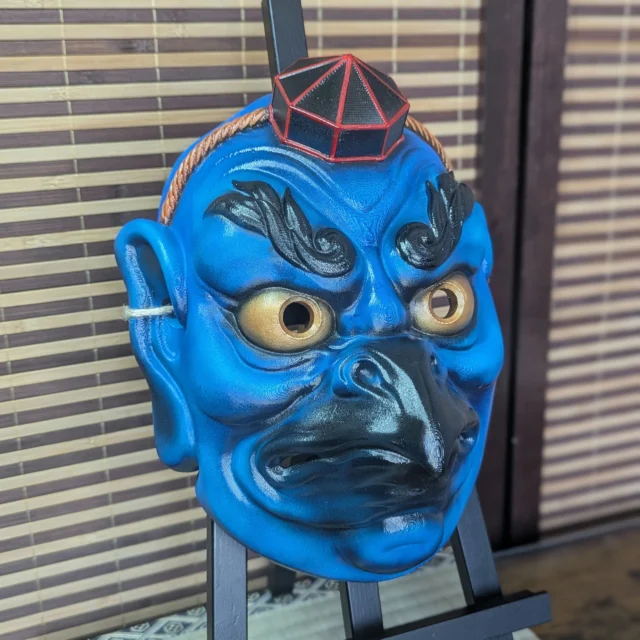
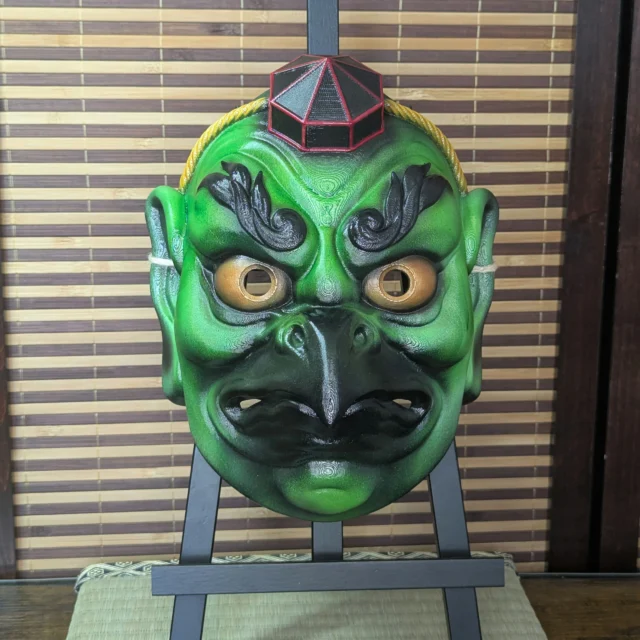
For other available variants, browse the Tengu mask collection or all handmade Japanese masks.
Making and caring for the masks: shared features
Whatever the motif, the Dai Yokai process involves work by hand. The PETG base is prepared and sanded, then acrylic paint is applied by hand before varnishing. Shades, shadows and small details may vary between pieces. These variations are part of making each piece to order; each example is not a perfectly identical reproduction of the photograph.
Keep the mask indoors, away from persistent damp and prolonged direct sunlight. Dust it with a soft, dry cloth without harsh products. For a wall display, use a mounting appropriate to the surface and weight. If adding a stand or display cabinet, check stability and leave enough room for horns, nose or beak.
A simple way to decide
- Choose the figure: a fantasy dragon and natural forces, or a mountain Tengu with human or bird features.
- Choose the silhouette: the Dragon's frontal mass, Tengu's long profile or Karasu Tengu's beak.
- Define the actual use: wall, cabinet or photographs of the object; costume only for a model identified as wearable.
- Measure the location: width, height, depth and viewing distance.
- Check the product page: status, price, lead time, options and mounting before ordering.
If you still like both equally, decide by the space. A wide wall with limited depth often favours the Dragon. An open location where the profile has room will better show off Tengu. In a collection, avoid crowding the pieces: their silhouettes need empty space to remain clear.
In brief: the best choice is not the “most powerful guardian”. It is the piece whose shape, cultural reference and use genuinely match your project. Dragon Ryū and Tengu draw on different imaginative worlds. Comparing them accurately helps you choose without inventing a spiritual function or promising comfort the object was not designed to provide.
Frequently asked questions
Are Dragon and Tengu both guardians?
Not as a shared category. Ryū is a dragon figure linked, depending on the stories and images, to water, clouds and natural forces. Tengu is a supernatural mountain being, sometimes dangerous and sometimes protective. The word guardian may fit some contexts but does not fully define either figure.
What is the main difference between a Dragon Ryū mask and a Tengu mask?
The Dragon Ryū mask is based on a dragon face, with animal forms, horns and a forceful expression. Tengu has either a red face with a long nose or a more bird-like form such as Karasu Tengu. Your choice changes both the silhouette and the cultural reference.
Can the Dai Yokai Dragon Ryū mask be worn?
No. The Dai Yokai Dragon Ryū is for decoration and display. It cannot be worn, even briefly. For photographs, show it on a wall or suitable support.
Can the large Tengu mask be worn for a long time?
The current large Tengu listing describes decoration, display cabinets and collecting. Wear and the fastening system are not confirmed. Do not choose it for extended wear without obtaining specific confirmation from the workshop.
How does a long-nosed Tengu differ from a Karasu Tengu?
The long-nosed Tengu has a more human face, often red, with an easily recognised profile. Karasu Tengu retains more bird features, especially a beak. At Dai Yokai, the warrior Karasu Tengu therefore has a darker, more bird-like presence, while the traditional Tengu is more frontal and classic.
Which mask should you choose for a wall display?
Start with the actual space. Dragon Ryū works well as a sculptural face seen from the front or at an angle. The large Tengu needs greater clearance in front of the wall because of its nose. Traditional Tengu reads more clearly from the front, while Karasu Tengu suits a darker, martial composition.
Which mask should you choose for photography or a costume?
The Dragon can be a displayed object in a photographic scene, but cannot be worn. For a costume, choose only a Tengu model whose product page allows wear, then check its size, fastening, field of view and freedom of movement before the shoot.
Are these Dai Yokai masks historical Japanese masks?
No. They are contemporary creations made and painted by hand in Brittany, inspired by Japanese figures. They are not antiques, ritual objects or museum reproductions. Cultural references explain the motif, while the product pages describe the actual object for sale.