Oni, samurai, Tengu or Hannya: these half masks have different silhouettes and effects. Start with how you will use the mask, the sculpted face and its place in a costume or display. Choose the colour afterwards.
Which Mempo half mask should you choose?
| Model | Visual effect | Choose it for | Check |
|---|---|---|---|
| Samurai | Armour lines and defined jaw | A martial direction without a particular yōkai | How it fits the rest of the costume |
| Oni | Fangs, wide mouth and demonic presence | A focal point for photography, studio or collection | Fang volume and jaw movement |
| Tengu | Projecting nose and distinctive profile | A reference to the mountain yōkai | Room for the nose within the costume |
| Hannya | Tense features, horns and teeth | A theatrical, intense expression | Consistency with the chosen character |
If unsure, start with the profile rather than colour. A red model may have a restrained shape, while a black one remains expressive through teeth and relief.

Historical Mempo and contemporary creations
Historical Mempo belongs to Mengu, the face defences worn with Japanese armour. The Metropolitan Museum of Art describes it as a half mask covering the nose and face below the eyes. It protected the face and helped secure the helmet.
A Musée des Confluences record shows that forms varied with the area covered. Its eighteenth-century example, made from steel, silk and hide, connected to the helmet at the cheekbones.
Dai Yokai half masks are contemporary creations inspired by these armour silhouettes. Oni, Tengu and Hannya name the visual references added to the format, not an official historical classification. See Mempo and Mengu: roles and types of samurai masks for more context.
Samurai Mempo: the clearest armour reference
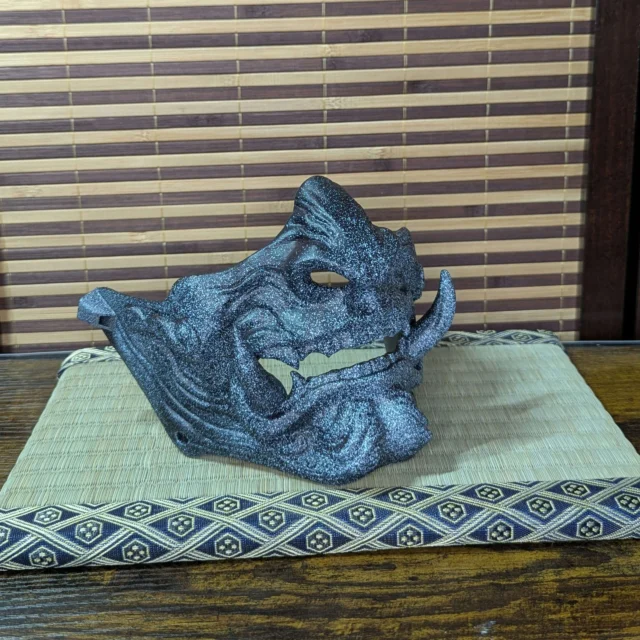
This model emphasises the jaw, nose and lines of a face defence. It suits an armour-inspired character without centring the design on an Oni or another specific yōkai. It also pairs readily with a helmet, dark hood, warrior costume or stand.
That does not make it neutral: teeth, openings and relief already create a strong expression. Look at the whole form before treating it as discreet.
Choose it for: a contemporary samurai costume, photo session, cabinet or display centred on Japanese armour.
Oni Mempo: fangs and visual impact
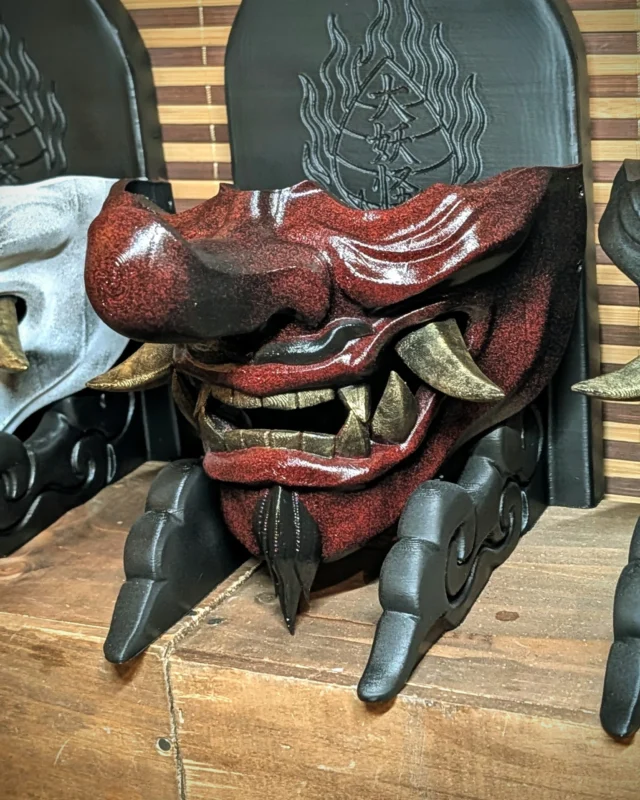
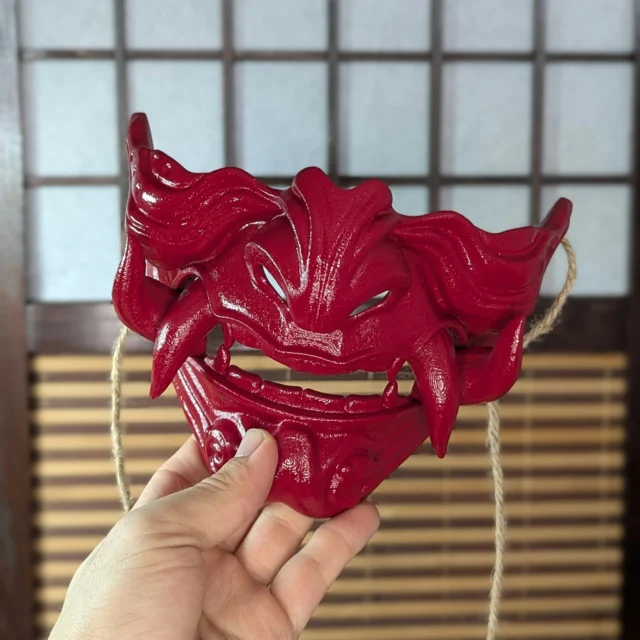
Oni Mempo has the most direct impact of the four. Fangs, an open mouth and deep shadows draw attention. It suits a demonic character, close-up photograph, convention or tattoo studio where the piece needs to read from several metres away.
Oni refers here to the demon of Japanese folklore, while the lower-face format draws on Mempo. This Dai Yokai reinterpretation is neither a ritual mask nor armour.

Choose it for: a dark silhouette, demon cosplay or display in which teeth become the focal point. For context, read about the meaning of Oni masks.
Tengu Mempo: a distinctive profile
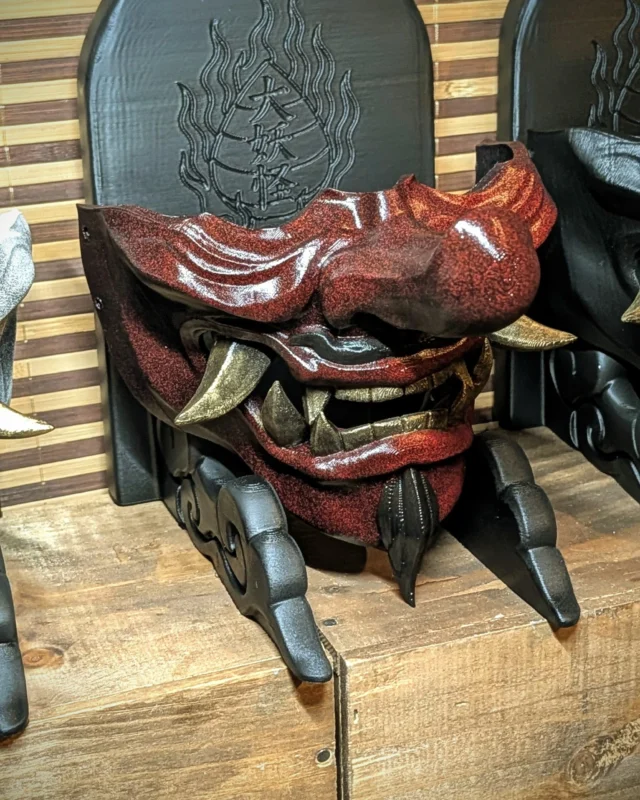
The projecting nose immediately identifies Tengu. Even on a half mask, it changes the profile more markedly than a samurai or Oni Mempo. It suits a character or display that should clearly evoke Tengu without a full mask.
For wearing, check the extra space the nose occupies in front of the face. It may affect clearance around a collar, hood or accessory held near the head.

Choose it for: a Tengu character, yōkai collection or mask whose side view matters as much as its front. The Tengu mask and folklore guide separates the traditional figure from this contemporary creation.
Hannya Mempo: a more theatrical expression
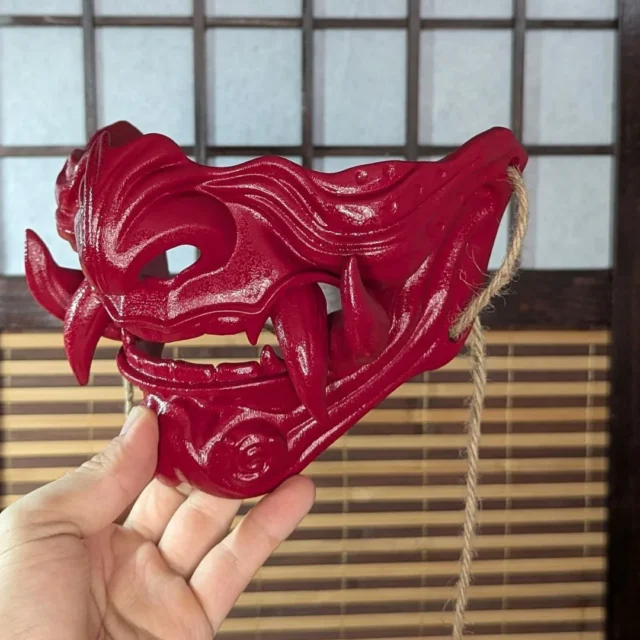
Hannya Mempo combines a lower-face format with horns, teeth and features inspired by Hannya. The result is more tense and narrative than a purely martial model. It suits expressions of tension, anger or transformation without wearing a complete Hannya.
This is a contemporary combination: Hannya comes from Nō theatre and Mempo from armour. Bringing them together creates a visual interpretation, not an old category of samurai protection.

Choose it for: expressive photography, a hybrid character, a Hannya collection or display built around horns and mouth.
Which model suits your use?
Cosplay or a photo session
Fit matters more than a general comfort promise. Check the fastening, cheek contact, jaw movement, breathing and compatibility with hair or hood. Try a short session first, then increase wearing time gradually.
Samurai fits an armour silhouette; Oni works when fangs should dominate the photograph. Tengu establishes the profile, while Hannya supports an expressive character. For an event, use the FAQ on wearing and caring for cosplay masks.
A convention
Test the mask at home. Make sure you can remove it quickly, drink and speak without strain, and that no area rubs after several minutes. Leaving the eyes free does not guarantee comfort: face shape, fastening and other costume elements affect the result.
A wall, shelf or tattoo studio
Look at the piece from its actual viewing distance. Oni and Tengu remain identifiable through fangs or nose. Hannya often benefits from lighting that reveals relief. Samurai fits readily with a helmet, decorative katana, prints or irezumi references.
Avoid prolonged direct sunlight and damp conditions. Use a stable shelf stand and check wall fixings before displaying a piece above a walkway.
Colour alone is not enough
Red, black, white and gold change presence without replacing shape. Red draws attention, black gives visual density, white reveals relief and gold highlights teeth or details. These effects are not a universal cultural code.
Choose the model first, then a palette that works with the room or costume. The guide to choosing Japanese mask colours develops this step.
What to check before ordering
- Main use: wall, stand, photography, costume or convention.
- Silhouette: armour lines, Oni fangs, Tengu nose or Hannya expression.
- Wearing: fastening, rubbing, breathing and costume compatibility.
- Safety: these pieces are not protective equipment.
- Colour: contrast with wall, clothing and light.
- Options: read the product page and confirm special requests before ordering.
Making them in the Dai Yokai workshop
The half masks are made to order in my Brittany workshop. The base is printed in PETG, then prepared, sanded, painted with acrylics and varnished. Shadows, tones and small finishing details may vary slightly between pieces.
These are openly contemporary creations. They draw on Mempo, Oni, Tengu and Hannya forms without presenting themselves as antique Japanese armour or authentic ritual objects.
Compare the available half masks
The four models below compare the samurai, Oni, Tengu and Hannya directions. Check each page for colours, options and ordering information, or browse the Mempo half-mask collection.
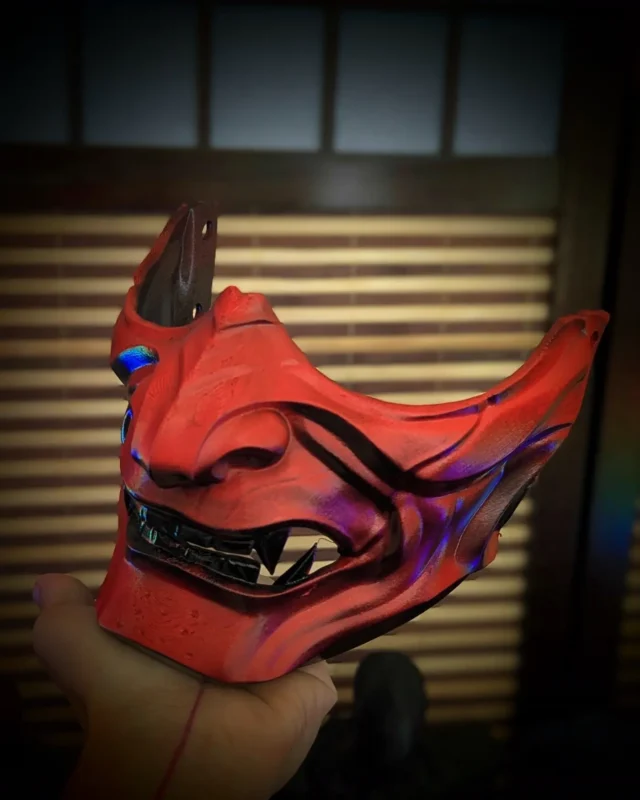
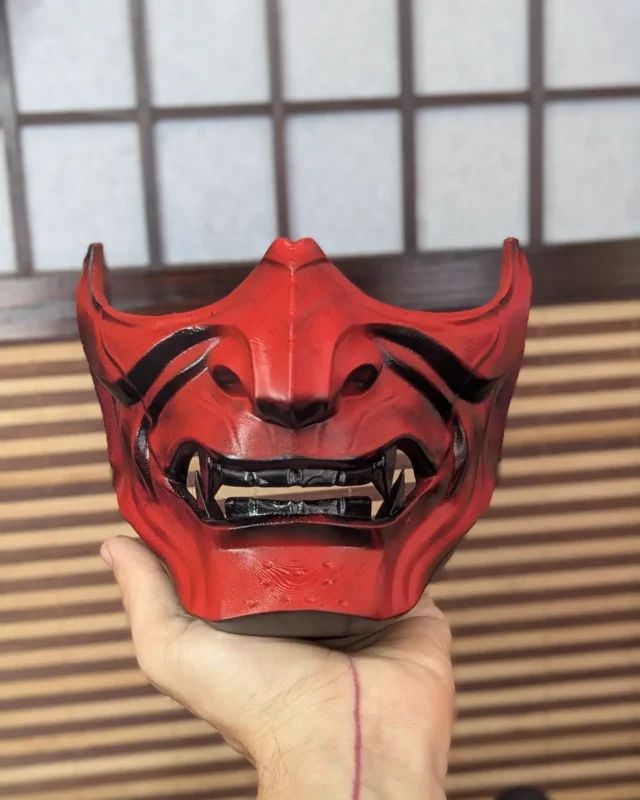
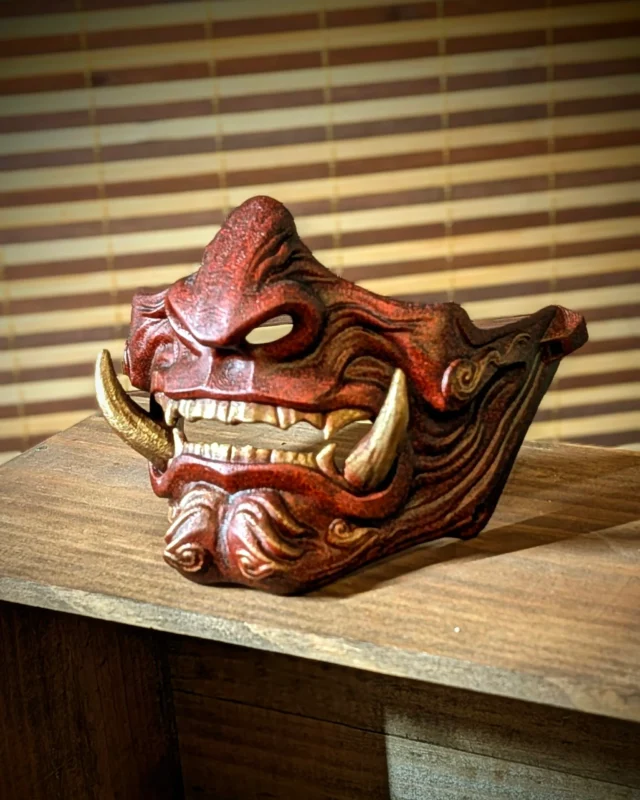
In summary
Samurai Mempo most directly evokes armour. Oni places fangs first, Tengu stands out through its nose and Hannya adds theatrical expression. Start with silhouette and use, then check wearing, colour and display.
Frequently asked questions
Which Mempo half mask is a good starting point?
Samurai is the clearest starting point for an armour silhouette without a specific yōkai. Choose Oni for fangs, Tengu for its projecting nose or Hannya for theatrical expression. Use and shape should come before colour.
How do samurai and Oni Mempo differ?
Samurai Mempo emphasises armour face-defence lines. Oni adds more obvious demonic features, with large fangs and an aggressive expression. Both Dai Yokai models are contemporary PETG display creations, not historical armour.
Are Oni, Tengu and Hannya Mempo historical types?
Not in this contemporary range’s form. Historical Mempo were samurai face defences. Dai Yokai combines that format with folklore and theatre imagery. They are inspired creations, not ritual or military reproductions.
Does a Dai Yokai Mempo protect the face?
No. Historical Mempo belonged to armour, but a Dai Yokai PETG creation is for display, photography, costume or occasional wearing. It is not protective equipment for airsoft, sport, work or activities exposing the face to impact.
Can you wear Mempo for cosplay or a convention?
Yes as costume, after checking fastening, breathing, jaw movement and rubbing on your own face. Test gradually before the event and keep it easy to remove. Comfort varies with model, adjustment and face shape.
Which Mempo suits wall display?
Samurai suits a restrained martial arrangement. Oni creates a focal point with its fangs, Tengu is immediately recognisable by its nose, and Hannya brings a tense expression. Consider viewing distance, wall colour and available light.
What is the difference between Mempo and Mengu?
Mengu is the broader category of face defences worn with Japanese armour. Mempo is the half mask covering nose and lower face. Modern usage sometimes applies Mempo more broadly. The dedicated guide covers the history and other Mengu types.
Can you request a custom colour?
A variation can be considered according to model, relief and available options. An Oni palette may work differently on Tengu or Hannya. Contact Dai Yokai before ordering to confirm feasibility, expected appearance and timing; not every combination suits every mask.