Yōkai dans les chefs-d’œuvre de l’ukiyo-e approaches the supernatural through pictures. This French-language book offers a different starting point from a dictionary of creatures: look at the scene before attaching a name to it. An unsettling face, a skeleton or an apparition raises three useful questions. What is actually visible, which story does the image refer to, and what can an identified source establish about it?
Start with the image rather than a label
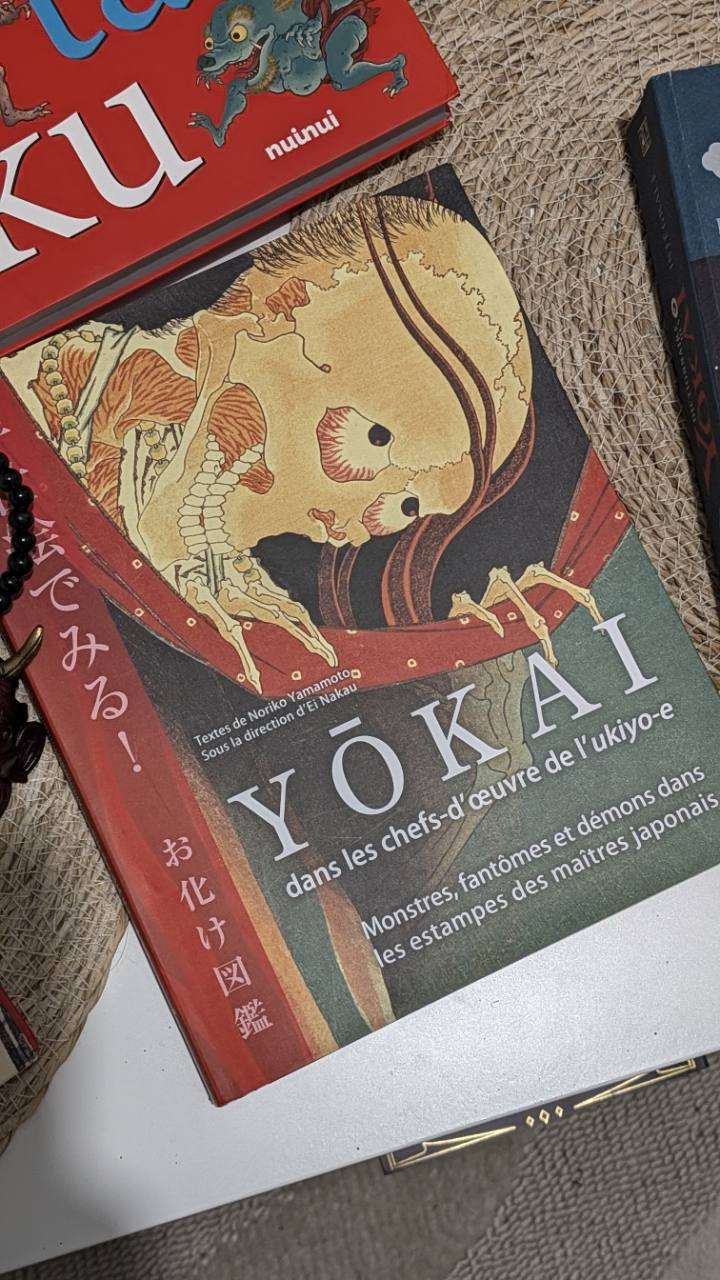
On the cover, the skull, eye and bony hands occupy most of the frame. The eye therefore encounters part of a body before reconstructing the scene around it. This gives a concrete starting question: how much space does the supernatural figure take up in relation to its surroundings? Framing and proportion contribute to its effect alongside the character’s name.
When looking at a print, first recording visible details avoids turning every feature into a compulsory symbol. Separate a human outline from an animal or an animated object, locate the gaze, and follow the direction of the gestures. Then use the title, caption and collection record to confirm or revise that first reading. A name attached to a cropped online image is not enough.
Keep the scene, story and local variants distinct
Kuniyoshi’s Takiyasha triptych, dated around 1845-46 by the Tokyo Fuji Art Museum, offers a way to practise this approach. Begin with the difference in scale between bodies, then follow gazes and gestures. Describing that arrangement provides a starting point for identifying the story behind the work, rather than stopping at the label “giant skeleton”.
To document a picture, record its artist, title, date, possible series and the institution holding the impression. Those details make the reference traceable. Then distinguish the scene’s narrative from a general definition of its creature. The guide to yōkai and their origins helps with that distinction, while the comparison of ten figures offers a starting map of different characters rather than a key to every image.
Who is this approach useful for?
It suits readers seeking visual references who want to identify what they are seeing. When preparing a drawing or discussing a motif with a tattoo artist, keeping the work’s title and context is more useful than extracting an isolated shape.
The yōkai book guide compares those uses. For visual research, decide what needs to be found: a figure’s name, the source of a story, or a way of composing the scene. The BnF records an index in this volume, providing a reference point for searches by term alongside the captions identifying individual works.
Identify the French edition
The Bibliothèque nationale de France record identifies the French NuiNui edition, copyright 2021, ISBN 9782889359066, under Ei Nakau’s direction. The full French title specifies its subject: monsters, ghosts and demons in Japanese masters’ prints. This is the French-language volume presented here, regardless of the language used for this article.
This edition is in French. I may earn a commission from this link. Find this edition on Amazon.fr (France).
The record describes a corpus of 120 works and 70 supernatural figures, with artists including Hokusai, Hiroshige and Kuniyoshi. That approach across artists raises a different question from ranking creatures: how does a figure become an image within a particular scene and visual language? Labels such as ghost, demon and yōkai should remain connected to the context of each representation.
For a different medium, the Dai Yokai Japanese masks are contemporary creations made in Brittany, printed in PETG before hand preparation and painting. Faces, volumes and expressions can then be viewed from several angles in an object intended to become part of a room, studio or display.
Sources
Documentary overview based on the cited records and the photographed copy.
The Kuniyoshi example demonstrates a viewing method independently of the book’s contents.