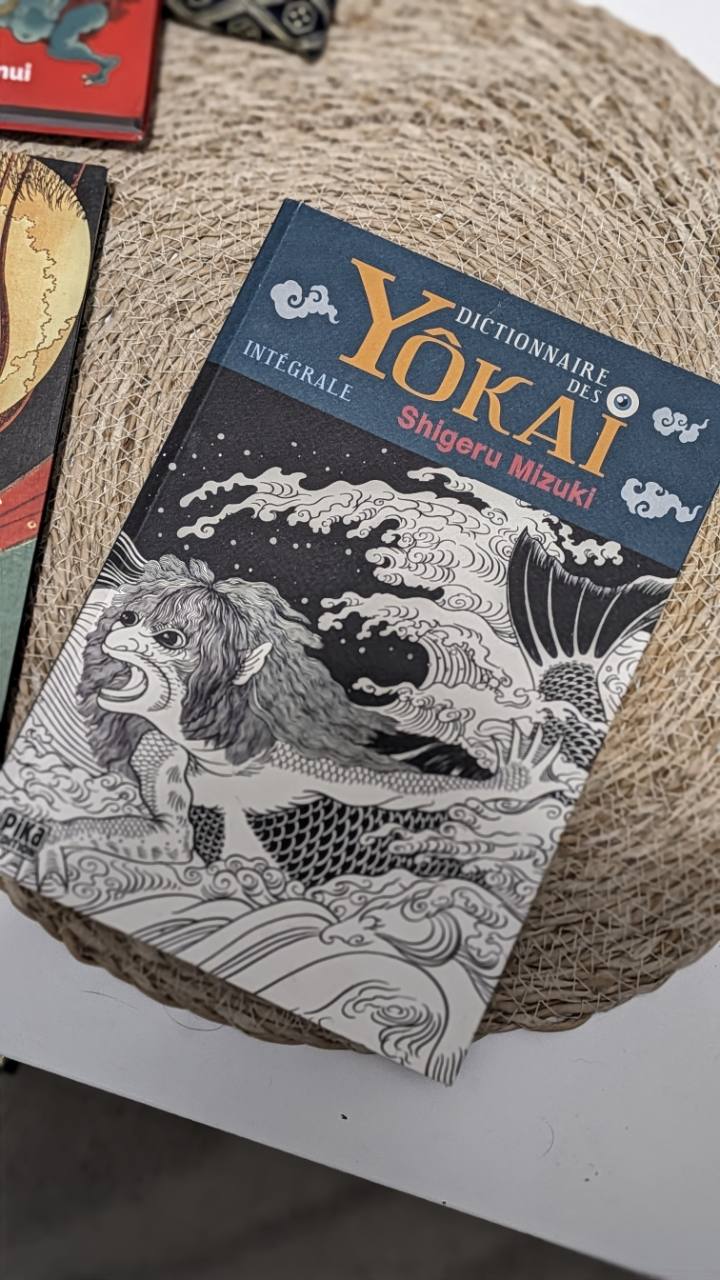
Shigeru Mizuki’s Dictionnaire des Yôkai offers a way into Japanese folklore through the work of a named writer and artist. The copy from my shelf shown here is Pika’s French-language omnibus. This article is in English, but the book is in French. To decide whether it matches your interests, separate three questions: what it covers, whose perspective it presents, and which edition you are looking at.
A dictionary shaped by a writer and artist
Mizuki’s name matters as much as the word “dictionary”. A manga artist known for Kitaro, he approached the supernatural through stories and drawing. That makes this a book to consider when you want to explore yōkai with a particular author as your point of reference. Its title should not be confused with the name of a manga series or taken to promise another Kitaro adventure.
Looking for information about folklore beings and their representation is a different activity from following a plot. It also differs from exploring the full body of a manga artist’s work. Being clear about that distinction helps you choose a book for the question you actually have.
What does yōkai include?
Pika’s introduction places these beings within a broad supernatural tradition and a history of images that includes Edo-period prints. The subject extends beyond a single category of threatening monsters. Our guide to yōkai and Japanese folklore introduces the main distinctions before you move to a specialist book.
That variety gives you several possible starting points. You might be looking for a name, a story, a visual feature or the context behind an image. Those interests overlap, but each can call for a different kind of reference.
Start with a question about one figure
A useful way to approach a folklore dictionary is to begin with a being encountered in a story or picture. Write down its name, then separate what you want to understand: its role in the story, the features used to depict it, and the setting associated with the account. This is a suggested reading approach, rather than a claim about this volume’s ordering or index.
If you do not yet have a name in mind, the guide to ten yōkai and folklore figures provides some starting points. It helps you choose a subject; it is not a list of confirmed entries in Mizuki’s book.
An illustration is one representation
A drawing can make a being memorable without settling every question about it. Keep the folklore figure distinct from one artist’s depiction. When investigating a date, an origin or a local version of a story, compare references suited to that question. If your interest is a particular woodblock print, a museum record can identify the artwork itself. A dictionary and an art catalogue can support the same interest while doing different jobs.
Identifying the French Pika omnibus
This is the French Dictionnaire des Yôkai omnibus published by Pika on April 8, 2015, translated by Patrick Honoré and Satoko Fujimoto. Its ISBN is 9782811616335. The publishing group lists 512 pages and a 17 × 24 cm format. These details distinguish it from other Mizuki books and translations with different titles. They should not be transferred to an English-language edition.
This edition is in French. I may earn a commission from this link. Find this edition on Amazon.fr (France).
Where to go next
The yōkai books from my shelf also include a Matthew Meyer bestiary and a book about Japanese prints. That selection explains how their approaches differ, if you want to continue beyond a dictionary.
For another approach to faces and form, explore the Dai Yokai Japanese masks, contemporary pieces prepared, painted and finished by hand in Brittany.
Sources
Pika’s book introduction; Hachette’s edition details and Shigeru Mizuki profile.